
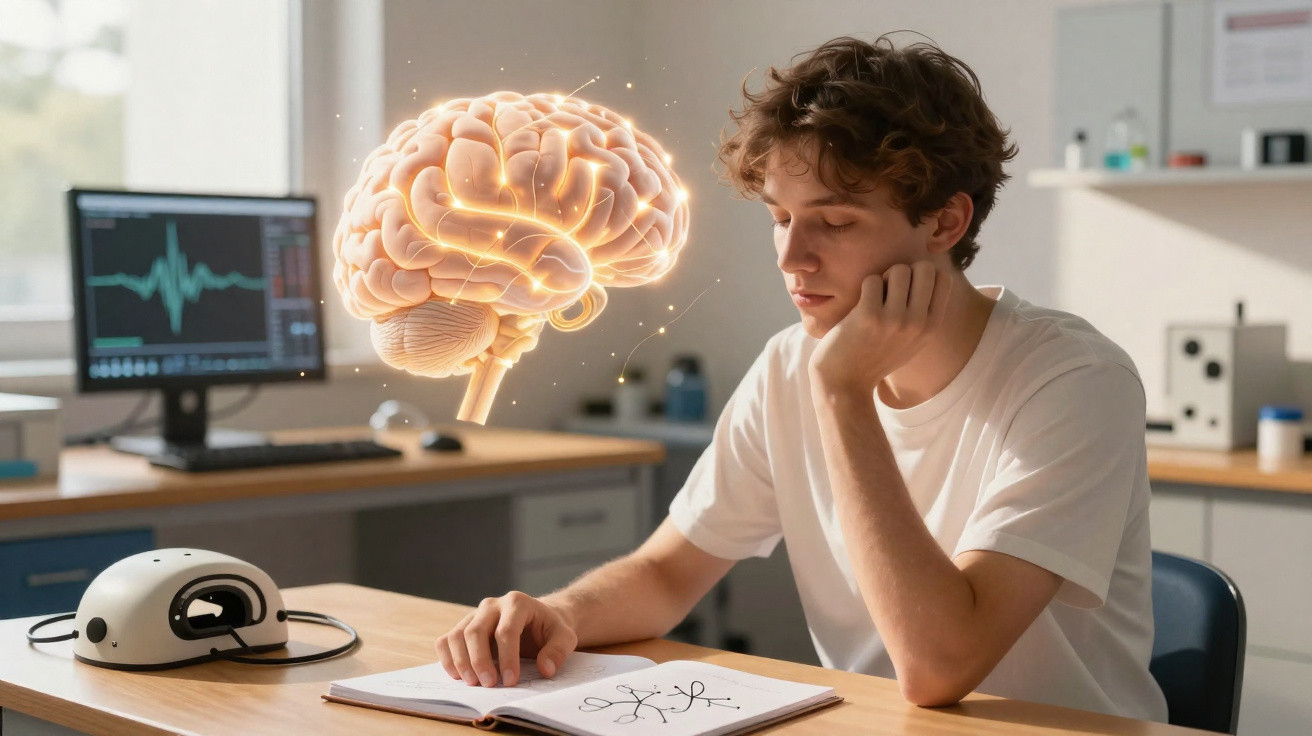
When you recognise a familiar face, your brain has to associate it with a name, a location and perhaps a memory.
Those details are not necessarily processed in one part of the brain. Even so, they are integrated so seamlessly that they feel like a single thought.
How brain ripples may connect information
Scientists may have identified one mechanism the brain uses to achieve this.
New research indicates that far-apart brain regions briefly synchronise when we retain and retrieve information. In these short-lived intervals, their cells are more likely to signal in unison, which could enable separate elements of a thought to be combined.
Published in Nature Neuroscience, the study was led by medical scientist Ilya Verzhbinsky and neuroscientist Eric Halgren at the University of California San Diego. It analysed brain recordings from 35 people undergoing monitoring for treatment-resistant epilepsy.
"'Firing together' may be the brain's basic currency for linking information."
– Medical scientist Ilya Verzhbinsky
The participants already had electrodes implanted in their brains for clinical purposes. This provided the scientists with a rare chance to record the electrical behaviour of individual brain cells as participants performed a memory test.
Participants viewed either one or three images, which they were asked to retain for several seconds. Afterwards, they had to judge whether a further image had been included in the original set.
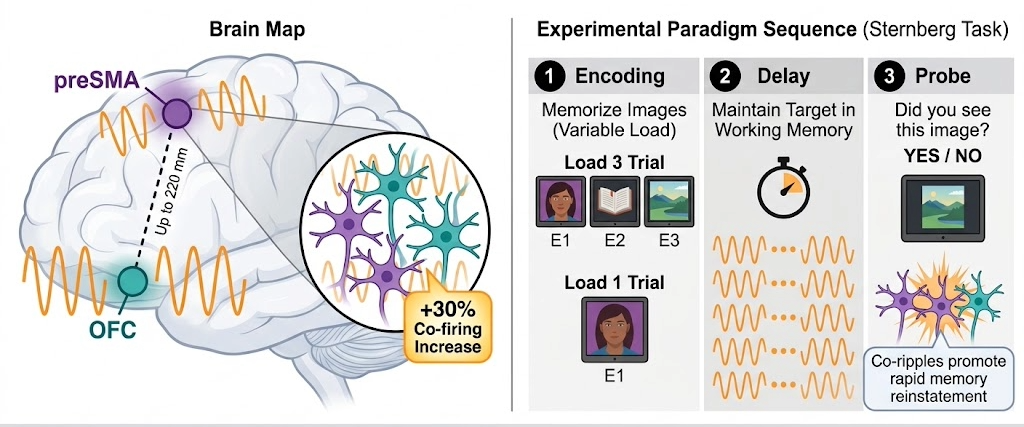
Synchronized ripple oscillations may support communication between distant brain regions during working memory. (Ilya Verzhbinsky, created with assistance from Google Gemini)
The team focused particularly on exceptionally short bursts of electrical activity known as ripples.
"A ripple is a very brief burst of rhythmic oscillations in neuron excitability – roughly 90 cycles per second, lasting only about a tenth of a second," Verzhbinsky told ScienceAlert.
Put simply, a small cluster of brain cells abruptly becomes very active and synchronises to the same rapid rhythm. The event ends almost as quickly as it starts.
Synchronous ripples across distant brain regions
Over 43 recording sessions, the scientists tracked activity in 1,373 brain cells. They found that ripples frequently occurred simultaneously in two distant brain regions.
Whenever this occurred, cells in those areas were about 30 percent more likely to send signals together. During certain stages of the task, that rise reached 49 percent.
This could explain how information held in different parts of the brain is unified into a single experience.
One region may process a face, another a name, and another still the place where the person was encountered. A shared rhythm might momentarily create a communication channel between these areas, enabling them to operate as one team.
"That matters because 'firing together' may be the brain's basic currency for linking information," Verzhbinsky said.
The most unexpected finding was the distance over which this co-ordination extended. Shared ripples connected regions up to 220 millimetres apart and were also detected across the brain's two hemispheres.
Normally, direct links between brain regions are less frequent the farther apart those regions are. Were the ripples reliant solely on direct wiring, their synchronisation would be expected to decline at greater distances. Instead, it did not.
The findings indicate that this co-ordination might not need one brain region to serve as a conductor. Rather, it could be like a crowd gradually clapping in time without anybody leading them.
The rhythm was also stronger as the memory test became more difficult. Compared with remembering one image, remembering three raised coordinated signalling by about 13 percent while participants held the images in mind, and by 19 percent when they attempted to recognise one.
Cells that signalled together when an image was initially viewed were also more likely to reproduce that pattern when the image was shown again. When this happened, participants generally recognised the image more quickly.

What the working-memory findings cannot yet show
Earlier work has associated comparable ripples with replaying and storing memories. One recent study reported by ScienceAlert found that a single exercise session could alter memory-related ripples in the human brain.
These latest findings suggest that the brief rhythms could additionally help the brain maintain a thought as it is being actively used.
However, the study does not demonstrate that ripples caused faster recognition. The researchers recorded the signals, but did not switch them on or off to test how memory would change.
Every participant also had severe epilepsy, and electrode placement was determined by medical requirements. As a result, researchers could examine only particular brain areas. The experiment also assessed only one kind of memory task.
Related: Unprecedented: Scientists Have Built Miniature Brains That Experience The Passage Of Time
Verzhbinsky said it would be too soon to view these signals as a treatment target for conditions affecting memory or thought. Scientists must first establish whether comparable activity happens in healthy brains and whether interrupting it alters memory.
For the moment, the findings present an intriguing possibility: thoughts may seem whole because distant brain regions briefly settle into the same rhythm.
The study was published in Nature Neuroscience.
This article was fact-checked and edited by Rebecca Dyer. Although we take pride in our process, we are only human. If you notice an error, please let us know.






Comments
No comments yet. Be the first to comment!
Leave a Comment