
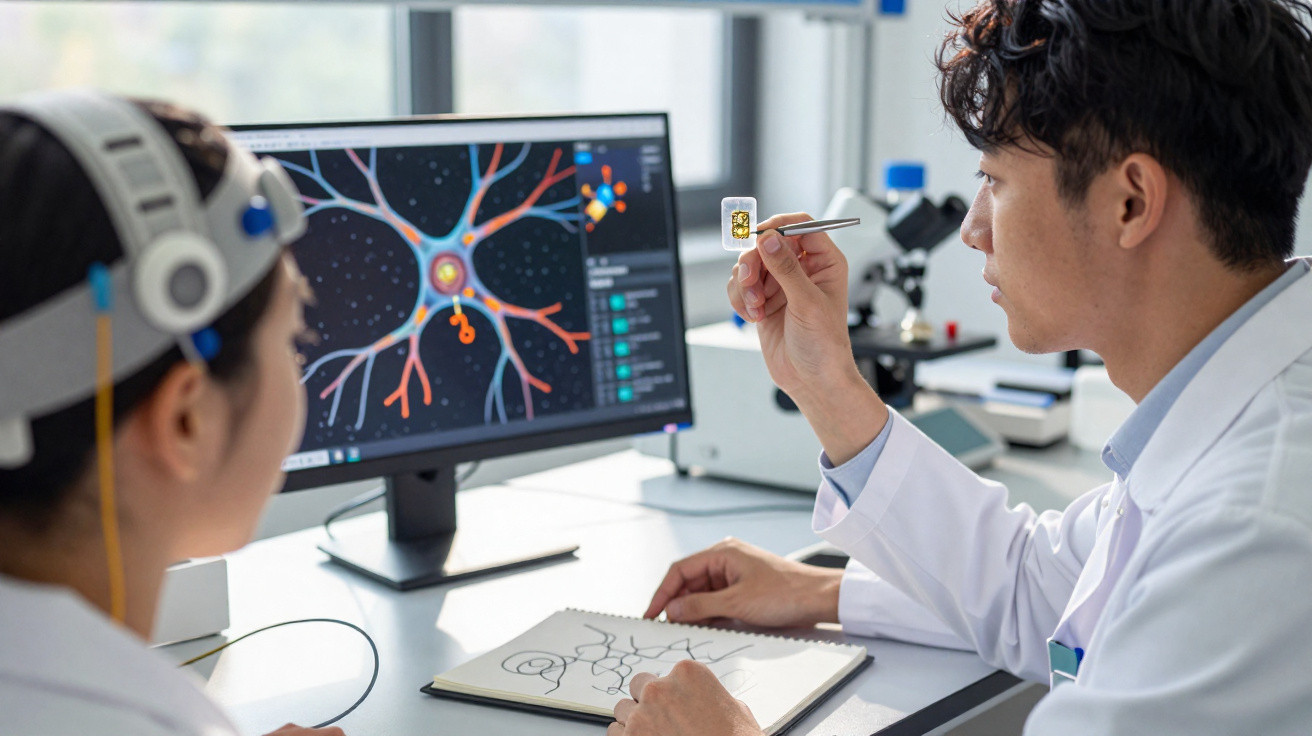
What sounds like the premise of a film comes from a credible study at the University of Massachusetts. A research team reports that it has built an artificial neuron which not only behaves like a nerve cell, but can also communicate directly with real neurons - using signals as subtle as those found in the human brain.
How real neurons work
To appreciate the significance of the research, it helps to first consider its biological model: the neuron. The human brain is estimated to contain roughly 100 billion of these nerve cells. Every one of them processes and sends electrical signals continuously, forming part of an immense, constantly changing control network.
A neuron comprises a cell body, branching dendrites and a usually longer projection called an axon. Dendrites receive messages from other cells, while the cell body integrates this incoming information. Once a particular threshold is reached, the neuron sends an electrical impulse along its axon to the next cell.
When parts of this network stop functioning, the effects can be immediately apparent in everyday life: movement disorders such as Parkinson’s disease, sensory loss, speech difficulties or memory loss of the kind seen in people with Alzheimer’s disease. Nerve cells that die generally do not return.
Neurons are the biological foundation of thought, emotion and movement - and their capacity to regenerate in adulthood is very limited.
Why medicine places great hopes in artificial neurons
As damaged neurons can barely be replaced, researchers have spent years looking for ways to bridge faulty brain regions technologically. Conventional brain implants, including those used for Parkinson’s disease, already employ electrical stimulation. However, they tend to deliver broad pulses, more like a pacemaker than the delicate exchange between individual nerve cells.
At the same time, a field known to specialists as “neuromorphic integration” has emerged. Its aim is to design electronics that mirror the structure and operation of the brain. Rather than rigid circuits, it seeks to create networks capable, at least to some extent, of learning, forgetting and adapting.
Within this area of neuromorphic research, one ambition stands above the rest: artificial neurons that can become part of biological networks, communicate with them directly and learn from them.
The breakthrough: an artificial neuron communicates with real brain cells
This is precisely the point at which the University of Massachusetts researchers begin. On 29 September 2025, they published a concept in the journal Nature Communications that brings this ambition considerably closer. They describe an artificial neuron that can regulate electrical signals with sufficient precision for real brain cells to recognise and respond to them.
A central limitation in earlier attempts was power consumption. Until now, artificial neurons had fired at voltages that were far too high. To biological cells, this was less like an ordinary conversation and more like an electric shock. The signals were strong, coarse and difficult to control.
The new artificial neuron operates at around 0.1 volts - similar to real neurons - and requires one hundredth of the power of earlier models.
For the first time, the system therefore operates within the voltage range used by the brain itself. Rather than “shouting” into a neural network, the artificial neuron now speaks at the same level in a whisper.
Protein nanowires: electronics that tolerate moisture
Its construction is technically even more intriguing. The team uses what are known as protein nanowires: exceptionally thin conductive filaments produced by certain bacteria to attach themselves to surfaces or exchange electrons.
These nanowires offer two advantages:
- They operate in moist surroundings, just as the brain does when it is bathed in fluid.
- They create a soft, biocompatible interface between rigid electronics and sensitive nerve cells.
Many previous approaches failed because conventional electronics require dry, protected conditions. Brain tissue is the complete opposite: warm, moist and chemically active. Protein nanowires provide a bridge in this setting. They survive under conditions similar to those experienced by biological neurons while still conducting electrical signals.
What communication looked like in the laboratory
In laboratory tests, the team connected the artificial neuron to cultures of biological nerve cells. The researchers then sent electrical pulses through the artificial system and monitored how the real neurons responded. Signal strength and timing were configured to resemble those in the brain.
The crucial finding was that the biological neurons responded. They generated action potentials in patterns also found in natural networks. This suggests that the artificial neuron does not merely interfere, but can become functionally integrated.
| Feature | Earlier artificial neurons | New artificial neuron |
|---|---|---|
| Voltage | around 1 volt | approx. 0.1 volts |
| Power requirement | high, difficult to miniaturise | around 100 times lower |
| Compatibility with moisture | problematic | designed for moist environments |
| Interaction with biological neurons | relatively coarse, disruptive | realistic and “quiet” |
What neuromorphic integration could mean in practice
The term may sound abstract, but it has very concrete objectives. In the long term, the aim is to link the brain and electronics more closely so that each can benefit from the other. Several potential applications are already emerging:
- More precise brain implants: Artificial neurons could stabilise defective networks in Parkinson’s disease or epilepsy more effectively than today’s stimulation probes.
- Prostheses with a sense of touch: Through artificial neurons, a hand prosthesis could send the brain signals that imitate natural tactile sensations.
- Chips that can learn: Neuromorphic processors could handle pattern recognition or speech processing energy-efficiently by networking in a neuron-like way.
In computing, the brain has long been regarded as a model. It needs only a few watts to perform complex tasks, whereas conventional computers require considerably more energy for comparable work. Artificial neurons that more closely approach real nerve cells could trigger a paradigm shift in this respect.
Risks and unanswered questions
For all its appeal, considerable uncertainty remains. Turning a laboratory prototype into a clinical application usually takes years and often decades. Several obstacles can already be anticipated:
- Long-term stability: How long can protein nanowires function in the body without breaking down or triggering reactions?
- Immune response: The immune system reacts sensitively to foreign structures. Inflammation could disrupt or destroy implants.
- Poor adaptation: If artificial neurons fire too strongly or too weakly, they could throw networks out of rhythm.
- Ethics: Brain-computer interfaces raise questions about autonomy, data protection and the limits of technological enhancement.
The final issue becomes particularly important if artificial neurons do more than compensate for impairments and instead enhance abilities. Who is liable if an implant works incorrectly? How can misuse or covert manipulation be prevented? These issues need answers well before products reach the market.
How close does this neuron come to the “real” brain?
As dramatic as the headline may sound, the artificial neuron replicates only a tiny part of the reality inside the head. The human brain does not depend on isolated neurons, but on dense, continually changing networks with trillions of connections.
Above all, the current work demonstrates that an artificial component can be tuned so that biological cells accept it. The focus is less on complete replication than on functional compatibility. Some specialists refer to “bio-hybrid systems”: areas in which silicon and living tissue cooperate actively.
The true revolution lies not in the individual artificial neuron, but in the prospect of entire hybrid networks combining technology and biology.
From a purely technical perspective, this creates the possibility of modifying existing neural circuits with great precision. A small implant could, for example, correct only those signals that malfunction in a particular disease while leaving the rest of the brain untouched.
Terms worth knowing
Anyone following the debate around these technologies will repeatedly encounter certain technical terms. Three are particularly important here:
- Action potential: The brief electrical impulse emitted when a neuron “fires”. Duration: milliseconds; effect: signal transmission.
- Synapse: The point of contact between two neurons. Here, an electrical impulse is converted chemically and passed to the next cell.
- Biocompatible: Materials with this property produce little immune response in the body and integrate relatively well with tissue.
The new protein nanowires are positioned exactly at this interface: they are intended to conduct electrical current without greatly irritating or damaging biological tissue.
What this could one day mean for everyday life
Consider a realistic scenario a few years from now: a patient with early Parkinson’s disease receives not a conventional stimulation implant that sets the rhythm for entire brain regions, but a fine network of artificial neurons built from protein nanowires of this kind.
Each artificial neuron connects with a small selection of biological cells. It compensates for misfiring, amplifies weak signals and suppresses overactive patterns. Ideally, the patient notices this only because tremors and stiffness lessen, while thought and feeling remain unchanged.
A further example concerns prostheses. An arm prosthesis that converts pressure-sensor data into signals for artificial neurons could restore something akin to touch for the brain. The technology would then enable not only movement but also feedback - for instance, indicating how firmly someone is holding a glass.
Both scenarios depend on a line of development that begins with experiments such as the one in Massachusetts. For now, this remains fundamental research. Even so, the study shows that the boundary between living tissue and electronics can be made far more flexible than many previously believed.






Comments
No comments yet. Be the first to comment!
Leave a Comment