
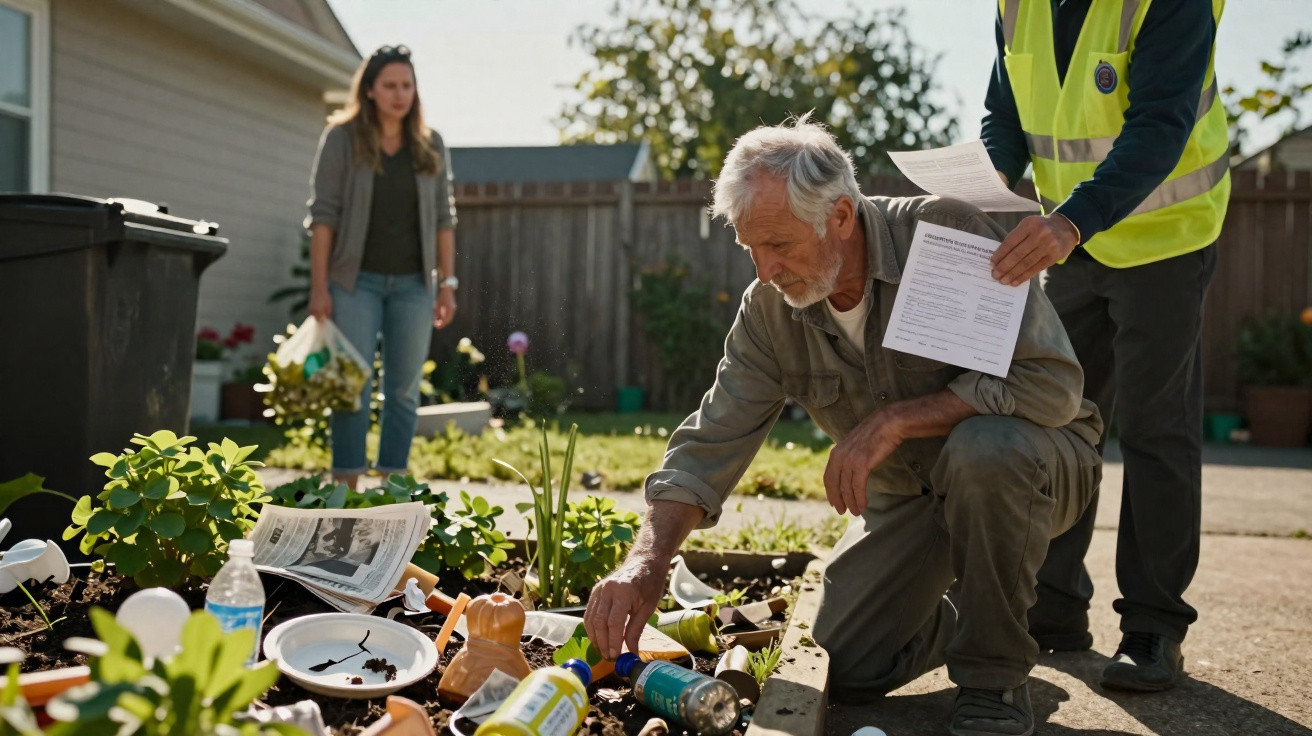
Neighbours noticed the smell before they spotted the bags.
At the edge of a quiet suburban garden, between two freshly clipped hedges, a modest mound of plastic sacks had gradually appeared over several weeks. They contained vegetable peelings, stale bread, wilted flower bouquets, scraps of cardboard and even several food trays. The owner, a recently retired handyman with more spare time than cash, carefully spread this so-called “mulch” across his beds, pleased to be reusing what everyone else discarded.
When a council inspector knocked at his door, he sincerely assumed it was about parking.
Instead, he returned to his garden holding a warning notice, with a knot forming in his stomach.
The pensioner shrugged and said, partly to himself and partly to the officer: “It’s just trash, not poison.”
That remark divided the street.
When “homemade recycling” becomes a legal headache
The man at the heart of this story is 71, widowed and living on a pension that only just pays his bills and feeds his dog.
He adores his garden, which he refers to as his “little country”, although it is just 150 square metres squeezed between two brick houses.
In an effort to save money, he began putting household rubbish straight onto the ground.
There was no compost bin, no sorting and no meaningful waiting period. He simply opened the bags, scattered their contents and lightly raked them over to “let nature do the work”.
At first, some neighbours found the practice amusing, seeing it as an eccentric habit.
Then the odour began.
One neighbour, a young mother, started shutting her windows every afternoon.
She says the smell became stronger during hot weather, as the peelings and leftovers rotted in sunlit patches.
A few streets away, the story travelled fast.
A resident uploaded photographs to a neighbourhood Facebook group showing pieces of plastic caught in the grass, marked paper plates lodged among the flowers and an ant trail that became a rat trail.
The comments quickly multiplied. Some claimed the retiree was “turning the street into a dump”. Others came to his defence: “At least he’s trying to be ecological, unlike those who throw everything away.”
We have all experienced that point when a “small personal arrangement” suddenly clashes with rules that affect everyone.
Legally, compost and waste are very different things.
Organic material that has been sorted, stored and left to break down under controlled conditions is classed as compost.
Unsorted household rubbish tipped directly onto soil is another matter entirely.
Plastic film, printing ink from packaging, fragments of aluminium, greasy residues and chemical cleaners left on kitchen roll all fall under the category of household waste.
Household rubbish spread in the open is often handled in the same way as illegal fly-tipping.
In many areas, this may result in warnings, formal notices and fines ranging from a few dozen to several hundred euros, depending on the amount involved and how long the issue continues.
The retiree did not realise he had crossed that boundary until the fine arrived through his letterbox.
DIY mulching and composting without an inspector’s visit
If you want to nourish your soil rather than fill your rubbish bin, there is a safer alternative to emptying your household waste into the garden.
The first step is extremely straightforward: sort everything rigorously.
Retain only materials the soil can break down safely.
This includes fruit and vegetable peelings, coffee grounds, loose tea leaves without plastic bags, finely crushed eggshells, dead leaves, grass cuttings, and small pieces of plain cardboard or newspaper.
Everything else should go into your normal rubbish bin or the appropriate recycling collection.
Rather than spreading the material immediately over the garden, leave it to decompose in a compost bin or a simple heap, turning it occasionally.
The soil loves organic matter, just not all at once and not in any form.
Many people assume that “natural” means “without rules”.
That is how cooked meals, meat scraps, cheese rinds and greasy pizza boxes end up in gardens, tipped out by people who believe the earth will somehow absorb it all.
In fact, such leftovers attract rats, stray cats, flies and, in rural areas, sometimes foxes.
They create bad smells, rot in dense clumps and may spread pathogens.
Let’s be realistic: no one sorts their rubbish with laboratory-level precision every day.
Even so, a few easy routines can make a difference: keep a dedicated compost caddy in the kitchen, place a small reminder beside the bin listing what is permitted, and cut larger items into smaller pieces so that they break down more quickly.
The important thing is not to create a miniature landfill while calling it “eco-friendly”.
The retiree, confronted with his fine, described his confusion in a single sentence: “I just wanted to avoid wasting and give back to the earth. I didn’t think I was doing something illegal.”
His situation captures a tension felt by many people: the wish to live more simply and cheaply without becoming overwhelmed by complicated rules and technical guidance.
Materials that are generally safe to compost
Vegetable and fruit peelings, coffee grounds, tea (without plastic), eggshells, crushed nutshells, dry leaves, grass cuttings, shredded uncoated cardboard and small branches.Materials that turn your garden into a problem zone
Cooked food, meat and fish scraps, dairy products, oily food, pet droppings, vacuum cleaner dust, cigarette ends, glossy magazines and any plastic at all, even “a tiny bit”.Best way to stay within the law
Use a compost bin or a defined area of the garden, keep waste out of public sight, do not mix in plastics or chemical products, follow local rules for garden waste, and stop at once if neighbours complain about smells or pests.
A garden, a fine and a question for everyone
This retiree’s story is about more than a local dispute over foul-smelling flower beds.
It raises something simple and deeply human: the belief that common sense should matter more than written rules, and that recycling “a bit roughly” must be better than doing nothing.
To some readers, the fine seems ridiculous, even harsh for someone on a small pension who was attempting to do the right thing.
To others, the exact same situation appears plainly selfish: plastic and decomposing food left in the open, children playing nearby and pests moving along the fences.
Between those positions lies the grey area inhabited by most of us.
We balance environmental intentions against limited time, tight finances and an incomplete understanding of what the law truly requires.
That is where the discussion begins: what sort of “homemade ecology” should be accepted on our streets, and at what point does everyone else’s right to a clean, odour-free environment begin?
Perhaps genuine change begins when we stop seeing soil as a magical bin and start treating it as a living neighbour too.
| Key point | Detail | Value for the reader |
|---|---|---|
| Legal risk of “DIY mulching” | Combining household waste with garden soil may be regarded as illegal dumping, resulting in warnings and fines. | Avoid costly penalties by knowing what may be used in a garden and what must enter official waste streams. |
| Safe composting practice | Compost only organic, untreated materials, ideally allowing them to pre-decompose in a bin or heap before they reach the beds. | Grow healthier plants, reduce waste and remain on good terms with neighbours and authorities. |
| Neighbourhood relationships | Odours, visible rubbish and pests can rapidly turn a “personal” decision into a shared concern in densely built-up areas. | Preserve social harmony by using methods that respect both the soil and the people who live nearby. |
FAQ:
- Question 1 Can I legally spread my kitchen peelings directly on my garden beds?
- Answer 1 Raw fruit and vegetable peelings are generally acceptable when used sparingly and lightly buried, but spreading mixed household rubbish is often considered illegal dumping. Check your local regulations, as some councils require all organic material to go through a composting process first.
- Question 2 What kind of waste risks getting me fined in my garden?
- Answer 2 Heaps of mixed rubbish-including plastic packaging, food trays, cooked leftovers, meat, dairy, greasy boxes and visible bags-can lead to neighbour complaints and inspections. If the authorities define it as a “dump”, you could receive a fine even where the waste is on private land.
- Question 3 Is a simple compost heap enough, or do I need a special bin?
- Answer 3 A basic heap is often sufficient provided that it is discreet, turned regularly and restricted to clean organic matter. Closed or partly enclosed bins help manage odours and pests, and many towns offer them at reduced prices or even free as part of particular campaigns.
- Question 4 How can I avoid odours and rats when composting at home?
- Answer 4 Do not add meat, fish, dairy, cooked food or oily food. Cover fresh material with dry matter such as leaves or shredded cardboard, chop larger pieces into smaller ones and mix the heap from time to time. Putting compost directly onto bare soil also lets worms and microbes work more quickly, keeping decomposition more balanced.
- Question 5 What should I do if a neighbour’s “mulch” is bothering the street?
- Answer 5 If you feel safe doing so, begin with a calm, straightforward conversation: explain the smell or pest issue instead of making it personal. If nothing changes and the problem persists, contact your town hall or local environmental service, which can assess whether the practice complies with current rules without making it a personal conflict.






Comments
No comments yet. Be the first to comment!
Leave a Comment