
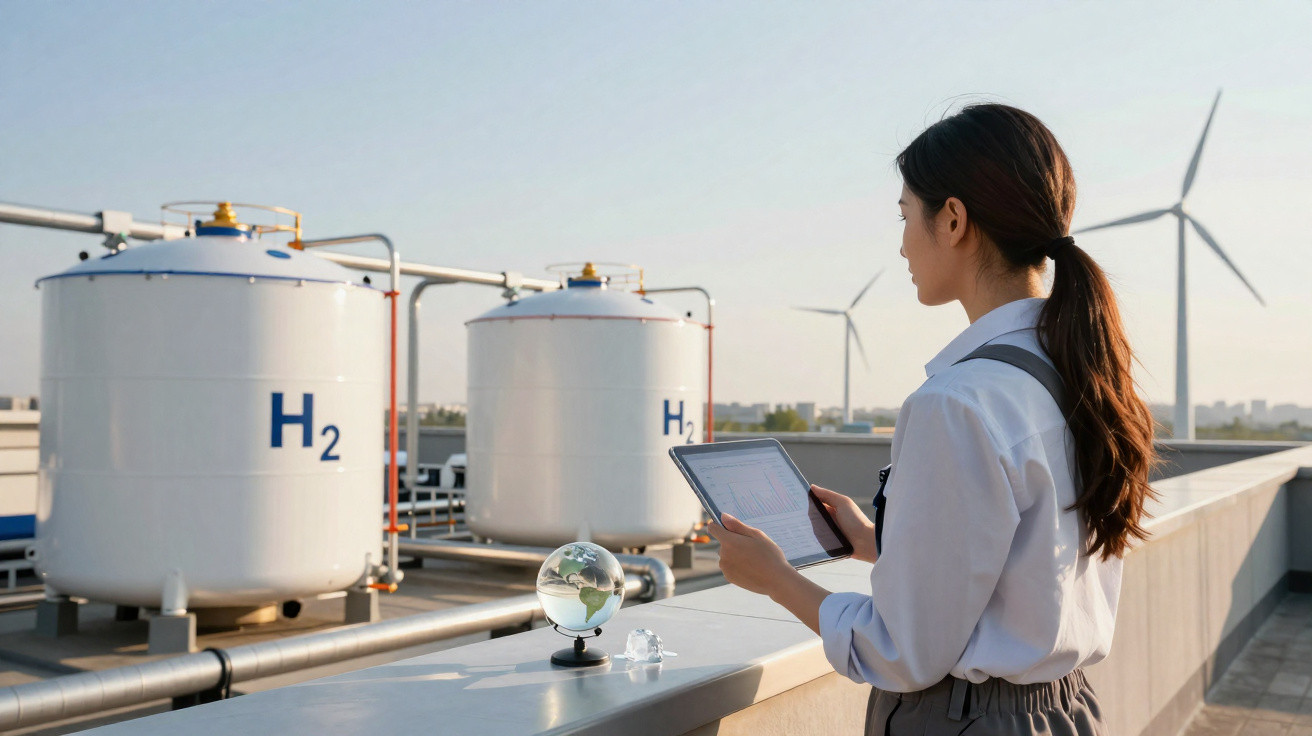
Hydrogen has long been promoted as a potential answer to the climate crisis, yet a study published on Wednesday cautioned that it may also make a small contribution to the problem.
Supporters of hydrogen envisage large-scale future production and use in transport and heavy industry, offering a cleaner replacement for fossil fuels because its use releases only water vapour.
Hydrogen emissions and climate warming
However, research published in the journal Nature concluded that hydrogen has contributed to rising temperatures by enabling methane, a powerful greenhouse gas, to remain in the atmosphere for longer.
The research found that hydrogen emissions increased from 1990 to 2020, adding a fraction of a degree - 0.02 °C - to the almost 1.5 °C rise in average temperatures since the pre-industrial era.
"We need a deeper understanding of the global hydrogen cycle and its links to global warming to support a climate-safe and sustainable hydrogen economy," said Stanford University scientist Rob Jackson, the paper's senior author.
The study was conducted by an international group of researchers known as the Global Carbon Project and found that human activity accounts for most of the growth in hydrogen emissions.
Researchers said the increase is associated with growing methane emissions from fossil fuels, livestock and landfill sites.
How hydrogen affects methane in the atmosphere
The two molecules are closely connected: as methane breaks down in the atmosphere, it generates hydrogen.
Although hydrogen is not itself a pollutant, it contributes indirectly to warming by consuming naturally occurring cleansing agents that break down methane, a potent greenhouse gas with a shorter atmospheric lifetime than carbon dioxide.
"More hydrogen means fewer detergents in the atmosphere, causing methane to persist longer and, therefore, warm the climate longer," said the study's lead author, Zutao Ouyang, an assistant professor of ecosystem modelling at Auburn University in Alabama.
Its interactions with these natural cleansing agents also influence cloud formation and generate greenhouse gases including ozone and stratospheric water vapour.
Hydrogen production and industrial leaks
Since 1990, further atmospheric hydrogen sources have included leaks from industrial hydrogen production.
Hydrogen can be made by using an electric current to divide water into hydrogen and oxygen, through a process known as electrolysis.
At present, though, most hydrogen is made from natural gas or coal through energy-intensive methods that release substantial quantities of carbon dioxide.
The aim is instead to manufacture "green" hydrogen at scale with renewable energy, but this remains costly and the industry has encountered significant obstacles.
© Agence France-Presse





Comments
No comments yet. Be the first to comment!
Leave a Comment