
It begins with the light from your screen.
You told yourself you would turn in earlier, yet somehow you are now lost among reels, emails and miscellaneous tabs you cannot even recall opening. Your body may be in bed, but your thoughts are still at a meeting, in the supermarket, or reliving an awkward conversation from three days ago.
Then the room eventually falls silent and it hits you: you are completely worn out, but sleep still feels nowhere near.
For many of us, this has become the new normal.
What is remarkable is how rapidly the body can change direction when it receives the right cues and takes the right shapes. Sometimes, five unhurried poses on the bedroom floor are all that is needed.
Why Yoga Before Bed Can Transform the Night
Most of us attempt to get to sleep from the neck upwards.
We swap pillows, lower the lights and play a podcast, only to remain awake with a restless hum beneath the skin. The day has left its mark on the body: shoulders tightened by typing, a lower back stiff from sitting, and hips holding stress you may not even have realised was there.
Yoga before bed takes a different approach.
Rather than asking an overstimulated mind to sleep, it gradually guides the body towards a state in which sleep becomes the natural next step.
I recently spoke with a woman who works busy night shifts as a nurse. She said she used to scroll until her eyelids ached.
She had tested sleep apps, herbal tea and even the old trick of “count backwards from 300”. Nothing lasted.
One night, feeling desperate, she searched YouTube for “simple yoga for sleep”.
She spent ten peaceful minutes on the floor in Child’s Pose, Legs Up The Wall and a long, motionless Savasana.
For the first time in weeks, she slept through the night.
At work the following day, she did not feel miraculously changed; she simply felt a little less sharp around the edges. That was enough to bring her back to the mat.
There is a very practical reason why these five gentle poses can be so effective at night.
They mobilise the spine, release the hips and encourage the nervous system to move out of fight-or-flight and into rest-and-digest. Prolonged holds and slower exhales give the brain a primitive message: the “threat” is over.
This is not about folding yourself into a pretzel.
It is about reassuring a hyper-alert body that it can at last release the day, and that the day is genuinely finished. As the muscles soften, the thoughts often do too.
5 Bedtime Poses That Actually Help You Sleep
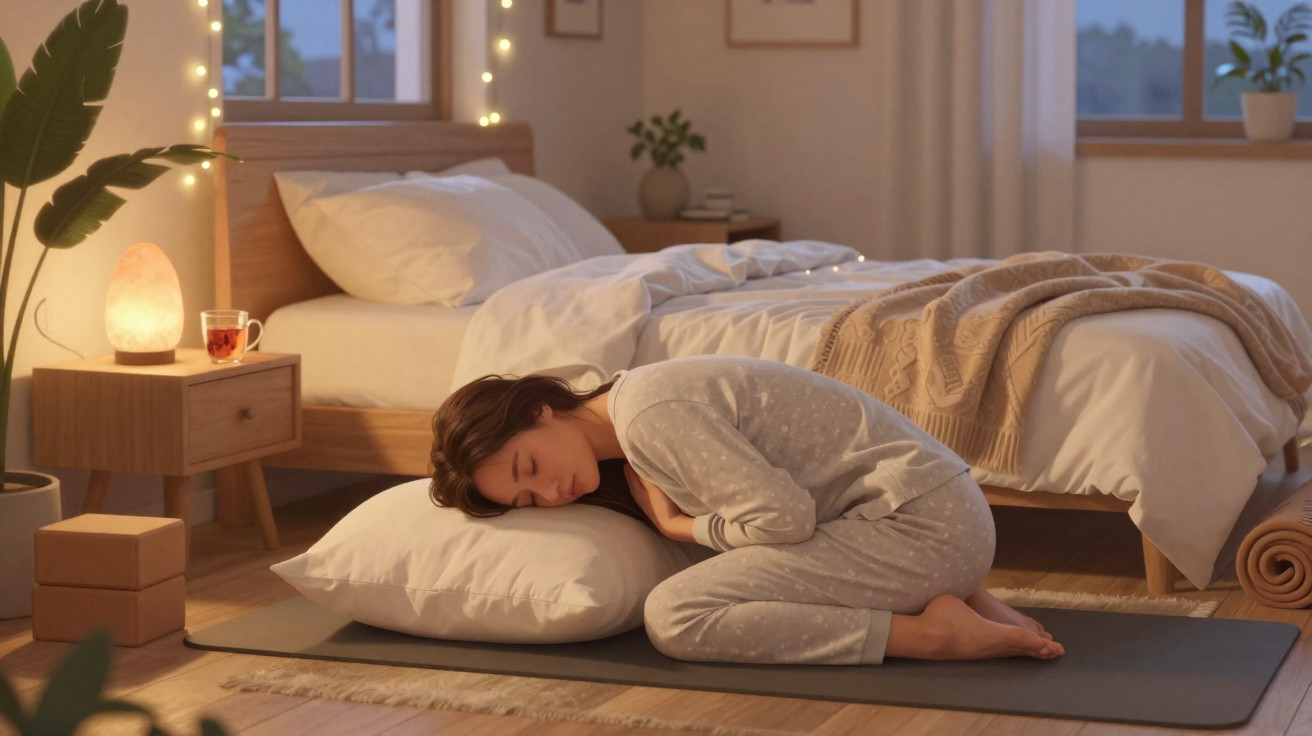
Begin with Child’s Pose (Balasana).
Kneel on the floor or your bed with your knees a little apart and your big toes together. Lower your hips towards your heels, bring your torso over your thighs, and place your forehead on the mattress, a cushion or your hands.
Remain there for 8–10 slow breaths.
Allow your shoulders to sink towards the floor and your jaw to unclench. The pose softly rounds the spine, presses the abdomen against the thighs and sends a clear message of safety to the nervous system.
Then move into Legs Up The Wall.
Lie on your back, bring your hips close to the wall and extend your legs upwards against it. If this feels too strong, keep a slight bend in your knees. Breathe. Your circulation changes, your lower back begins to release and your brain finally receives the message that the wind-down has started.
The part many people miss is deliberately moving slowly.
We have all rushed through three yoga poses as though working to a deadline, then questioned why we still feel wired. Night-time yoga is the reverse of a workout; it is almost a physical rehearsal for sleep.
Keep every pose for at least one full minute.
For Reclined Twist, lie on your back and draw your knees into your chest, then gently lower them to one side as your arms stretch into a T shape. Turn your gaze in the opposite direction if your neck is comfortable. Pause there. Breathe into your ribs, then repeat on the other side.
The main mistake is treating the poses as another item to tick off.
They are most effective when they feel a little languid and dreamlike, as though you are already partway into sleep.
You can create a small sequence beside the bed that takes ten or fifteen minutes, without ever needing a studio-perfect yoga mat.
“My rule is simple,” says Delphine, a yoga teacher who specialises in sleep routines. “If a pose makes you feel more ‘awake and accomplished’, skip it. At night, you want shapes that invite you to disappear.”
- Child’s Pose – 1–3 minutes, forehead supported, slow breathing
- Reclined Twist – 1–2 minutes each side, soft belly, heavy legs
- Seated Forward Fold – knees bent, 1–3 minutes, no pulling, just hanging
- Legs Up The Wall – 3–5 minutes, optionally with a cushion under your hips
- Savasana (Corpse Pose) – 3–7 minutes, lying on your back, blanket over you, eyes closed
Realistically, no one does this every single day.
But on the evenings when you do, you will often notice the effect before you have even looked at the clock.
Letting the Day Leave Your Body
At some point, a subtle change becomes noticeable.
Your shoulders are no longer positioned somewhere near your ears. Your jaw feels like your own again. Nothing in the room has changed and your to-do list still exists, but the day’s weight has shifted from being “inside” you to sitting “outside”.
That is the real value of a five-pose bedtime routine.
It does not undo what happened during the day. Instead, it offers those small, unprocessed moments a route out through the breath, spine and hips.
You do not require incense, an impeccable playlist or a 90-minute class.
You need a floor, a pillow and a small promise that, tonight, you will arrive in your body before drifting off to sleep. Everything else is a quiet experiment you can return to as frequently as you wish.
| Key point | Detail | Value for the reader |
|---|---|---|
| Gentle poses settle the nervous system | Child’s Pose, Reclined Twist and Savasana communicate safety through slow breathing and supported shapes | Helps you get to sleep faster and lessen mental overactivity at night |
| Brief, regular routines are most effective | 5–15 minutes on the bedroom floor, holding each pose for 1–5 minutes | Makes improved sleep achievable even on busy days, without a full class |
| Comfort matters more than “perfect” alignment | Use cushions, blankets or the bed itself to support joints and reduce effort | Limits strain, avoids overstimulation and makes the practice enjoyable enough to repeat |
FAQ:
- How soon before bed should I do these poses? Ideally, practise during the final 30–45 minutes before you intend to sleep. Keep screens off or dimmed so your body receives a clear “night” signal.
- Do I need previous yoga experience? No. These poses are beginner-friendly and require little effort. Move slowly, do not push through pain, and use cushions or blankets for support.
- What if I feel more awake after stretching? Leave out anything that feels like exercise. Instead, choose longer holds, deeper exhales and very gentle, supported shapes such as Legs Up The Wall and Savasana.
- Can I do these poses in bed instead of on the floor? Yes, for most of them, particularly Child’s Pose, Seated Forward Fold and Savasana. Twists and Legs Up The Wall tend to be steadier on the floor, but you can experiment.
- How long until I notice better sleep? Some people notice a change on the first night, while others need a week or two of regular practice. Repetition is what matters, along with treating it as a ritual rather than a quick fix.


Comments
No comments yet. Be the first to comment!
Leave a Comment