
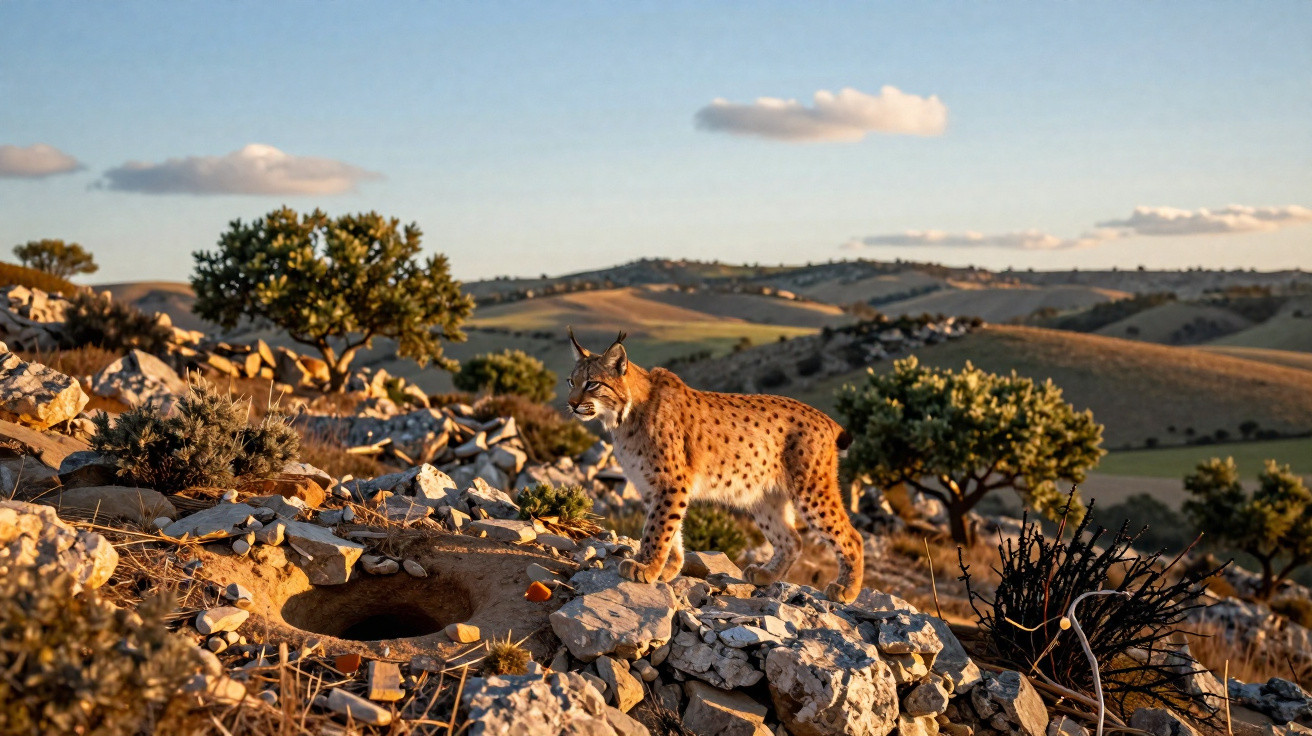
On a pale spring morning in Andalusia, mist gradually rises from the scrub and dew-covered rockrose. A male Iberian lynx pads across a dirt track: a fleeting flash of spotted coat and tufted ears before he disappears again among broom and holm oaks. The GPS collar around his neck quietly sends a signal to a satellite. A biologist in Lisbon, a few hundred kilometres away, sees it on her screen and nearly chokes on her coffee.
The location reveals something that, on paper, should scarcely be possible.
Born in Spain, this male is now moving through territory that has been mapped as exclusively Portuguese for decades. More than that, he is breeding there.
For scientists who spent years characterising lynx populations as “islands”, the map is suddenly not merely incomplete, but profoundly wrong.
When “isolated” lynx quietly crossed the border
For years, the story of the Iberian lynx seemed almost fixed. Spain had its strongholds in Doñana and Sierra Morena, followed by newer locations in Castilla-La Mancha and Extremadura. Portugal had a valuable core population close to the Guadiana river, supported by reintroductions and protected fencing. Two pockets. Two separate worlds.
At conferences, biologists repeated the same message: populations were vulnerable, geographically separated and genetically endangered. Maps showed tidy coloured blocks divided by heavy border lines. The possibility that lynx could cross those boundaries in a meaningful way appeared closer to wishful thinking than robust science.
Now those assumptions are unravelling in real time.
The change was not announced with great fanfare; it began with several persistent dots on computer screens. During 2023 and 2024, teams in Spain and Portugal noticed GPS-collared lynx disregarding the boundaries people had drawn. Males leaving Spanish release sites travelled tens of kilometres, passing through olive groves, avoiding motorways and following valleys rich in rabbits.
In Portugal, camera traps started recording unfamiliar animals, recognisable by distinctive spot patterns, different whisker markings and unrecorded ear notches. Genetic material from droppings and hair completed the picture. These animals were not simply passing through. Kittens born in Portugal carried the DNA of Spanish fathers, while Spanish dens contained mothers first born in Portuguese enclosures near Mértola.
The laboratory spreadsheets began to resemble family trees rather than isolated sets of charts.
For conservation scientists whose careers have centred on combating fragmentation, the finding is both exciting and unsettling. For years, papers described the Iberian lynx as “the most endangered feline in the world”, confined to dwindling and divided habitats. The idea of “isolated populations” informed funding decisions, conservation strategies and international agreements.
Then, as often happens, reality found its way through the fence. The animals had not read the reports. They followed prey, shelter and instinct, joining Spain and Portugal through one nocturnal journey after another. What was supposed to be a conservation archipelago has quietly become a living, breathing network.
For a field accustomed to predicting disaster, such unexpectedly positive news can feel almost suspicious.
How Iberian lynx made a political border a genetic bridge
This unexpected interbreeding is not simply a stroke of magic. It follows years of unglamorous labour: agreeing wildlife corridors, clearing old snares and modifying roadside fencing so that an agile lynx can pass underneath rather than end beneath a vehicle. On both sides of the frontier, teams mapped “green veins” linking rabbit-rich areas and thick scrub from Extremadura to the Alentejo.
Releases followed. Captive-bred lynx from breeding centres in Silves, El Acebuche, Zarza de Granadilla and elsewhere were released at carefully selected locations. Some remained nearby, but many did not. They dispersed. Once regarded as a danger, that movement has become the concealed driver of a new population shared between the two countries.
We have all seen it: a plan looks orderly in a PowerPoint presentation, then real life arrives and follows a slightly different course. Conservation is no different. Initial projects sought to “anchor” lynx in particular places, because dispersal was feared to mean lost animals or, worse, added roadkill figures.
Yet the strongest results now come from lynx that would not stay put. One well-known male, monitored after leaving Castilla-La Mancha, travelled in a zigzag pattern for months before settling in a location absent from every conservation blueprint. There he found rabbits and cover, and ultimately a Portuguese-born female. Their kittens, part Spanish and part Portuguese, became living evidence that rigid models can overlook the wildest-and most promising-outcomes.
Let’s be honest: nobody really predicts this kind of cross-border love life on the first draft of a management plan.
For readers wondering what this alters beyond a handful of romantic stories, the answer is direct: genetic flow is survival. Small, separated populations can build up serious difficulties, including inbreeding, greater susceptibility to disease and reduced fertility. For years, Iberian lynx breeding programmes relied on “genetic matchmaking” to prevent closely related animals being paired in captivity. Nature is now undertaking some of that work unaided.
Field teams are recording healthier litters, strong dispersal ability and, crucially, the establishment of new territories where few people would have seriously imagined lynx living a decade ago. The formerly broken-up map is becoming a gradient: a genuine meta-population extending across the peninsula. In the wild, that is precisely what long-term resilience looks like.
Why this “miracle” is not a free pass
Hearing this account can prompt an understandable sigh of relief: “Great, nature is fixing itself.” News is full of extinctions and collapses, so a single recovery can seem like a lifeline. But the danger lies in treating the lynx as a symbol that no longer requires attention.
On the ground, matters are far less straightforward. The same GPS routes exposing cross-border pairings also reveal bleak diversions around new infrastructure, hazardous road crossings and fenced hunting estates where lynx are still unwelcome. Remaining alert to these obstacles is the unglamorous side of the story.
Conservation workers acknowledge privately that fatigue is beginning to set in. Funding opportunities end, public attention shifts elsewhere, and the lynx-long used as a flagship species-must now compete with fresh crises and headlines. This is where a major error often occurs: assuming a positive trend will continue without help.
The recovery of the Iberian lynx, including this remarkable interbreeding between Spain and Portugal, depends on continued monitoring, habitat management and cooperation among institutions that do not always work together willingly. Should one of those foundations fail, the whole structure can still be shaken. Success doesn’t mean the job is done; it means the margin for error just got a little wider.
“Ten years ago, we were praying not to lose the species,” a Portuguese field ecologist told me, standing by a dusty 4×4 near Serpa. “Now we’re arguing about how far it can spread. That’s a luxury problem. But it’s still a problem we can mess up if we get complacent.”
The team had fixed a straightforward checklist to the dashboard of that 4×4:
- Monitor dispersing lynx and exchange data across the border in near real time
- Locate and protect the crossing points most frequently used beneath major roads
- Collaborate with hunting estates so lynx and rabbits can live alongside one another without conflict
- Continue genetic monitoring, even when funds are under pressure
- Engage local communities so lynx are regarded as neighbours rather than intruders
These points may not generate viral headlines, but they provide the quiet foundation for every “miracle” recovery story we celebrate.
A wild cat that redraws our mental maps
The scientific community’s disbelief reveals as much about people as it does about lynx. We divided the Iberian Peninsula into management units with neat borders, then discussed “connectivity” as though it were a theoretical extra rather than an essential requirement for any living species. The lynx disregarded that arrangement and connected a larger narrative.
Its significance extends beyond biologists and policymakers. It challenges how shared landscapes are understood, from the Guadiana valley to the dusty tracks of Sierra de Gata. It asks whether we can accept that wild animals occupy space that reaches across languages, laws and land uses, or whether we continue to pretend that a fence marks the edge of their world.
The enduring image is uncomplicated: a female born in Portugal moving silently through the shade of cork oaks, with her kittens behind her and their father somewhere beyond an invisible frontier. They have no awareness that they are revising textbooks or making planners in Madrid and Lisbon sit around the same table. They simply travel, hunt, breed and begin again.
For someone reading this on a phone between two Underground stops, the story may seem remote. Its principle is not. Wild systems are more disorderly, inventive and stubborn than our reports allow. When they surprise us positively, the appropriate response is not to relax, but to ask what we got right this time-and how far we can test that fortune without breaking it.
| Key point | Detail | Value for the reader |
|---|---|---|
| Cross-border interbreeding | Lynx born in Spain and Portugal are producing mixed litters across the frontier | Demonstrates that firm political boundaries do not define real ecosystems |
| From isolation to connectivity | Previously fragmented populations now function as one connected meta-population | Provides a live example of habitat corridors and sustained work delivering results |
| Fragile success | The recovery relies on ongoing monitoring, cooperation and local backing | Shows that environmental “good news” still demands active involvement |
FAQ:
Question 1: Are Iberian lynx in Spain and Portugal different subspecies?
The Iberian lynx is one species, Lynx pardinus, with no officially recognised subspecies separating Spain from Portugal. The “separation” discussed by scientists referred to geographical and genetic isolation between population pockets, not an official taxonomic division.
Question 2: How did scientists discover the populations were interbreeding?
They used GPS monitoring, camera traps and genetic testing together. Collared lynx were recorded entering neighbouring countries, while DNA from droppings, hair and tissue samples identified kittens whose parents came from opposite sides of the border.
Question 3: Why is this interbreeding good news for the species?
Gene flow between groups that were formerly isolated lowers the risk of inbreeding, may improve fertility and health, and produces a more resilient, widespread population better able to cope with disease, habitat change and random disasters.
Question 4: Does this mean the Iberian lynx is no longer endangered?
The species has moved back from the edge of extinction, but it is still regarded as threatened. Numbers are increasing, yet populations remain reliant on healthy rabbit populations, effective corridors and careful management to prevent decline.
Question 5: Can people actually see these lynx in the wild?
Sightings are uncommon and can never be assured, but guided wildlife tourism has quietly emerged in parts of Andalusia, Castilla-La Mancha and the Guadiana region. The best way to “see” the animals may still be through the stories and data showing how they are reshaping the Iberian landscape.





Comments
No comments yet. Be the first to comment!
Leave a Comment