
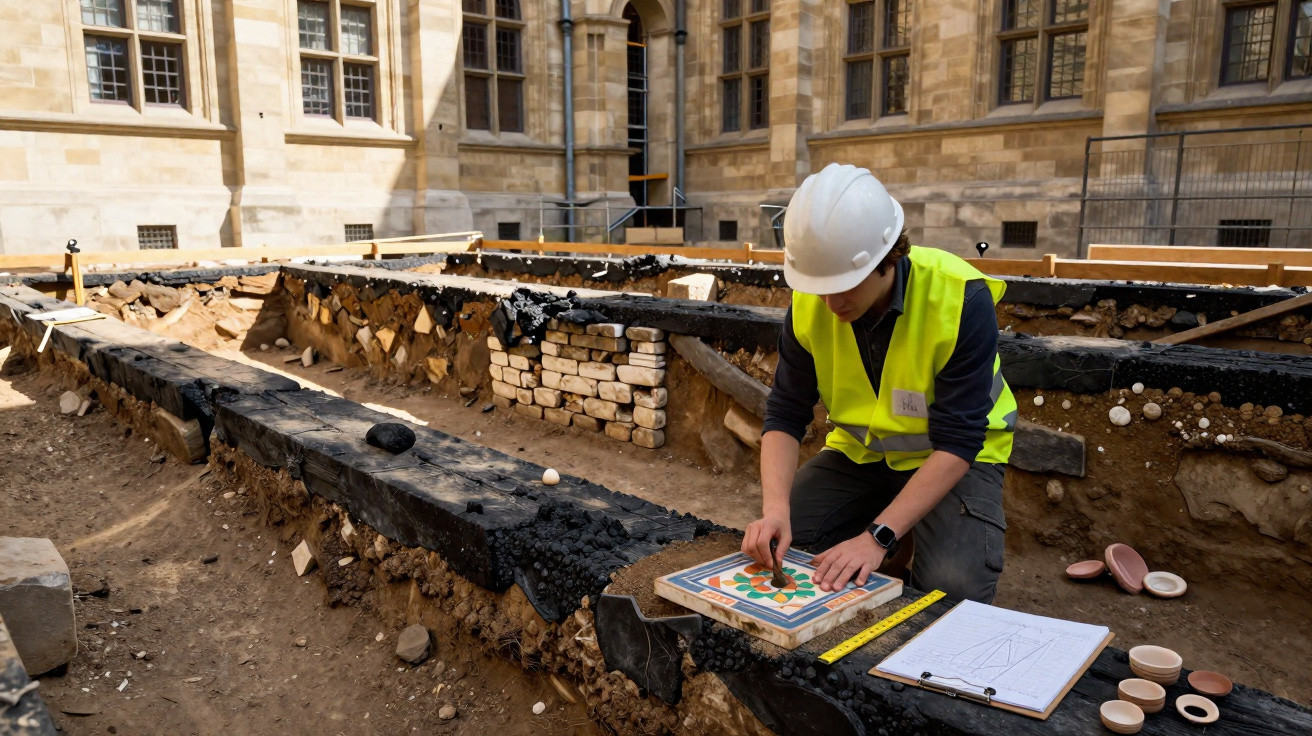
While construction workers were expected at the Paris Palais de Justice on the Île de la Cité for a major refurbishment, archaeologists arrived first. What initially appeared to be a routine procedure quickly became a modest archaeological sensation: beneath the paving of these venerable court buildings, traces emerged of a city that has been continually rebuilt, reshaped and reimagined for almost 2,000 years.
A courthouse sitting on a historic powder keg
The Palais de Justice stands on the Île de la Cité, one of Paris’s oldest continuously settled locations. Today, law courts, the police prefecture and Sainte-Chapelle stand side by side there. Many local residents associate the site with lengthy queues outside courtrooms, terrorism trials and landmark cases from French history.
Beneath the surface, however, lay a very different Paris. Between August and November 2025, archaeologists from the City of Paris and the French research institute Inrap carried out what are known as preventive excavations. In France, such investigations precede major building schemes so that potential discoveries can be secured at an early stage.
In an area of only just over 100 square metres, an unexpectedly dense cross-section of almost two millennia of urban history came to light: from the early Roman period to modern times.
The investigation focused on the Cour du Mai, the ceremonial courtyard of the Palais de Justice. Precisely where excavators are due to operate, fragments of floor tiles, old walls and even graves lay close together, often only a few centimetres below the modern surface.
The mysterious ancient wall at the Palais de Justice
A substantial structure beneath the courtrooms
Among the most striking discoveries was a substantial wall base revealed during the work. The foundation measures around three metres across – far too large for an ordinary home, and too substantial for a simple retaining wall.
Archaeologists believe it may form part of the Late Roman fortification constructed around the Île de la Cité between the 3rd and 5th centuries AD. Paris, then known as Lutetia, faced political crises, Germanic incursions and internal unrest during this period. Many towns contracted into smaller, more defensible centres and enclosed themselves with thick protective walls.
Should the wall’s defensive character be confirmed, historians will have to redraw the previously accepted route of the city wall on the Île de la Cité – a sensitive revision to a scholarly picture of the city established for decades.
Around the wall section, researchers also identified about twenty pits, postholes and six inhumation burials. These features suggest that the location was more than a bare defensive installation; it was a space with complex uses, perhaps an area between the wall and built-up land where people lived, worked and buried their dead.
Even earlier evidence from the start of the Common Era
The surprises did not end with Late Antiquity. Deeper levels contained features dating from the transition between the 1st century BC and the 1st century AD. At that time, Lutetia was shifting from a Gallic settlement into a Roman-influenced town.
The archaeologists recorded ditches, smaller hollows and early evidence of settlement. Although these structures may seem unremarkable, they offer clues to the spatial organisation of early Paris: Where did routes run? Where were workshops located? Which parts of the island were used first?
- Late Roman wall line (3 m wide)
- At least six burials in the immediate vicinity
- Around twenty pits and postholes
- Early settlement traces around the start of the Common Era
Medieval splendour beneath fire debris
Burnt deposits and royal tiles
The excavation did not reveal Roman remains alone. Directly above the ancient layers were extensive rubble deposits, probably connected with the major rebuilding works that followed the devastating fire of 1776. Much of the old royal palace burned down at that time, and large sections of the present judicial complex were later built in its place.
Within this chaotic demolition material, archaeologists found countless so-called “carreaux historiés”, decorated floor tiles from the 13th and 14th centuries. Many feature fleur-de-lis, the heraldic emblem of the French kings, or animal designs. Such tiles are already known from the Cour Carrée at the Louvre, where they were long regarded as rare evidence of courtly interior decoration.
The tiles at the Palais de Justice demonstrate that, in the High Middle Ages, the Île de la Cité was not only a political centre but also a setting for elaborate interior architecture.
The outline of a medieval cellar room also emerged. This cellar probably belonged to buildings within the Capetian royal palace, which stood on the island during the Middle Ages. Significantly, the room does not appear on historic plans. The excavation therefore revises the previous understanding of the palace complex’s exact layout.
A place of justice that was once a royal court
Today, many people associate the Palais de Justice with legal hearings, solicitors and security checks. In the Middle Ages, the site was above all a royal residence. The Capetians lived here before the centre of power gradually shifted to the Louvre and later to other palaces.
The discoveries fit this transformation closely: royal decorative tiles, prestigious interiors and then extensive modern demolition layers show how the island was repeatedly rebuilt and adapted to new purposes – from a royal centre to the judicial machinery of the modern era.
Eleven graves between courthouse walls
Particular attention is being paid to a small cluster of graves. A total of eleven skeletons were uncovered in the Cour du Mai area. They are inhumation burials without lavish grave goods, simply laid out and placed close together.
Their precise date remains uncertain. Archaeologists will now date the bones and carry out anthropological analysis, examining age, sex, possible illnesses, evidence of injuries and malnutrition. Such research offers insight into the daily lives and physical hardships of the population at the time.
| Number of graves | Possible indications |
|---|---|
| 11 | Small cemetery or the edge of a larger burial area |
| Body position | Evidence of religious rites or local burial customs |
| Bone analyses | Information about diet, illness and physical labour |
The graves’ position within a densely built-up centre of power raises compelling questions. Could they be early medieval burials from a period when the island had a stronger religious character? Or was an open area used temporarily for burials before new buildings were constructed over it?
What happens next to the discoveries
A second excavation campaign and documentary research
The excavation completed so far covers only part of the site. A second campaign in another sector of the Palais de Justice is planned for spring 2026. It could reveal further stretches of the presumed city wall, additional cellars or more graves.
At the same time, assessment will begin in laboratories and archives. Pottery, tiles, wall remains and human remains will be dated, conserved and compared. Historians will examine old plans, construction records and written sources to place the finds within known events, including building phases of the royal palace and the aftermath of the 1776 fire.
Only the combination of excavation, laboratory analysis and archival research makes a reliable reconstruction of the Île de la Cité’s development possible – from Roman settlement to today’s judicial centre.
Why discoveries like these reshape the story of Paris
Paris’s history often seems exhaustively researched. Guided tours, museums and school textbooks create the impression that every phase is already known. Finds at the Palais de Justice reveal a different reality: even at the city’s very heart, unknown walls, rooms and burials still exist.
For researchers, this provides an opportunity to test established models. If the route of the Late Roman wall shifts, interpretations of attacks, floods and the extent of the city at the time must also change. A newly discovered cellar may offer conclusions about uses, access arrangements or supply routes at the royal court.
For urban planning, the discoveries bring both opportunities and risks. Large building schemes in the historic centre must allow for delays when significant remains are unexpectedly uncovered. At the same time, they provide starting points for public interpretation projects: temporary exhibitions, information panels or virtual reconstructions that can help local people see their city anew.
How non-specialists can better understand such discoveries
Technical terms such as “preventive archaeology” or “demolition levels” can appear abstract at first. In essence, preventive archaeology simply means excavating before construction begins, rather than waiting until an excavator accidentally cuts into a foundation. This allows structures to be recorded without requiring a project to be halted completely.
The frequently mentioned “demolition layers” or “demolition levels” are essentially historic rubbish dumps. When a palace was altered after a fire, roof tiles, broken floor tiles and charcoal residues were tipped into pits or spread to reshape the ground. Careful analysis of these deposits can reveal a great deal about earlier materials, construction standards and even fashions in interior design.
Visitors to Paris can already experience comparable processes directly elsewhere: at the archaeological crypt museum beneath the square in front of Notre-Dame, in parts of the Cluny thermal baths, or among the underground remains beneath the Louvre. What has now been uncovered at the Palais de Justice belongs to the same family of evidence, but in an area that tourists do not normally see.
In the long term, digital models could make the new discoveries visible. One possible scenario would see visitors point their smartphones at the Palais de Justice while an app overlays the Roman wall, medieval cellars and graves. A seemingly enclosed complex of power would then suddenly become transparent, revealing Paris for what it is beneath the surface: a layered city in which every building project has the potential to bring about an archaeological reunion with the past.






Comments
No comments yet. Be the first to comment!
Leave a Comment