
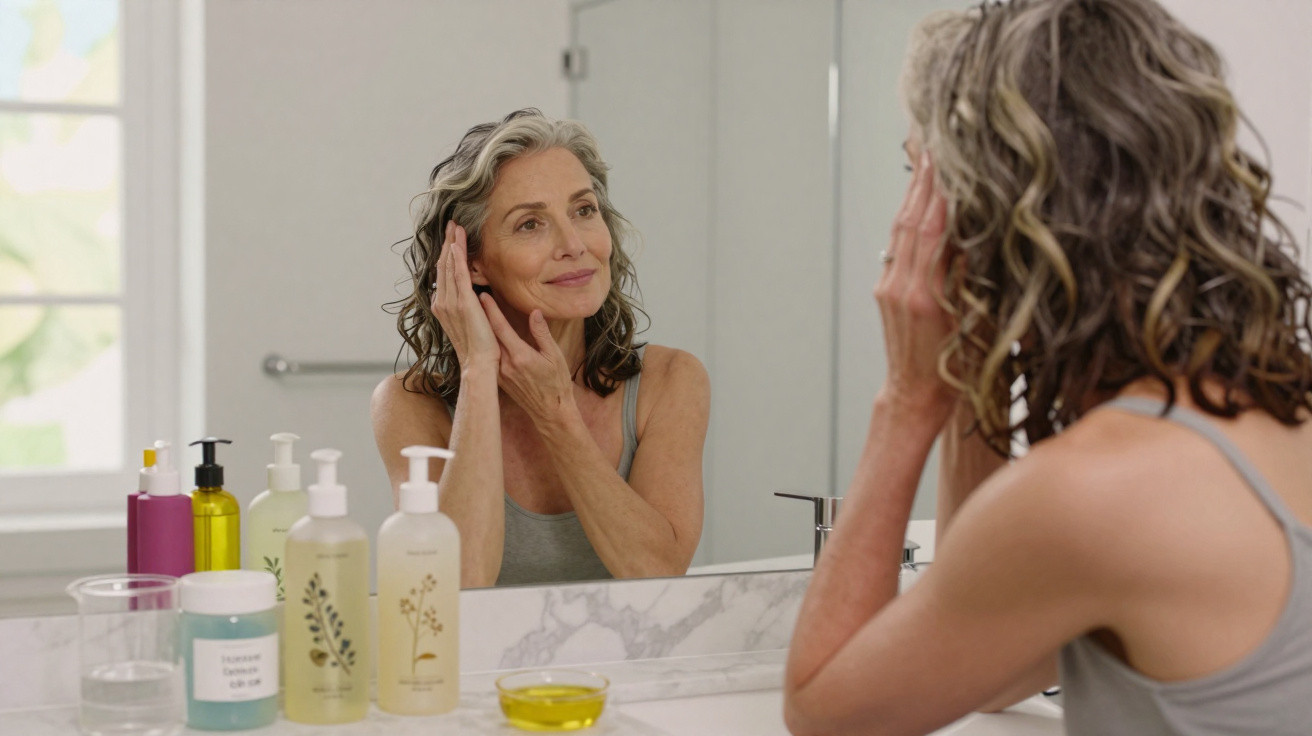
For many women, it begins with an ordinary moment: running their hands through their hair in the shower and realising it no longer feels the same. The lengths snag, curls lose their shape and the hairbrush fills up faster than it once did. Hot flushes are widely discussed, but far less is said about this quiet, personal loss that unfolds on the pillow and in the bathroom.
It is not simply a case of “drier hair”. Some women find their hair has suddenly become fluffy; others notice finer lengths or curls turning into limp waves. Products that worked for a decade can abruptly seem useless. You may find yourself studying shampoo labels under supermarket strip lighting, hoping to find a magic word that does not exist.
But what if this deeply personal shift in texture is driven by a far more precise biological process than we tend to assume?
The hormonal shift quietly changing your hair
Menopause rarely announces itself dramatically. It works its way into daily life: a strand snapping as you quickly tie up a bun before a video call, or a fringe that suddenly refuses to straighten. Much of this subtle change is hormone-led, particularly by oestrogen and progesterone, which once acted as invisible protectors for your hair.
As oestrogen levels decline, the scalp produces sebum differently. The natural oil that once covered every strand like a tiny conditioner becomes less plentiful and less evenly spread. Hair fibres lose their natural glide, leaving them rougher, drier and more “squeaky” beneath the fingertips.
Meanwhile, the hair follicle’s growth cycle becomes shorter. More hairs enter the shedding stage sooner, while new hairs emerge finer. What feels like “my hair texture has changed” is often a combination of finer regrowth, drier existing lengths and a scalp trying to catch up.
This is not merely salon anecdote. A major review in dermatology journals indicates that as many as 40–60% of women notice a change in hair density or texture around menopause. Some find that previously straight hair becomes wavy. Others who have had curls throughout their lives suddenly see them lose their definition and bounce.
Consider Claire, a 52-year-old solicitor who had always relied on a straightforward routine: a foaming supermarket shampoo and a quick in-shower conditioner. It served her well for years. Then, over 18 months, her ponytail began to feel half as thick and her ends resembled straw, however often she had them trimmed. She switched shampoo three times before understanding that the problem was not the brand, but the ingredients in the bottle meeting a new hormonal reality.
Her experience is far from unusual. Studies suggest that post-menopausal hair often has a rougher cuticle and a lower water content. In everyday terms, strands become less flexible, break more readily, and take in and lose moisture more quickly. A shampoo that felt “refreshing” at 35 may feel stripping at 52 simply because the hair fibre itself has altered.
There is a clear science behind this change. Oestrogen helps to regulate sebum and maintain blood flow to the follicles, supporting the cells that form the hair shaft. When oestrogen falls, follicles may become slightly miniaturised, especially in women with a genetic predisposition. Hair then grows with a smaller diameter, changing how it reflects light, forms curls and feels when touched.
At the same time, the protective lipid coating on the hair surface becomes less consistent. Picture missing roof tiles: moisture escapes more easily, while heat, UV exposure and friction create greater damage. Cuticle scales lift, producing the dull, frizzy look many women recognise. Ingredients that were once manageable - powerful detergents and high levels of alcohol - can suddenly be too harsh for this more delicate, lipid-poor fibre.
The outcome is something of a “perfect storm”: hormonal change meets established habits and modern formulas never developed for a menopausal scalp. Dryness is often the earliest visible sign that these factors are no longer working together.
Menopausal hair dryness: ingredients to avoid
When your hair feels drier after menopause, the first practical move is not an expensive mask or an unusual oil. Instead, take a calm look at the products on your bathroom shelf. Begin with shampoo and check the cleansing ingredients, which usually appear within the first five lines of the list. Strong sulphates such as Sodium Lauryl Sulfate (SLS) and Ammonium Lauryl Sulfate cut through grease efficiently, but may be overly harsh for a scalp already making less sebum.
Moving to milder surfactants - including Sodium Cocoyl Isethionate or Coco-Betaine - will not fix everything overnight, but it removes a repeated source of stress. Think of it not as overprotecting your hair, but as updating software for different hardware. Your scalp at 52 is not the same device it was at 32.
Next, consider alcohol. Not every alcohol is a problem. Fatty alcohols, such as cetyl alcohol and cetearyl alcohol, are genuinely softening and improve slip. The ingredients to be aware of are short-chain, drying alcohols placed high on the list: Alcohol Denat., SD Alcohol 40 and Isopropyl Alcohol. They evaporate rapidly and may draw moisture from hair that is already thirsty, especially when found in daily-use sprays, mousses and some leave-in products.
Let us be honest: nobody really studies labels with a magnifying glass over the sink every day. However, if your favourite root-lifting spray leaves your hair feeling like crisp paper, that is a useful sign. Many volume-focused styling products rely on drying alcohols and firm resins. These may have worked on oilier, younger scalps, but when hormones change, they can create a cycle of dryness and breakage.
Silicones are more complicated. Ingredients ending in “-cone”, “-conol” or “-siloxane”, including Dimethicone and Cyclopentasiloxane, can immediately create shine and slip, which can feel particularly welcome on rougher hair. The issue is potential build-up. When hair already struggles to absorb moisture, repeated layers of non-breathable film can make it look smooth while remaining dehydrated within.
For some women, a small amount of lightweight, water-dispersible silicone works well. For others, particularly those with waves or curls, heavier silicones can leave hair flat and increasingly dry because they prevent hydrating ingredients from getting through. Hair texture, climate and individual tolerance all play a part here, and it can take several weeks of silicone-light or silicone-free products before a difference becomes clear.
Preservatives and fragrance also deserve consideration. Parabens themselves have not been shown to cause hair dryness; the situation is more complex than that. For many menopausal scalps, irritation is the larger concern. Strong synthetic fragrances, high concentrations of particular preservatives and excessive use of essential oils may trigger low-level inflammation.
An irritated scalp can feel tight and itchy, while producing even less good-quality sebum. Micro-inflammation around follicles may also affect how well the hair shaft develops. Therefore, although “fragrance” may look harmless on an ingredient list, heavily scented shampoos - especially those containing added menthol or cooling ingredients - can quietly intensify dryness and discomfort on a scalp already under hormonal pressure.
Gentle care that supports menopausal hair
The most useful approach is surprisingly straightforward: reduce the harshness and increase the support. Where possible, leave longer between intensive washes; on wash days, focus on massaging the scalp rather than scrubbing it. Use warm rather than hot water. Concentrate shampoo at the roots and let the lather travel over the lengths instead of rubbing them directly.
Opt for a formula with gentle surfactants, no harsh sulphates and, ideally, calming ingredients such as panthenol, glycerin, aloe or oat derivatives. After menopause, the scalp often benefits from the same barrier-supporting approach used for mature facial skin. Spending a few minutes on a gentle scalp massage may also encourage local microcirculation, supporting follicles as they produce the best possible version of your new hair.
Conditioner is no longer “optional”. It becomes a daily defence against friction. Apply it mainly through the mid-lengths and ends, where the cuticle has experienced the most wear. Seek out formulas containing lightweight oils, such as argan, jojoba or grapeseed, alongside amino acids and humectants including glycerin or hyaluronic acid. A cool rinse helps the cuticle sit flatter and reflect more light, visually countering the dullness many women notice.
Reduce harsh, multi-stage habits: double shampooing, daily high-temperature heat styling and vigorous towel-rubbing. Replace a rough cotton towel with an old soft T-shirt or a microfibre hair wrap, then squeeze gently rather than twisting. It may sound overly careful, but these small repeated points of friction are what break weaker fibres and create frayed-looking ends.
There is an emotional dimension too: that small sting when your hair no longer behaves like the hair you grew up with. Many women respond by trying to “control” it more, with stronger-hold sprays, tighter ponytails or more frequent colouring. The impulse makes sense. Yet it can lead directly to ingredients and habits that worsen dryness: high-alcohol sprays, strong sulphates needed to remove them, and aggressive bleaching intended to brighten dulled colour.
A better option may be to work with the changed texture rather than oppose it. If your hair has gained more wave, lightweight creams and curl gels can moisturise and define it without crunchy fixatives. If it has become straighter and finer, volumising mists made with polymers and peptides rather than alcohol alone can provide lift without drawing moisture from the cuticle.
“The biggest shift happens when women stop treating menopausal hair as ‘damaged’ and start seeing it as ‘different hardware with new needs’,” shares a London trichologist. “Once that mindset clicks, product choices and habits fall into place much more naturally.”
To make this easier to apply during a busy week, use this simple mental checklist when choosing products:
- Cleansers – avoid harsh sulphates appearing high on the list; choose mild surfactants with moisturising additions.
- Stylers – use high-alcohol sprays and mousses sparingly; favour creams, milks or low-alcohol formulas.
- Treatments – choose masks containing oils, ceramides and proteins in moderation instead of strongly scented or “tingly” products.
Pausing briefly before a purchase - reading the first five ingredients and asking, “will this nourish or strip?” - can gradually change how your hair feels over three to six months. It is not instant magic, but a gradual, consistent softening of both the fibre and your relationship with it.
Living with changing hair rather than fighting it
Hair during menopause is seldom only “about hair”. It can affect identity, attractiveness, confidence at work and the way you walk into a room. Dryness, frizz and thinning may feel like visible evidence of private changes you have not necessarily chosen to share. Some women react by cutting their hair very short, others choose extensions, while others turn to hats or carefully placed headbands.
Knowing the science behind these changes does not remove the emotion, but it can do something subtler: restore a sense of control. When you understand that lower oestrogen changes sebum production, cuticle structure and follicle cycles, dryness no longer feels like a personal failure of self-care. It becomes another factor to work with - rather like needing glasses or changing shoe size.
It also helps to talk about it. Speak to a hairdresser who listens rather than repeating the same blow-drying routine they used ten years ago. Discuss it with friends who are equally surprised by their “new” texture. Talk to your GP if hair changes come alongside other symptoms of hormonal imbalance. Exchanging routines, gentler shampoo recommendations or simply admitting, “my hair feels like someone else’s lately” creates a very different experience from quietly struggling beneath a flawless blow-dry.
This period may even become a creative turning point. Some women rediscover their natural wave once they stop flattening it with silicones and aggressive cleansers. Others embrace softer layers that suit their finer texture rather than pursuing thickness that will not return in exactly the same way. Hair will continue to change in the years after menopause, and your routine can change alongside it, one small step at a time.
Beneath the labels and Latin ingredient names on your bottles lies one simple question: does this product respect the reality of my hormonal life now, or is it still trying to care for the woman I was twenty years ago? The fibres on your head keep a precise record of your choices. You can begin to change that story at your very next wash.
| Key point | Detail | Why it matters to the reader |
|---|---|---|
| Hormones and texture | Falling oestrogen = less sebum, a rougher cuticle and finer hair | Understand why hair becomes drier and changes shape |
| Ingredients to avoid | SLS, drying alcohols, heavy silicones and aggressive fragrances | Reduce breakage and dryness by choosing suitable products |
| A tailored routine | Gentle cleansers, moisturising care, less harsh handling and more flexible stylers | Build a practical ritual to restore softness and comfort |
FAQ
- Does every woman’s hair become drier during menopause? Not always, but many women notice some change in texture, density or shine. Genetics, existing hair habits and overall health all influence how strongly hormonal changes show up in the hair.
- Are sulphates always bad for menopausal hair? No, occasional use of sulphates is not a disaster. The concern is frequent, high-foaming washing with strong sulphates on a scalp that is already producing less protective sebum.
- Can switching shampoo really improve hair dryness? Yes, particularly over several weeks. Milder cleansers and fewer drying ingredients reduce cumulative damage, so hair breaks less and retains moisture more effectively.
- Should I stop using every silicone after menopause? Not necessarily. Lightweight, water-dispersible silicones can help with frizz and tangling. It is the heavier, build-up-prone silicones found in many styling products that may leave hair coated but dry inside.
- When should I see a doctor about changes in my hair? If you experience sudden or patchy hair loss, scalp pain, or shedding that seems extreme compared with your usual amount, speak to a dermatologist or GP. They can rule out thyroid, nutritional and other medical causes beyond normal menopausal change.






Comments
No comments yet. Be the first to comment!
Leave a Comment