
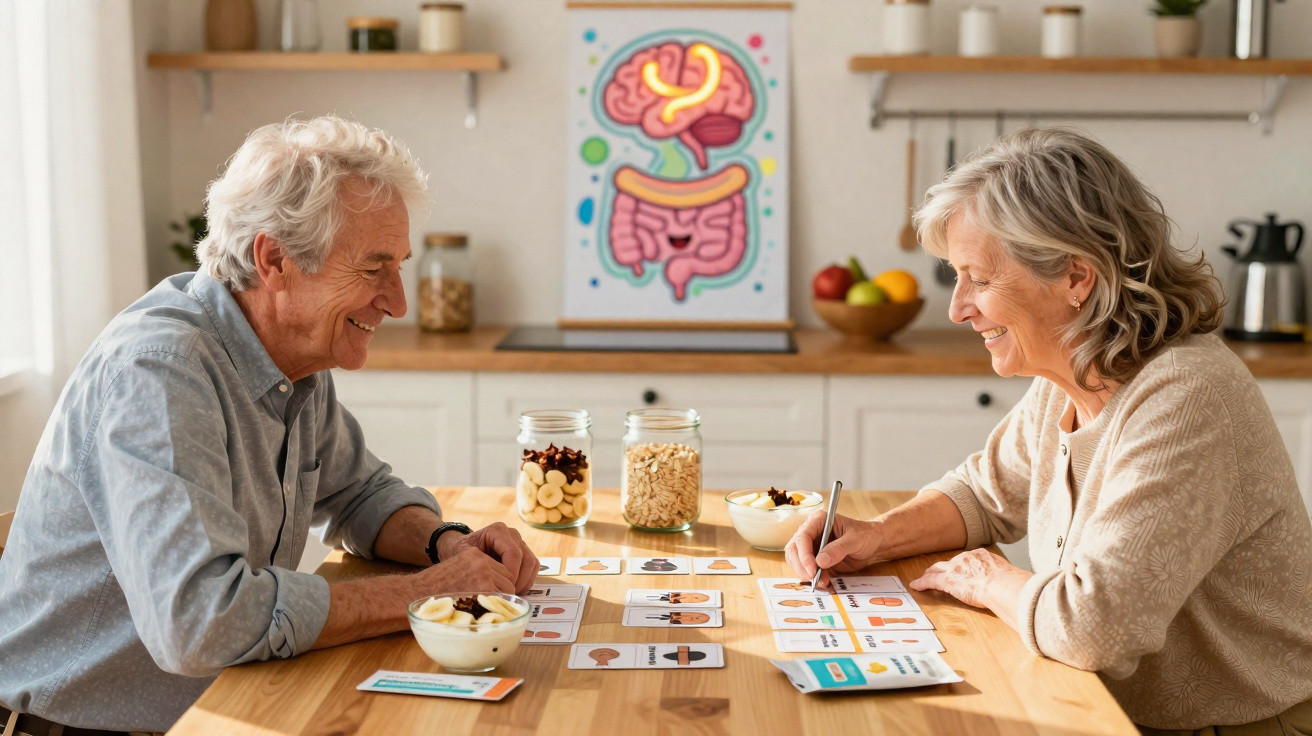
What benefits an ageing gut could also support an ageing brain.
A pioneering study involving twins has shown that daily protein and prebiotic supplements may raise memory-test scores in adults aged over 60.
Published in 2024, the results are particularly noteworthy because the same visual memory and learning assessment is used to identify early indications of Alzheimer's disease.
The double-blind trial examined two low-cost plant-fibre prebiotics, both available without prescription in many countries.
Prebiotics are non-digestible substances that encourage the activity of microbes in the gut.
One supplement was inulin, a fructan-type dietary fibre. The other was fructooligosaccharide (FOS), a plant carbohydrate frequently used as a natural, low-calorie sweetener.
Watch the video below for a summary of the research:
Prebiotics, memory and the ageing brain
To investigate the effects of these supplements on the ageing brain, scientists at King's College London recruited 36 pairs of twins, all aged 60 or older.
Each pair was randomly divided: one twin was given a daily prebiotic blended with protein powder, whereas the other was given a placebo powder.
After three months, the twins who had unknowingly consumed inulin or FOS tended to achieve better results in a cognitive test.
In addition, daily fibre supplementation was associated with small differences in the twins' gut microbiomes.
For example, beneficial Bifidobacterium was more abundant among participants taking inulin or FOS.
Mouse research indicates that Bifidobacterium can lessen cognitive deficits by regulating gut-brain connections.
"We are excited to see these changes in just 12 weeks. This holds huge promise for enhancing brain health and memory in our aging population," said Mary Ni Lochlainn, a geriatric medicine researcher at King's College London, when the findings were published.
"Unlocking the secrets of the gut-brain axis could offer new approaches for living more healthily for longer."
King's College maintains the United Kingdom's largest registry of adult twins, and twin research is especially useful for separating the influence of genetics from that of environment on human health.
Earlier rodent studies suggest that high-fibre supplements such as inulin and FOS can 'feed' the microbiome in the colon, enabling 'good' bacteria to flourish.
Several of these bacterial contributors have also been associated with stronger cognitive function in mice and humans alike.
The gut-brain axis and cognitive decline
Evidence of the close link between the gut and brain continues to build each year. The findings have persuaded some experts to describe the gut as the body's 'second brain'.
However, exactly how these two nervous systems interact is still unknown.
The KCL twin study suggests that eating particular 'brain foods' may offer a promising route for addressing cognitive decline, complementing research indicating that important nutrients could slow its progression.
"These plant fibers, which are cheap and available over the counter, could benefit a wide group of people in these cash-strapped times. They are safe and acceptable too," said geriatrician Claire Steves at KCL.
"Our next task is to see whether these effects are sustained over longer periods and in larger groups of people."
Although prebiotics seemed to improve certain elements of cognitive function in an ageing brain, including memory and processing times, the study found no significant physical advantages.
Muscle loss was not improved in the older twins receiving high-fibre supplements, despite inulin and FOS being important to musculoskeletal maintenance.
Study limitations and wider health implications
Most twins enrolled in the present trial were female. Although the researchers accounted for sex differences in their analysis, they recognise that there could be selection bias within KCL's twin cohort.
Nevertheless, women are more vulnerable to Alzheimer's disease, and studies such as this reinforce the developing view that cognitive decline is not invariably a disease of the brain alone, but may also involve outside factors.
A recent Lancet Commission for Dementia calculated that 7 percent of Alzheimer's risk is attributable to elevated midlife levels of low-density lipoprotein, which transports cholesterol and fatty acids throughout the body.
According to a 2025 study led by King's College London researchers, this risk factor could help account for women developing Alzheimer's at twice the rate of men.
Also in 2025, researchers found that, in people and mice, a lower proportion of Bifidobacterium relative to Akkermansia within gut bacteria is associated with multiple sclerosis; this imbalance was also linked with more severe disease.
The gut is involved in many bodily 'pies', including the immune system and central nervous system. Nourishing its microbiome with particular prebiotics and probiotics could create opportunities to treat a multitude of illnesses and diseases.
The study was published in Nature Communications.
An earlier version of this article was published in March 2024.





Comments
No comments yet. Be the first to comment!
Leave a Comment