
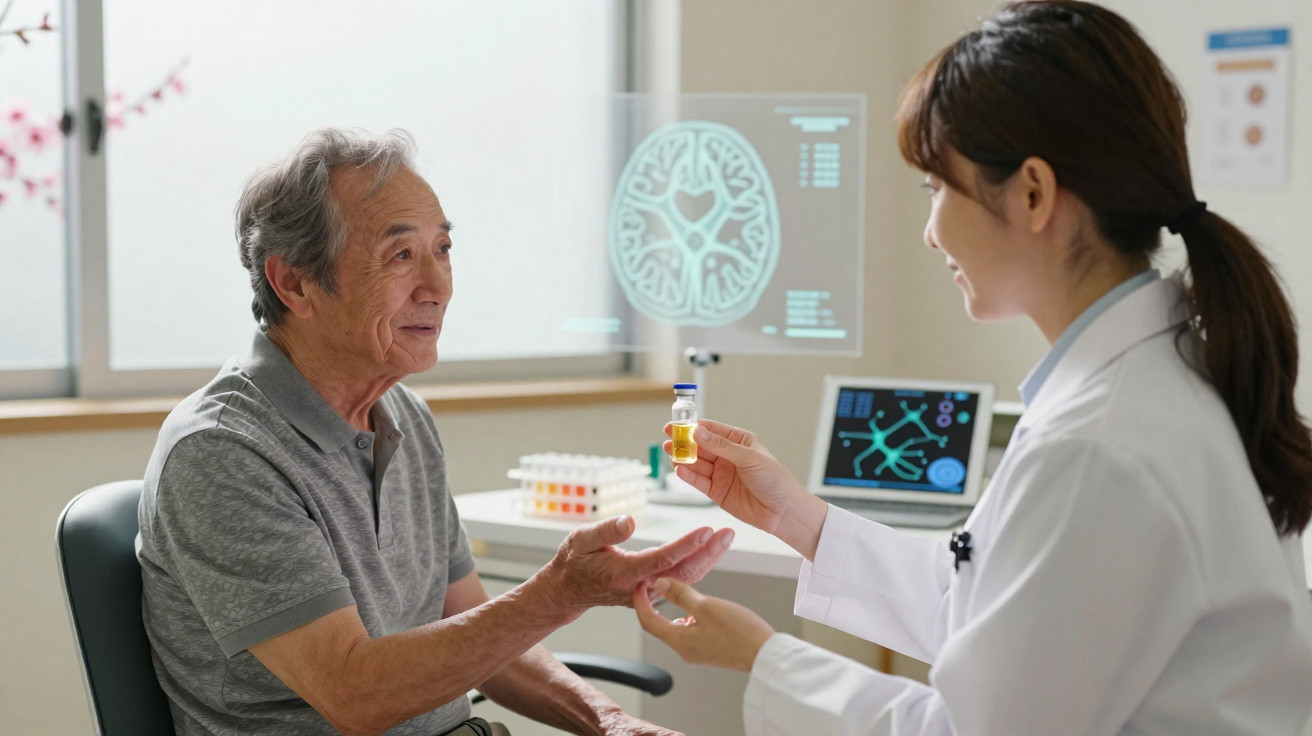
In Japan, regulators have discreetly authorised a groundbreaking therapy that may reshape the future of treatment for brain disorders.
For the first time globally, a stem cell-based medicine has gained formal approval for Parkinson’s disease, transforming years of experimental research into a treatment option for patients.
A landmark approval in Japan
On 6 March 2026, Japanese pharmaceutical company Sumitomo Pharma said it had been authorised to manufacture and market Amchepry, a stem cell therapy for Parkinson’s disease.
Granted through Japan’s accelerated regenerative medicine pathway, the authorisation is the first commercial clearance anywhere in the world for a stem cell treatment aimed at Parkinson’s disease.
Amchepry uses lab-grown cells derived from adult tissue, reprogrammed and turned into dopamine-producing brain cells before being implanted into patients.
The decision was based on a small clinical trial involving seven people with Parkinson’s disease, aged between 50 and 69. Each participant had either 5 or 10 million cells implanted directly into the brain. The cells were induced pluripotent stem cells (iPS cells) pre-differentiated into dopamine-producing neurons.
Participants were followed for two years. Sumitomo Pharma reported no serious safety signals over that time, while four of the seven volunteers saw their symptoms improve.
How stem cells entered the picture
What stem cells are
Stem cells are commonly characterised as the body’s basic building blocks. Unlike ordinary cells, which perform a defined task, stem cells are “undifferentiated”. They are able to develop into numerous cell types and to replenish themselves over time.
Scientists generally recognise several principal categories:
- Unipotent stem cells – produce just one kind of cell, such as skin cells, while continuing to renew themselves.
- Multipotent stem cells – generate several related cell types, as blood stem cells do when producing red cells, white cells and platelets.
- Pluripotent stem cells – occur in very early embryos and can create more than 200 different cell types throughout the body.
- Totipotent stem cells – exist immediately after fertilisation and can form an entire organism along with its supporting tissues.
This adaptability makes stem cells strong candidates for repairing injured tissue, creating cell therapies and possibly replacing parts of organs that no longer work correctly.
However, embryonic stem cells, among the most adaptable types, raise significant ethical concerns because they have traditionally been obtained from embryos at a very early stage.
The iPS revolution that changed the debate
In 2006, Japanese researcher Shinya Yamanaka discovered how to return normal adult cells to a pluripotent state through reprogramming. Known as induced pluripotent stem cells, or iPS cells, these cells share many characteristics with embryonic stem cells but can be produced from a sample of skin or blood.
iPS technology broke the dependence on embryo or foetal tissue, opening a new path for regenerative medicine that avoids some of the toughest ethical battles.
Yamanaka received the 2012 Nobel Prize in Physiology or Medicine for this work. Amchepry’s approval suggests that the technology has moved beyond laboratory research into everyday clinical practice, at least in Japan.
Why Parkinson’s disease is a target
Parkinson’s disease is a neurodegenerative condition that gradually destroys particular brain cells, notably the dopaminergic neurons in an area known as the substantia nigra.
Those neurons make dopamine, a chemical messenger involved in controlling movement. As dopamine levels decline, routine tasks such as writing, fastening a shirt or lifting a fork to the mouth may become slow, tremulous or unachievable.
| Key feature | Impact on patients |
|---|---|
| Loss of dopaminergic neurons | Stiffness, tremors, slowed movement |
| Progressive nature | Symptoms worsen over years |
| Current drugs | Replace dopamine, but do not stop cell loss |
From the 1980s onwards, researchers attempted to replace the disappearing neurons with tissue from aborted foetuses. While some patients improved markedly, occasionally for much longer than a decade, others gained no benefit and some developed severe involuntary movements.
The method also relied on scarce foetal donations and prompted substantial ethical opposition. Its biological inconsistency, unpredictable outcomes and moral controversy led researchers to seek cleaner, more controllable cell sources.
What makes Amchepry different
Amchepry does not use cells from embryos or foetuses. Instead, its cells are created in the laboratory by converting adult cells into iPS cells and then “nudged” into dopamine-producing neurons.
This offers several potential benefits:
- Greater consistency in quality between batches.
- No dependence on donated foetal tissue.
- A future possibility of personalised treatments made from a patient’s own cells.
The Japanese trial suggests that implanting iPS-derived neurons directly into the brain can be done without major short-term complications, at least in a tiny cohort.
Nevertheless, the authorisation rests on data from only seven patients. Symptoms improved in four people but not in three. The full clinical evidence has yet to receive extensive independent assessment, and follow-up beyond the initial two years will be equally important.
Fast-track pathway raises eyebrows
Japan has established a dedicated regulatory route for regenerative treatments. It allows promising therapies to be authorised on early evidence and sold for as long as seven years while larger trials continue.
The aim is to provide patients with innovative options sooner, particularly where few alternatives exist. Yet the pace of this process concerns some scientists and clinicians.
Stem cell therapies have particular risks. In theory, reprogrammed cells may multiply uncontrollably and create tumours. Cells that are incorrectly placed or behave unexpectedly in the brain could also cause seizures or abnormal movements.
Critics fear that accelerated approval might not leave enough time to pick up rare but serious complications such as tumour formation.
Japanese regulators maintain that earlier access, together with rigorous monitoring after approval, makes the pathway worthwhile. Whether that judgement proves sound will depend on outcomes as more people receive Amchepry over the coming years.
Part of a broader regenerative push
Amchepry is not the sole product benefiting from Japan’s drive into regenerative medicine. Cuorips, another company, has been authorised to market ReHeart, a stem cell treatment intended for heart failure.
Both therapies may become available to patients as early as this summer, indicating Japan’s willingness to serve as a real-world testing ground for treatments with high risks and high potential.
What patients and families should know
For those living with Parkinson’s disease, the prospect of replacing lost brain cells rather than simply supplementing dopamine with tablets is compelling. Even so, expectations must be managed carefully.
- Amchepry is not a cure; Parkinson’s is complex and involves more than one region of the brain.
- Its long-term safety remains uncertain; close monitoring will be required.
- Early access may be restricted to Japan and specialist centres.
- Costs are likely to be high, particularly initially.
One possible future model would combine medication to control symptoms, deep brain stimulation for particular movement difficulties and cell therapy for carefully selected people whose disease is advancing but who are otherwise fit.
Key terms explained
Two scientific ideas recur throughout this story and may initially seem confusing:
Dopamine: A brain chemical messenger that carries signals between nerve cells. Among its functions is the fine control of movement. In Parkinson’s disease, dopamine levels drop as the cells that make it die.
Induced pluripotent stem (iPS) cells: Normal adult cells, including skin cells, that have been genetically reprogrammed to act like embryonic stem cells. They can subsequently be developed into many other cell types, including neurons and heart muscle cells.
For patients who may consider taking part in comparable trials in the future, a practical measure is to compile a detailed medical history and document symptom changes over time. Neurologists are increasingly using rating scales and apps to monitor movement, sleep and daily function; such information will help determine who is most likely to benefit from invasive procedures such as brain cell implants.
Families also need frank discussions about their tolerance of risk. Some individuals may choose to accept unknown long-term hazards for the possibility of improved function now, whereas others may favour well-established treatments even where the improvements are more modest. As evidence from Japan expands, these personal decisions should progressively be made on a firmer evidential basis.





Comments
No comments yet. Be the first to comment!
Leave a Comment