
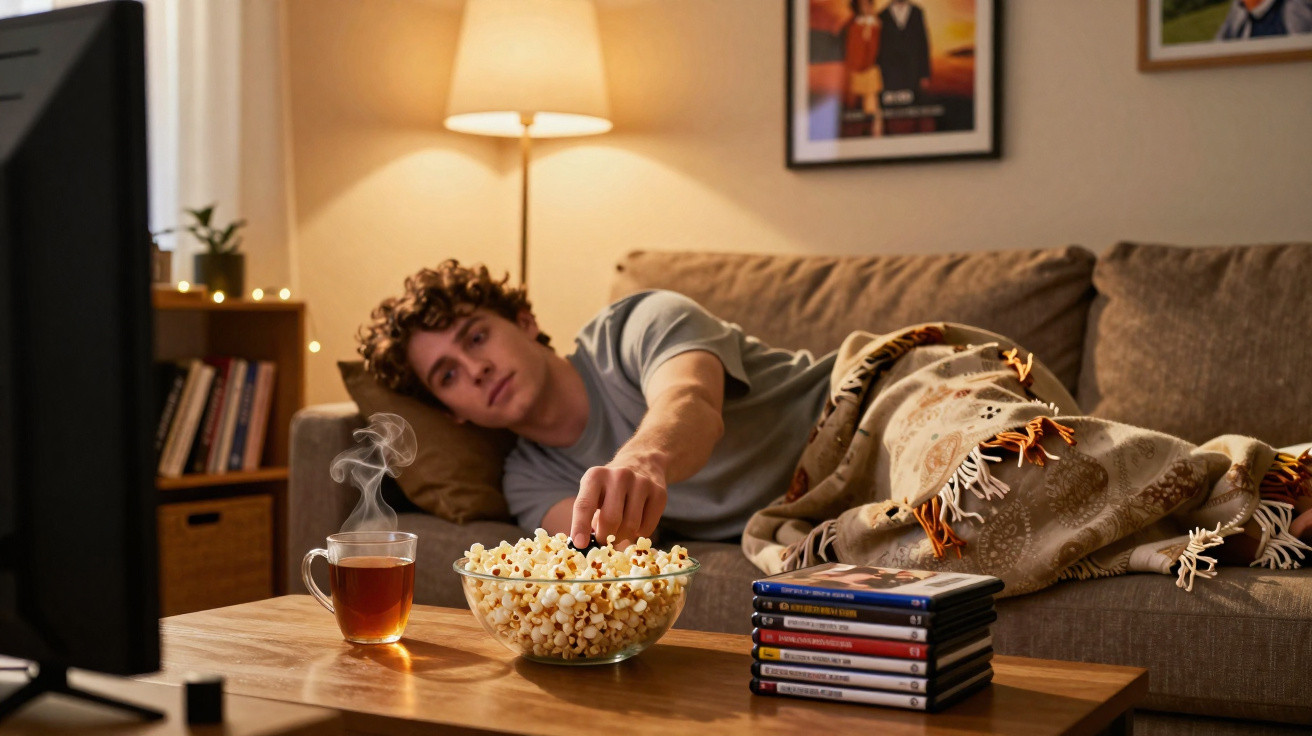
The other evening, after a day that had felt like a slow squeeze inside a lift, I opened three separate streaming apps, looked through their limitless thumbnails… then chose the film I have watched at least twelve times. The algorithm pushed glossy new releases at me, yet my thumb went straight to the familiar artwork as if it knew the route itself. Within ten minutes, I was nearly saying the dialogue along with it. None of the jokes were unexpected, the music held no surprises and the ending was guaranteed – but my shoulders began to loosen. My breath became slower. Something inside me eased.
Most of us have done it: stressed, exhausted or quietly coming undone, we return to the one film we always watch. It is the movie that feels like a blanket with no need to put it away afterwards. Friends make jokes about the habit and social media is full of it, yet psychologists say it is not laziness or a failure of imagination. It is more emotional than that, and oddly tender. Rewatching the same movie when life becomes overwhelming is one way the brain attempts to protect us – and the science behind it is far more personal than it may first appear.
The comfort of already knowing what happens
Ask psychologists about this behaviour and one term quickly comes up: predictability. Real life can be painfully uncertain – jobs disappear, relationships end and bills land like unwelcome messages. When it feels as though everything could fall apart without warning, following a story you already know from beginning to end becomes a small, quiet resistance. You press play, knowing that for the next two hours nothing in that world can take you by surprise.
Your nervous system appreciates that certainty. Psychologists explain that uncertainty can strongly trigger anxiety, as our brains are designed to look out for threats. A new series or film demands effort: unfamiliar faces, different rules and fresh emotional risks. A familiar movie offers the reverse. It allows your mind to move into a safer state, able to forecast the next scene, line and even musical cue, and that sense of certainty gradually lowers the volume on stress.
There is an additional, slightly unusual benefit: anticipation. You know that treasured moment is ahead – the reunion, the speech or the absurd dance in the rain. As it approaches, your body starts to release feel-good chemicals, rather like making your way towards a dessert you have already selected. A psychologist described this as “emotional pre-gaming”: comfort is not only available in the present; you are also drawing some happiness from what you know is coming next.
The emotional “safety net” of familiar stories
When everyday life feels unforgiving, fictional settings can act as places to practise emotion. You can experience powerful feelings – fear, loss, love and victory – inside a story that cannot harm you once the credits begin. This is where rewatching becomes especially valuable. By the second, fifth or tenth viewing, your body already understands which emotions are ahead, and that familiarity can make it feel unexpectedly safe to experience them properly.
Psychologists sometimes refer to this as “regulated exposure”. Rather than being caught out by your feelings during a work call or in a supermarket aisle, you make the choice to feel alongside the characters. You may cry as a couple finally separates or a hero loses a fight, but the experience has a secure boundary around it. The narrative carries you before letting you go at the end, and your mind may register, almost without you noticing: okay, we survived that. We can survive our own stuff too.
This helps explain why people revisit particular movies while dealing with break-ups or bereavement. Beneath the storyline, they may be looking for the experience of being understood: seeing their pain reflected back, but gentled through fiction. Sometimes we pick the movie that hurts in exactly the right way because real life hurt feels too raw to touch directly. The film provides a cushion, somewhere secure in which to “rehearse” sadness.
The nostalgia effect: borrowed memories, real comfort
Nostalgia adds another layer, and this part is particularly complicated and human. We first watched many of the films we replay during an entirely different period of life – in school holidays, during early romances or on lazy Saturday afternoons when picking snacks was the day’s biggest dilemma. Returning to them is not simply revisiting the plot; in a quiet way, it can mean trying to return to the person you were then.
Psychologists who research nostalgia say it functions rather like emotional glue. It connects separate stages of life, helping you feel more whole and less divided into fragments. That can be especially powerful when your current situation feels uncertain. One psychologist called it “borrowing stability from the past to steady yourself in the present”. The movie is simply the entrance; the feeling behind it is the real destination.
Smells, sounds and small ghosts of the past
Have you ever noticed how a particular soundtrack can transport you instantly to one specific year? Two seconds of a piano motif might put you back on an old sofa in your parents’ living room, with a faint scent of oven pizza and a sibling sighing beside you. These small sensory ghosts explain part of why rewatching feels so calming. A film becomes a time capsule that you can open whenever you choose.
Honestly, nobody switches on their “comfort film” in the hope of discovering new intellectual stimulation. You press play because you want to recover a remembered feeling: being younger, more protected and less complicated. Research has found that nostalgia can strengthen feelings of meaning and connection, even if your real circumstances remain exactly the same. Your bank balance may still look brutal and your inbox may still be overflowing, but for two hours you are also the person who once thought the world might be a little kinder.
Control, in a world where you have almost none
Control is another understated reason we hold on to familiar films in stressful periods. Much of adulthood involves acting as though we are in charge while privately recognising that we often are not. Rewatching a movie reverses that situation. Here, at least, you genuinely know what will happen next.
A therapist I spoke to said that some of her most anxious clients replay the same movie or series in high-pressure weeks, even when they are not watching closely. It plays in the background with the steadiness of a heartbeat. The characters repeat the same words, make identical errors and reach the same outcome every time. During a week when everything else resembles quicksand, such predictability can become an anchor.
The gentle power of low-stakes choices
There is also comfort in not needing to make another new decision. Choice may sound appealing until you have spent all day making them: replying to emails, balancing responsibilities, arranging meals and trying to work out which version of yourself others expect. By evening, the mind rarely wants to assess twenty unfamiliar programmes. It wants a simple, low-stakes choice, and an old favourite movie is the least risky item on offer.
Psychologists use the term “decision fatigue” for the way repeated decisions deplete mental energy. A rewatch counters that completely. You are not risking two hours on something that could bore, upset or consume your final reserve of energy. There is no gamble involved, and the reward is dependable comfort. This is not laziness; it is self-preservation dressed up as a movie night.
Why we fall for the same characters, over and over
Listen to people describe their favourite movies and they rarely begin with the plot. More often, they mention the characters: the somewhat chaotic friend, the quietly devoted sidekick or the imperfect lead whose repeated mistakes somehow resemble their own. With time, these characters can become very nearly emotional companions.
Some psychologists understand this through “parasocial relationship” – a one-sided connection to fictional people who cannot actually know you. It may sound bleak, but it is more nuanced than that. When life feels overwhelming, watching a beloved character face their own difficulties can offer profound reassurance. You may feel less alone in your own disorder, even when the person you identify with exists only on a screen.
There is a quieter question of identity, too. Every time you revisit a film, you pick up different things according to your stage of life. At 16, the rebellious romantic interest may be irresistible; at 35, you may suddenly understand the exhausted parent in the background. Rewatching gives you a way to check in with the person you have become. The film remains unchanged, making your own development visible in a strangely clear way.
The ritual: what your movie night is really saying
Consider your personal comfort-film routine and there is often a small ritual attached. The same place on the sofa. The same blanket. The same promise that you will “just watch the first half”. These details may appear insignificant, but rituals are psychologically powerful: they communicate to the brain, “We’re safe now. This is downtime.”
One clinical psychologist told me that she encourages especially anxious clients to create precisely these kinds of gentle rituals. They are not intended as avoidance, but as a route out of high alert. When your body is trapped in fight-or-flight mode, logic and problem-solving alone cannot get you out of it. You need something straightforward and physical that signals the threat has passed, at least for now. Watching the same film in the same way at the same time can become that message.
There is a subtle but meaningful distinction between numbing and soothing. Numbing means escaping regardless of the cost. Soothing means building a small area of safety that helps you return to life with more resources. Replaying the same movie throughout stressful weeks often sits between those two states. What matters is recognising whether it helps you breathe… or helps you avoid everything entirely.
When comfort turns into hiding
Psychologists are clear that there is nothing “wrong” with rewatching a favourite movie when you are stressed. It is among the kinder methods of self-soothing, and far healthier than certain alternatives. They do, however, offer one warning: if the rewatching becomes constant and automatic, it may indicate that you are more overwhelmed than you are prepared to acknowledge.
If you are zoning out to the same film on most evenings, barely following it and simply letting it pass over you, your brain may be raising a small white flag. The movie can become a barrier between you and thoughts that feel too large or painful to confront at 11pm. From the outside, the scene looks cosy. Internally, you may be quietly trying not to feel anything at all.
That is the point at which some honesty is useful. Are you pressing play because you want reassurance, or because silence frightens you? Do you feel truly soothed, or only temporarily less aware? Psychologists suggest making the credits a brief moment to check in with yourself. Once the film finishes, ask: do I feel a little more present in my life, or more eager to escape from it?
Why this small habit is more tender than it looks
Beneath the psychological language and brain scans, there is something unexpectedly gentle in our urge to rewatch the same movie when stressed. It is a deeply human compromise between what we would like to cope with and what we can actually manage. Perhaps we are not ready for unfamiliar heartbreak, risks or cliffhangers. Instead, we choose an old story that has already assured us: this ends okay. You know how to get through this one.
There is a quiet kindness towards yourself in making that decision. You are not insisting that a tired mind cope with new turns or weighty subjects. You are offering it a gentle place to settle, a narrative it can move through with half-closed eyes. Familiar dialogue can wash over you like a beloved song, not because you are trapped in the past, but because part of you is attempting – awkwardly and bravely – to feel safe enough to meet the present.
The next time you hover over a hundred new releases and your thumb returns to that same old movie, perhaps try not to judge yourself too severely. The choice may be revealing what you need: certainty, gentleness and proof that some stories reach a good ending. If you listen carefully, beneath the soundtrack and closing credits, there may be a small, reliable truth: your mind is not being lazy right now. It is trying to care for you in the only way it knows how.





Comments
No comments yet. Be the first to comment!
Leave a Comment