
The gym is about to close, the lights have been turned down halfway, and you are still short of breath after that final set of sprints.
You step into the chilly night air feeling energised, flick through your phone and feel strangely pleased with yourself. Yet when you get into bed later, your body is spent while your mind remains fully alert, replaying the session as though it were a highlights programme.
Elsewhere across town, somebody has just taken the dog for a slow trip around the block. There is no sweat, stopwatch or fitness-tracking app. They have a glass of water, do a little stretching in the kitchen, then fall asleep 15 minutes after their head reaches the pillow.
It is the same time of day and two different forms of movement, but the nights that follow are completely different. Oddly, it is the second person who wakes up feeling more refreshed.
Why lighter movement calms a wired brain
Consider how you genuinely feel after a demanding evening workout. Your heart is racing, your muscles are flickering and there is a persistent hum beneath your skin. That feeling does not simply disappear when you shut your front door. Your nervous system remains on high alert, as if it has not yet understood that the threat has passed.
Light exercise has the reverse effect. An easy walk, gentle cycling or a yoga flow that does not become a cardio session all tell your body, “We’re safe, we’re winding down.” You move sufficiently to relieve the day’s tension, but not enough to trigger your internal alarm.
In other words, you are gently guiding your sleep system rather than forcing it.
The figures make the trend clearer still. Several sleep laboratories have found that people who complete vigorous evening workouts take longer to get to sleep and wake more often overnight, particularly when their session finishes less than an hour before bed. Their core temperature remains elevated, their resting heart rate stays higher and the first sleep cycles lose some deep sleep.
Those who do light activity later in the day, such as 30 minutes of slow walking or relaxed stretching, commonly show the opposite pattern. Their heart rate gradually declines, cortisol levels slowly drop and the body cools enough for sleep pressure to take hold. They are more likely to describe themselves as “sleepy-tired” rather than “wired-tired”.
A study of office workers revealed something almost frustratingly straightforward: participants who replaced a late HIIT workout with a short post-dinner walk said they fell asleep around 15 minutes sooner on average, and reported fewer complaints of a “mind racing”. Sometimes the unexciting solution genuinely does work.
There is nothing mystical about the reasoning. Hard exercise activates the fight-or-flight system through adrenaline, noradrenaline and raised cortisol. That is excellent at 7am, when you want to feel awake and active. Later in the day, though, it conflicts with what your brain is quietly attempting to do: turn down the lights within your body.
Light exercise still produces endorphins, but it does not stamp on the accelerator. It can help clear workday stress hormones while giving your brain a steady pattern: one step after another, one breath after another. For your nervous system, that rhythm acts like background music, easing it down several levels.
Temperature matters too. Intense sessions raise core body temperature, and it can take hours for it to fall fully. Sleep favours a cooler core temperature. With gentle evening movement, your body can continue along its natural night-time cooling curve instead of battling a post-exercise heat surge.
How to move in the evening without wrecking your night
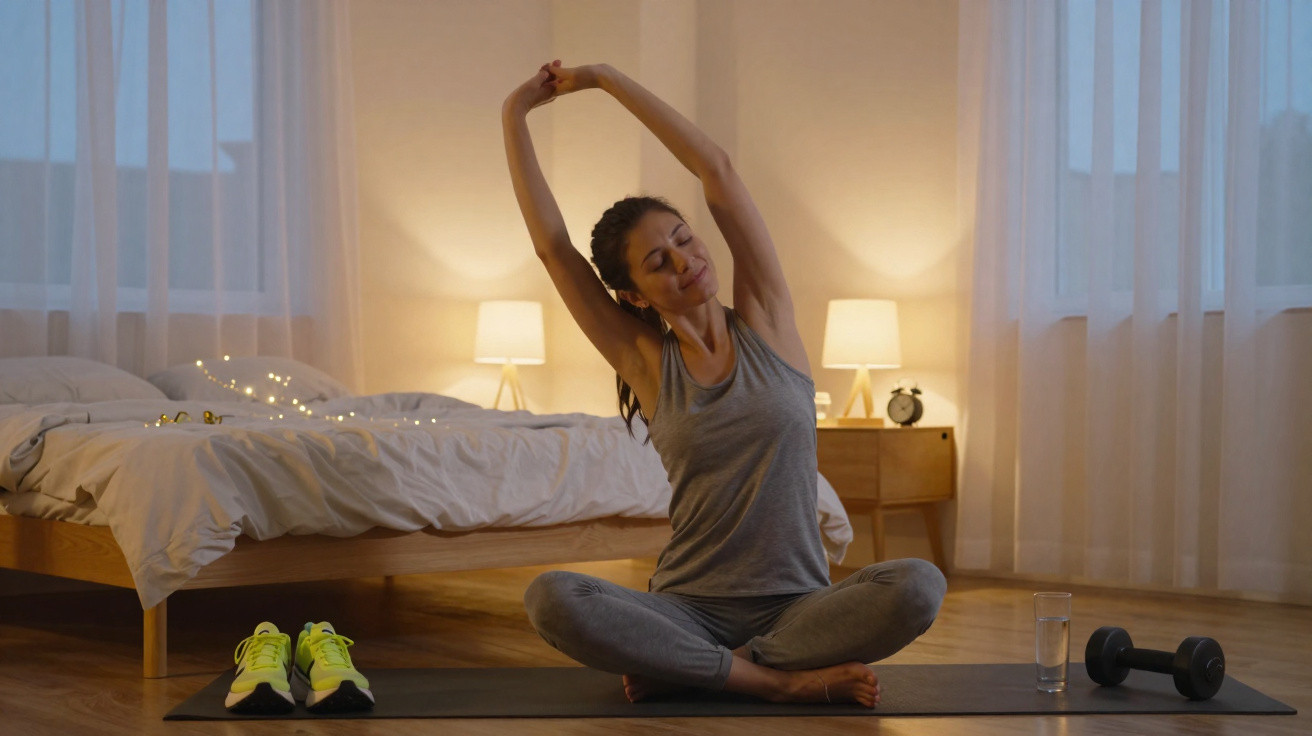
A useful guideline for many people is to keep late movement at a “conversation pace”. If you can speak in full sentences without struggling for breath, you are probably in the right range. That could mean a leisurely walk around your neighbourhood, mellow yoga or light mobility exercises on the sitting-room floor.
Timing is important as well. Allowing a two- to three-hour window between any tougher workout and bedtime lets your system settle again. If evening training is your only option, aim to complete the intense section earlier and use the final part of the night for gentler, more relaxed movement.
Treat it as an internal dimmer switch, not an on-off control.
On a dreary Tuesday evening in Manchester, a software developer called Hannah tried this unintentionally. She had been attending 8pm spin classes, only to lie awake at midnight, scrolling through sleep advice she was not actually following. Then, one evening, her train was delayed and she missed the class, so she walked home from the station instead.
She listened to a podcast, strolled at an unhurried pace for 25 minutes and stretched for five minutes in her hallway. There was no sweat angel on the floor and no “beast mode” selfie. She was asleep by 10:45pm and woke before her alarm, puzzled but rested.
After repeating that accidental routine for a week, her wearable recorded fewer disturbances during the night and a longer period of deep sleep. The intensity setting was the only thing she had really altered.
At first glance, this may seem contradictory: surely you have to “tire yourself out” to sleep properly? Many of us absorbed that idea through school sport and diet culture. We imagine sleep as a prize for reaching complete exhaustion. The body does not quite operate that way.
Sleep depends more on rhythm and safety than on fatigue alone. When your brain detects exertion and speed-heavy breathing, a pounding heart and bright lighting in a busy gym-it subconsciously notes that this is “not ideal moment to fully switch off”. Light, repetitive movement conveys almost the opposite message: familiar, safe and manageable.
Your body doesn’t just count effort; it interprets it. Light evening exercise can help you clear the day’s mental inbox without signalling to your brain that there is a crisis to handle. That is often where deeper, more consistent sleep develops.
Building an evening routine that actually helps you sleep
Begin with something small and almost surprisingly gentle. Choose one light activity you could do nearly automatically: a 20-minute walk after dinner, five minutes of hip and back stretches while the kettle boils, or ten slow lengths in a quiet swimming pool. The important thing is that it feels easy enough to do even when you are tired and grumpy.
Attach it to something you already do. Take your walk straight after washing up. Stretch while watching the beginning of a programme. Complete a brief yoga flow after brushing your teeth. You are teaching your brain: “This kind of movement means we’re heading for sleep soon.” Repetition strengthens that connection.
Think ritual rather than workout.
We have all watched videos depicting the perfect evening routine: herbal tea, journalling, ambient lighting, no screens, 30 minutes of yoga and eight hours of deep sleep. Let’s be honest: nobody really does that every single day. Life is untidy; children wake up, late emails come in and trains are delayed.
Instead, target “better” rather than perfect. If you have had a stressful day and feel inclined to smash out a workout at 9pm, stop and conduct a quick internal check: are you wired, or genuinely energised? If you are wired, swap the sprints for walking, stretching or very light strength work with lengthy rests.
A frequent mistake is making light exercise into a covert contest: trying to close activity rings, reach a step target or beat yesterday’s total. The more you pursue numbers at night, the more you push your nervous system into performance mode rather than sleep mode.
“The body is listening every evening,” says one sleep specialist I spoke to. “You’re telling it a story with your habits: either ‘We’re still in the race’ or ‘The race is over, we’re safe now.’ Light exercise, done calmly, tells the second story far more clearly.”
To make this practical, use a straightforward checklist on evenings when you want to sleep better:
- Select movement that keeps your breathing smooth and easy.
- Finish at least an hour before bed, then move on to quiet activities with minimal screen exposure.
- Use warm, dim lighting during and after your light session.
- Avoid heavy late-night snacks, which do not pair well with gentle exercise.
- Pay attention to how you feel when you lie down: wired-tired or truly sleepy?
We have all experienced the moment when we promise ourselves a punishing workout will “knock us out”, only to find ourselves doomscrolling with sore legs. Those evenings are not failures; they are feedback. Your body is quietly telling you: “I liked the movement. Just not like that, not that late.”
The quiet power of doing a bit less
The curious thing is that light evening movement can feel “not worth it” precisely because it is so effective. There is no dramatic rush, drenched T-shirt or feeling that you have conquered anything. It is understated. Your shoulders relax, your jaw releases and you notice that you are blinking more slowly than before.
That understated quality is exactly the point. Sleep responds well to quiet signals repeated over time. A short, easy circuit of the block may not make an impressive fitness post, but it could be the one thing that changes how you feel at 3am while staring at the ceiling. It is not glamorous; it is simply highly practical.
And light does not mean lazy. It means purposeful. It means you stop treating your body as a machine that can be battered into submission at any hour, then criticised when its software crashes. You are working with the system instead of against it, especially during that vulnerable period between dinner and bed.
This becomes especially relevant for anyone concerned with performance, mood or simply avoiding snapping at people the next morning. Improved sleep from lighter evening exercise does not only benefit your nights. It carries into your mornings, your work and how much you enjoy genuinely intense workouts when you do them at a more suitable time of day.
So the quiet question beneath all of this is straightforward: what if doing a little less, a little later, gave you more of what you had been seeking all along-real rest, real energy and a body that is not constantly negotiating with itself simply to fall asleep?
| Key point | Detail | Benefit for the reader |
|---|---|---|
| Moderate intensity in the evening | Prioritise walking, gentle yoga and mobility work at a “conversation” pace. | Improves sleep onset and reduces the feeling of having an “overheated brain”. |
| Timing of exertion | Leave 2–3 hours between intense exercise and bedtime. | Lowers heart rate and body temperature before the night. |
| Ritual rather than performance | Repeat small, easy routines linked to everyday actions. | Creates a stable association between light movement and the urge to sleep. |
FAQ:
- Can I ever do intense workouts in the evening and still sleep well? Yes, some people tolerate it fine, especially if sessions end at least three hours before bed and are followed by a slow, calm wind-down routine.
- Is walking really enough to improve my sleep? For many, yes: 20–30 minutes of relaxed walking in the evening can ease stress, lower cortisol and gently cue the body towards rest.
- What if I only have time to train after 8pm? Try keeping those late sessions shorter and lighter on intensity, and save your hardest training for days when you can move it earlier.
- Does light yoga count as exercise for sleep benefits? Absolutely, as long as it stays gentle and breath-focused rather than turning into a fast-paced power workout.
- How quickly will I notice a difference if I change my routine? Some people notice better sleep within a few nights, others over a couple of weeks; tracking how you feel can help you see the pattern.






Comments
No comments yet. Be the first to comment!
Leave a Comment