

With advancing age may come wisdom – along with what appears to be some corroding plumbing in the brain.
A growing body of evidence indicates that the lymphatic system serving the central nervous system may become slower at draining fluid from the head as people get older.
The explanation could be found in the neck.
A systematic review of 96 peer-reviewed studies has now identified shrinking lymph nodes in the neck as a consistent characteristic of ageing.
What this decline means for the brain remains uncertain. Elsewhere in the body, however, an ageing lymphatic system has been associated with poorer wound healing and weakened immune defences.
If lymphatic flow through the neck decelerates with age, might waste, fluid, or pathogens accumulate in or around the brain?
Researchers are now exploring whether cervical lymph nodes could act as 'bins for the brain'.
"What struck me most was how consistently the evidence pointed beyond the brain itself," neuroscientist Onder Albayram, who studies the aging brain at the Medical University of South Carolina, told ScienceAlert.
"That changed the way I think about brain aging. I increasingly see impaired clearance not simply as a local defect inside the brain, but potentially as a progressive loss of communication between the brain and its peripheral drainage infrastructure."
The review findings appear in Neurobiology of Aging.
Cervical lymph nodes and the brain's drainage system
Deep cervical lymph nodes are immune organs located in the neck and head. They receive and filter lymphatic fluid, capturing pathogens as well as aged or abnormal cells.
The body has about 800 lymph nodes in total, with 300 located in the cervical region alone.
That substantial number suggests an important function, yet scientists had until recently believed that cervical nodes handled only peripheral lymphatic fluid.
"The cervical lymph nodes are not simply passive collection sites; they are also immunological organs."
– Neuroscientist Onder Albayram
That view shifted dramatically in 2015, when scientists studying mice found a previously unseen lymphatic system concealed in the meninges, the membranes covering the brain.
Two years afterwards, researchers obtained the first evidence for a comparable lymphatic network in the meninges of the human brain.
Research into the meninges and their lymphatic vessels has expanded rapidly since then. New studies suggest that these vessels drain to lymph nodes in the neck, while also transporting some cerebrospinal fluid from the brain.
This fluid reaches the brain's deepest regions, exchanging waste products and immune signals with fluid between neurons. Known as the 'glymphatic system', this process was only linked to the meningeal lymphatic system within the past decade, when scientists realised that some cerebrospinal fluid enters it too.
That previously hidden connection may alter our fundamental understanding of neurological disease.
"For many years, investigators focused on how waste moves through the brain but less on what happens after that material reaches the brain's borders," Albayram explained to ScienceAlert.
"Yet drainage has to have an endpoint. The cervical lymph nodes are not simply passive collection sites; they are also immunological organs receiving central nervous system-derived molecules and immune signals."
Albayram says glymphatic transport, meningeal lymphatics, and cervical lymph nodes should now be viewed as "components of one connected clearance pathway."
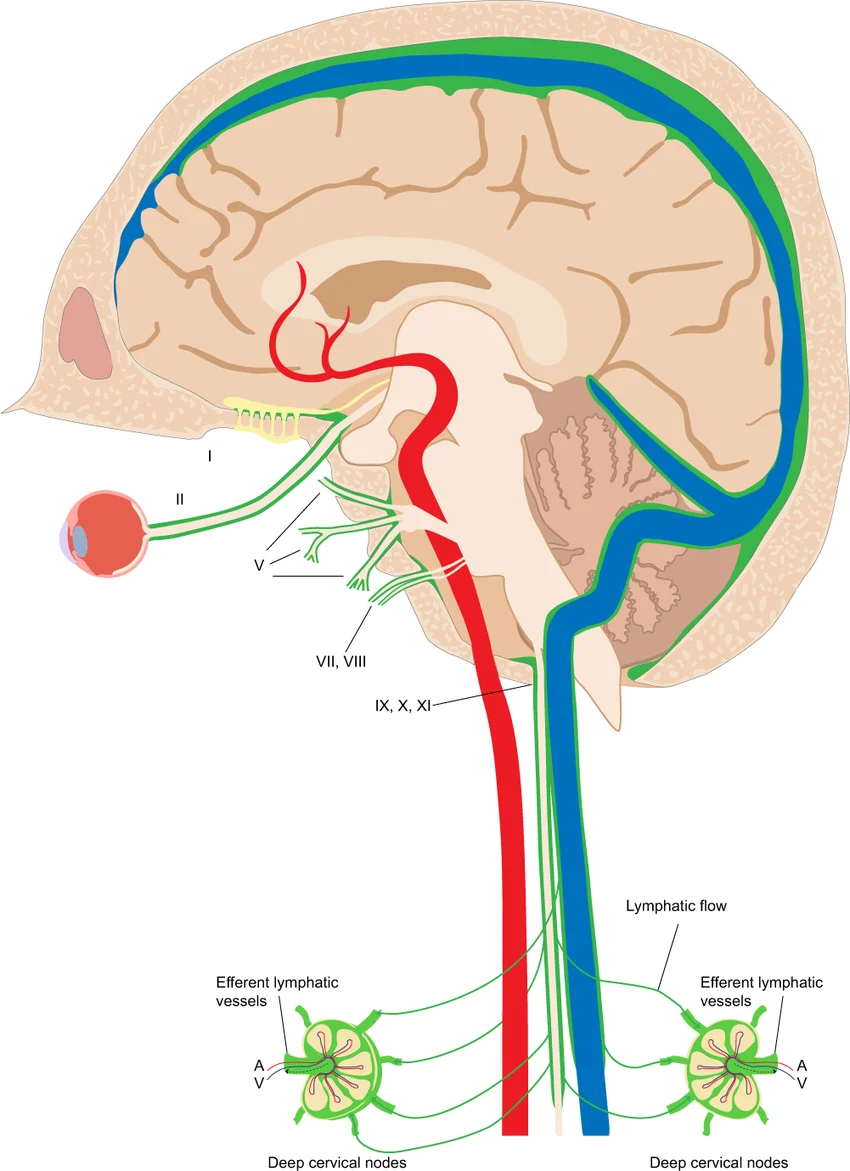
The lymphatic system within the brain's meninges. (Albayram et al., Nature Comms. , 2022)
Growing evidence indicates that lymphatic drainage from the brain's meninges may have an important part in neurological diseases including Alzheimer's and Parkinson's.
Should long-term clinical trials take place, deep neck lymph nodes could eventually provide warning indicators that the brain's drainage system is failing.
"I think this is one of the most exciting translational possibilities, although we are not yet at the point where cervical lymph-node measurements can be considered a clinical biomarker," Albayram told ScienceAlert.
"More recent work has shown that central nervous system-associated proteins, including amyloid-beta and phosphorylated tau, can be detected and in some cases strongly enriched in cervical lymph nodes."
For example, researchers in a 2025 study sampled neck lymph nodes from 25 participants with autoimmune neurological diseases.
"We found high levels of proteins that usually define Alzheimer's disease in lymph node samples from younger people," explained lead author and clinician-scientist Adam Al-Diwani of Oxford University.
"This supported the hypothesis that the lymph nodes act as a drainage basin from the brain. We then saw that this reduced in older people, suggesting that this was less effective with age… We see this as evidence that the cervical lymph nodes are acting as 'bins for the brain'."
Ageing lymph nodes, glymphatic drainage and disease
According to Albayram, the next stage is longitudinal research in humans. Without it, scientists cannot determine whether neck lymph nodes help cause disease, react to it, or merely change alongside ageing.
So far, research into the brain's lymphatic system has largely centred on animal models and high-resolution imaging of living people.
MRI studies have shown that people over 50 tend to have smaller cervical lymph nodes and thicker lymphatic channels than younger people.
Glymphatic drainage likewise appears to become slower with age.
More clinical work is needed to establish whether these observations are related, although the evidence from animals is encouraging.
In preclinical studies, scientists have shown that deliberately slowing meningeal lymphatics in mice causes a greater build-up of toxic, disease-associated by-products in the brain.
Furthermore, early evidence from rodents indicates that enhancing the activity of lymphatics that drain the brain could improve recovery after stroke, or even enhance memory.
Related: In a First, Chronic Fatigue Syndrome Linked to The Brain's Clearing System
Encouraged by these findings, teams at Yale University and the Monash Institute of Pharmaceutical Sciences are already developing non-invasive devices intended to pump the lymphatic vessels in the neck more efficiently.
Other research groups are attempting to use carbon dioxide to stimulate the brain's drainage system, with the aim of improving treatment for conditions such as Parkinson's.
Why more evidence is needed
Even so, it is vital not to move beyond the evidence. The brain's lymphatic network has only been transforming neuroscience for a decade.
Results seen in mice may not be replicated in clinical trials.

Although imaging technology has given scientists a broader view of the brain's drainage system than ever, sceptics have cautioned that certain MRI signals may be mistaken for lymphatic tissue.
"I would like to see the field move from describing individual lymphatic structures toward measuring the entire brain-to-neck clearance circuit in living humans," Albayram told ScienceAlert.
"Ultimately, I hope we can determine whether lymphatic dysfunction is simply a consequence of brain aging or whether it is one of the processes that helps set the pace of brain aging."
If the second possibility proves correct, an important component of brain ageing could be reached through the neck, potentially making imaging and therapeutic interventions easier.
The brain's drainage system may be elusive, but by 'going with the flow', scientists may be able to identify its bottleneck.
The review is published in Neurobiology of Aging.
This article was fact-checked and edited by Rebecca Dyer. While we pride ourselves on our process, we are only human. If you spot a mistake, please let us know.






Comments
No comments yet. Be the first to comment!
Leave a Comment