
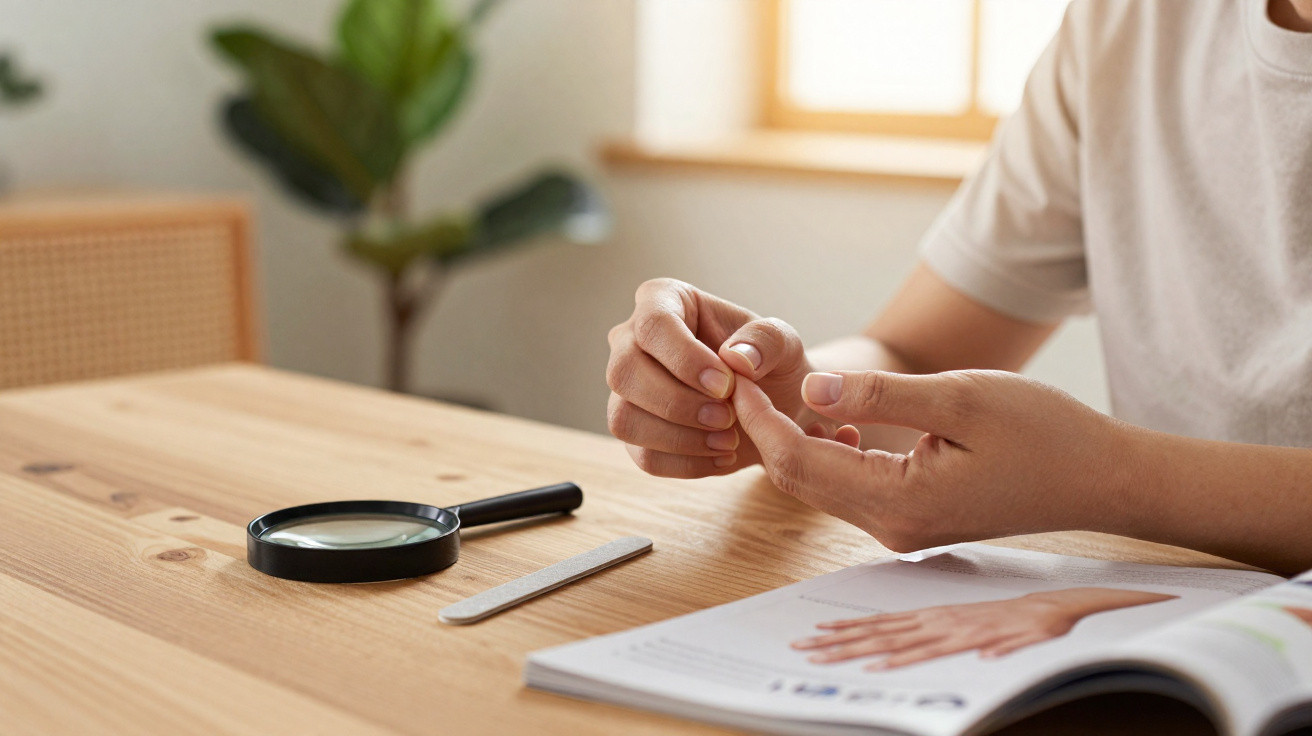
While studying medicine, nails were one aspect of anatomy that I found particularly difficult. At first, I struggled to cope with the sight of painful injuries involving nails.
Perhaps this squeamishness began when I saw somebody yank a plaster from a stubbed big toe and remove the entire toenail with it. Ouch. I have since got over it, fortunately, because nails can reveal a great deal to doctors about a patient's health.
Like hair, fingernails and toenails are extensions of the skin. Made from keratin, a strong substance, they grow towards the tip of the finger or toe to form a hard plate. The cuticle - the band of skin covering where the skin and nail meet - provides further protection from injury and infection.
Pay attention to alterations in your nails' texture or appearance, as these may offer significant information about your health. These are some of the main signs to watch for.
Spoon-shaped nails
Healthy fingernails and toenails usually have a gently convex curve, with no hollows or indentations. Koilonychia, by comparison, describes nails that curve inwards. In certain cases, the central hollow is deep enough to contain a drop of liquid, much like medicine in a spoon - hence the familiar term "spoon nails". Nails with this condition often appear thinner and may also become more fragile.
Koilonychia may be a sign of anaemia, in which too few red blood cells are circulating to transport oxygen to the body's tissues. It is linked with iron deficiency. Poor diet, coeliac disease and cancer of the gastrointestinal tract can, for example, cause low iron levels.
Mechanics and hairdressers may face a greater risk of koilonychia through working with petroleum-based solvents in engine oils and perming products. Yet spoon-shaped nails have a long list of possible causes, so you should speak to your doctor if the condition persists.
Discoloured nails
Under normal circumstances, nail beds - the skin beneath the nails - should be a well-perfused pink. Illness or infection can discolour either the nail bed or the entire nail. Yellow nails, for example, may point to a fungal infection or changes caused by a skin condition such as psoriasis.
Leukonychia is the medical name for white discolouration of the nails, and it can appear in several different ways.
Sometimes, white marks on the nails may signal poisoning from heavy metals such as lead or arsenic. Both continue to cause problems in many countries around the world because of water-system pollution.
When whiteness covers the whole nail and affects several nails, a lack of protein in the circulation is a more likely explanation. This may potentially suggest liver or kidney disease.
Small white spots, however, are most likely to result from some kind of trauma. This could range from stubbing a toe or dropping a heavy object on it to trapping a finger in a door. Nail biting and overly vigorous manicures can also damage the nails.
If you have ever stubbed a toe or trapped a finger, you may have seen the nail turn dark purple, blue or red afterwards. This is known as a subungual haematoma: blood collecting between the nail and nail bed following an injury. Although these generally resolve over time, they can lead to infection or cause the nail to separate from its bed.
Emergency nail tests
In a medical emergency, doctors commonly inspect a patient's nails to assess blood oxygen saturation. They use a pulse oximeter, which is attached to a finger and shines light through the fingertip before measuring how much blood passes through it. This indicates the amount of oxygen entering the bloodstream and, in turn, how effectively the heart and lungs are functioning.
The capillary refill time (CRT) test provides another measure of how well circulation is working. A clinician presses a nail or fingertip for five seconds, causing the skin underneath to blanch.
Once the pressure is released, the skin should regain its usual colour within two seconds. If it takes longer, you may be dehydrated or cold, or have poor peripheral perfusion. This means either that the heart is not pumping strongly enough or that something is preventing sufficient blood from reaching the most distant parts of the body, potentially because of shock.
Pressing on the nails can also be used when assessing a drowsy or unconscious patient. This examination is part of the Glasgow Coma Scale, which assesses responsiveness and the degree of impaired consciousness in patients.
What to do if you notice something unusual
There are numerous nail problems beyond those described here, including nails that crumble, have pits or lines, are clubbed or swollen, or show red marks underneath. The possible diagnoses are equally wide-ranging, from minor conditions to serious illnesses.
If you are concerned about nail discolouration or a change in the shape of your nails, have them examined by your GP. The same applies to serious nail injuries, particularly if the nail has been pulled off. When the skin beneath a nail is injured, proper care is essential to avoid complications such as infection and to identify other injuries, including a broken bone.
Finally, artificial or painted nails can conceal visible changes. Take care not to gloss over your nails, and pay attention to what they may be indicating about your health.
Dan Baumgardt, Senior Lecturer, School of Physiology, Pharmacology and Neuroscience, University of Bristol
This article is republished from The Conversation under a Creative Commons licence. Read the original article.





Comments
No comments yet. Be the first to comment!
Leave a Comment