
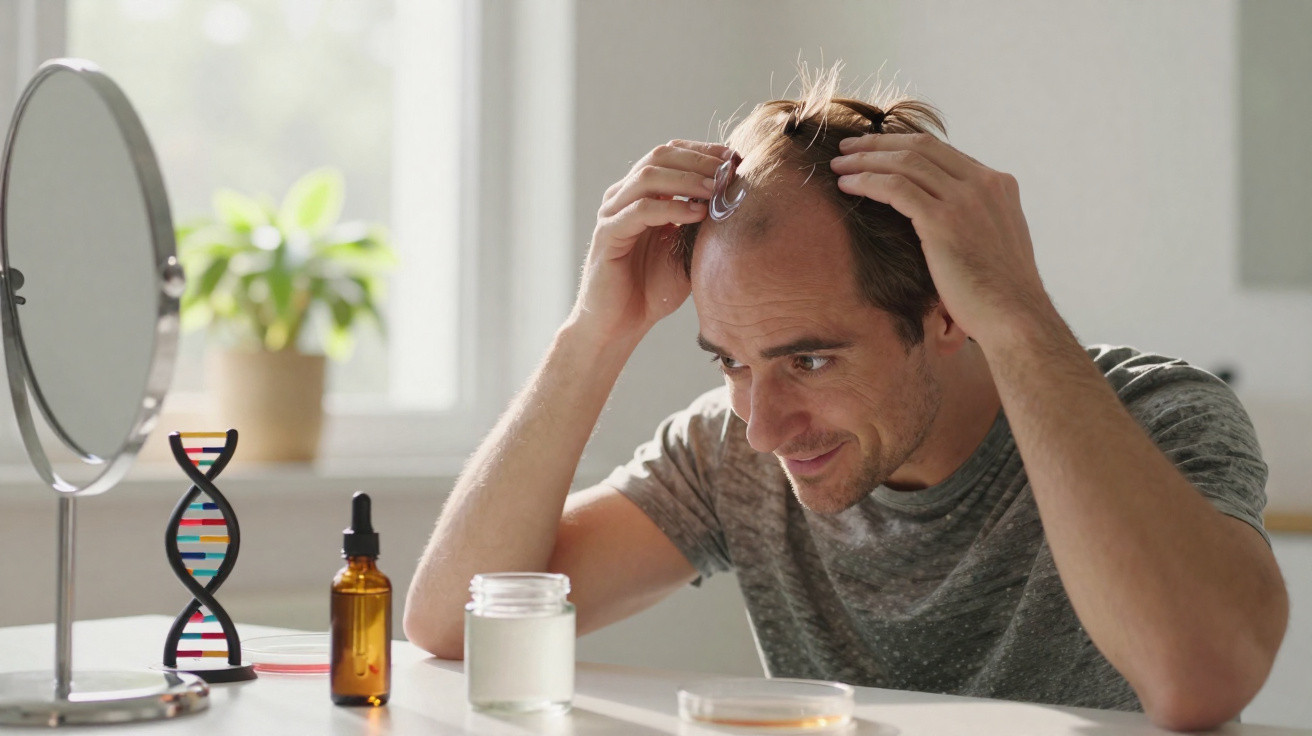
In 2024, researchers identified a possible new therapy for hereditary-patterned baldness, the leading cause of hair loss among men and women around the world.
The discovery emerged from work involving a sugar produced naturally by the body, which helps to make up DNA: the ‘deoxyribose’ component of deoxyribonucleic acid.
While investigating how these sugars could aid wound healing in mice when applied to the skin, scientists from the University of Sheffield and COMSATS University in Pakistan observed that fur surrounding the wounds returned more quickly than it did in untreated animals.
That unexpected finding prompted the researchers to examine the effect in more detail.
Deoxyribose gel and hair loss research
For a study released in June 2024, the team used male mice with testosterone-driven hair loss and shaved the fur from their backs. Researchers applied a small amount of deoxyribose sugar gel to the bare skin every day. Within a few weeks, the treated area displayed ‘robust’ regrowth, producing long, thick individual hairs.
The team found that the deoxyribose gel performed as effectively as minoxidil, a topical hair-loss treatment widely recognised under the brand name Rogaine.
"Our research suggests that the answer to treating hair loss might be as simple as using a naturally occurring deoxyribose sugar to boost the blood supply to the hair follicles to encourage hair growth," said tissue engineer Sheila MacNeil from the University of Sheffield.
Hereditary-patterned baldness, also called androgenic alopecia, is a natural condition influenced by genetics, hormone levels and ageing. It affects males and females in different ways.
The condition affects up to 40 percent of people, yet the US Food and Drug Administration (FDA) has so far authorised only two medicines for its treatment.
Current androgenetic alopecia treatments
Over-the-counter minoxidil may slow hair loss and encourage some regrowth, although it does not work for everyone affected by hair loss.
Where minoxidil does not work, male patients may use finasteride, sold under the brand name Propecia. This prescription oral medicine blocks the conversion of testosterone into dihydrotestosterone, but it has not yet been approved for female patients.
Finasteride can reduce hair loss in around 80 to 90 percent of male patients. However, once treatment begins, it must be taken continually. The medicine may also be linked to unwanted and, in some cases, serious side effects, including erectile dysfunction, testicular or breast pain, lower libido and depression.
"The treatment of androgenetic alopecia remains challenging," MacNeil and her colleagues, led by biomaterial researcher Muhammad Anjum from COMSATS, write in their published paper.
The researchers created a biodegradable, non-toxic deoxyribose gel and used it on mouse models of male-pattern baldness.
They also tested minoxidil on balding mouse models, while some animals were given both the sugar gel and minoxidil.
Compared with mice treated using a gel containing no medicine, those given a gel containing deoxyribose sugar began developing new hair follicles.
In mice with male pattern baldness, both minoxidil and the sugar gel produced 80 to 90 percent hair regrowth. Using the two treatments together, however, made little additional difference.
Photographs taken at several points during the 20-day trial clearly show the outcome.
What the mouse trial found
The scientists do not yet know why deoxyribose gel encourages longer, thicker hair growth in mice. However, they observed more blood vessels and skin cells around the treated area.
"The better the blood supply to the hair bulb, the larger its diameter and the more hair growth," the researchers write.
Should deoxyribose gel prove effective in people as well, it could potentially treat alopecia or promote regrowth of hair, eyelashes and eyebrows after chemotherapy.
"This is a badly under-researched area, and hence new approaches are needed," write the authors.
The experiments so far involved male mice only. Further studies could determine whether these natural sugars are also effective in female mice with testosterone-driven alopecia.
"The research we have done is very much early stage," said MacNeil, "but the results are promising and warrant further investigation."
The study appeared in Frontiers in Pharmacology.
An earlier version of this article was first published in July 2024.






Comments
No comments yet. Be the first to comment!
Leave a Comment