
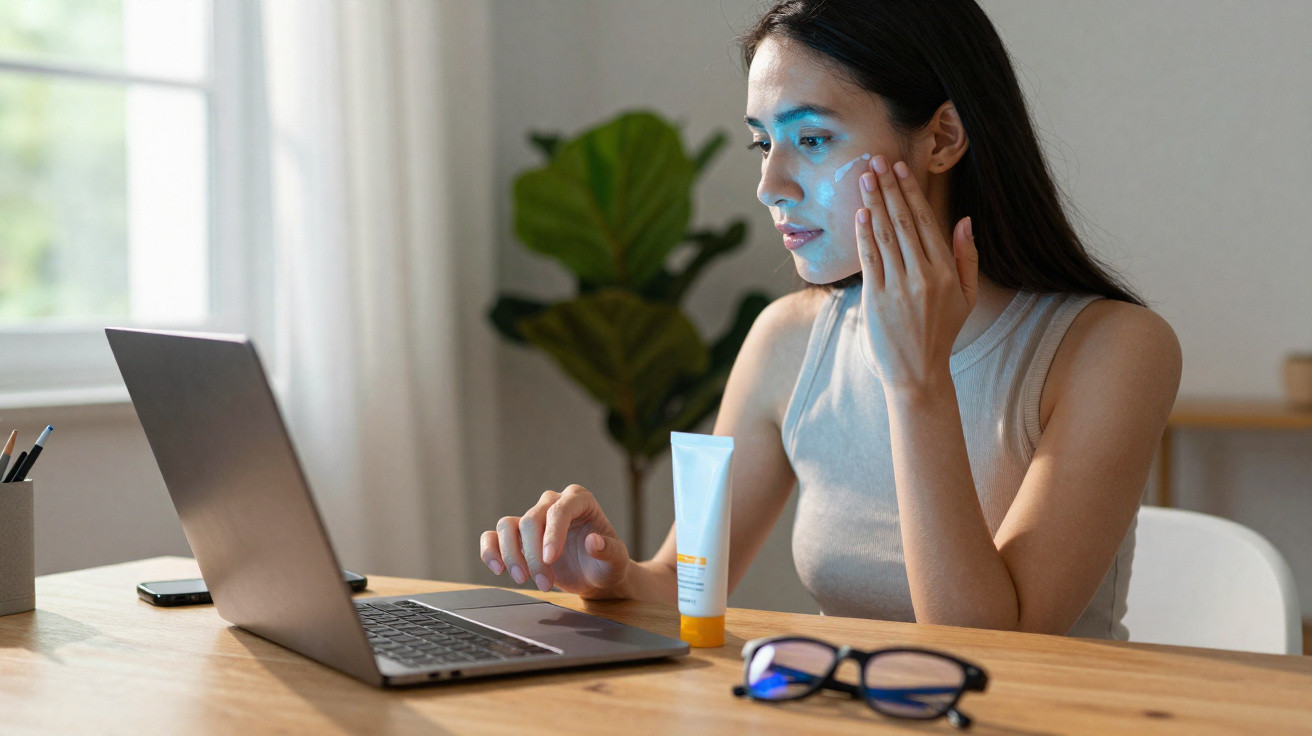
Social media is packed with assertions that ordinary daily behaviours can damage your skin. It is equally packed with product recommendations and adverts claiming to protect it.
Blue light from our devices has now become social media’s latest target.
But can spending time scrolling on a phone genuinely harm your skin? And could creams or lotions make a difference?
This is what the evidence currently indicates, and where our attention should really lie.
What exactly is blue light?
Blue light forms part of the visible light spectrum. The sun is by far its most powerful source. Electronic screens, including those on phones, laptops and televisions, emit blue light too, though at concentrations 100–1,000 times lower.
Because we spend so much of our time on these devices, concerns have been raised about how blue light may affect our health, including our sleep and eyes.
Researchers are now also gaining a clearer understanding of its effects on the skin.
How does blue light affect the skin?
Research into blue light’s effects on skin is still developing, although several findings are noteworthy.
1. Blue light can increase pigmentation
Research indicates that blue-light exposure may trigger the production of melanin, the natural pigment responsible for skin colour.
Excessive blue light could therefore potentially aggravate hyperpigmentation - an overproduction of melanin that causes dark patches on the skin - particularly among people with darker skin.
2. Blue light can give you wrinkles
Some studies suggest blue light could harm collagen, a protein crucial to the structure of skin, and may therefore speed up wrinkle development.
One laboratory study found that this may occur after holding a device just one centimetre from the skin for as little as an hour.
For most people, though, keeping a device more than 10 cm from the skin cuts exposure by 100-fold. This makes a meaningful effect far less likely.
3. Blue light can disrupt your sleep, affecting your skin
When the skin around your eyes appears puffy or dull, it can be tempting to blame blue light itself. Yet because blue light is known to affect sleep, these are more likely to be visible consequences of sleep deprivation.
Blue light is particularly effective at suppressing melatonin production. This naturally occurring hormone tells the body when it is time to sleep and helps control the sleep-wake cycle.
When blue-light exposure occurs before bedtime, suppressing melatonin interferes with this normal process. It can make falling asleep more difficult and may reduce sleep quality.
The stimulating content we view on screens can disrupt sleep further. Social media feeds, news stories, video games and even work emails may keep the brain alert and active, making it harder to move into a sleeping state.
Persistent sleep difficulties may also exacerbate existing skin conditions, including acne, eczema and rosacea.
Sleep deprivation can raise levels of cortisol, a stress hormone that breaks down collagen, the protein that gives skin its firmness. Too little sleep may also compromise the skin’s natural barrier, leaving it more vulnerable to dryness and environmental damage.
Can skincare protect me?
The beauty industry has seized on worries about blue light, with protective products such as mists, serums and lip glosses now available.
In practical terms, blue light from devices is probably only a concern for people with the more difficult form of hyperpigmentation called melasma.
With this condition, skin needs continuous protection from all visible light. Products that completely block light - mineral-based sunscreens and certain cosmetics - are the only fully effective options. If you cannot see the skin through the product, it will be effective.
However, non-opaque products have not been rigorously tested outside laboratory settings. As a result, it is difficult to establish whether they work or are worth including in a skincare routine.
What can I do to minimise blue light then?
These straightforward measures can reduce your exposure to blue light, especially in the evening, when it may interfere with sleep:
- use the "night mode" setting on your device, or a blue-light filter app, to reduce blue-light exposure in the evening
- limit screen use before going to bed and establish a calming bedtime routine to avoid the kinds of sleep disruption that may affect skin health
- keep your phone or other device away from your skin to reduce blue-light exposure
- use sunscreen. Mineral and physical sunscreens containing titanium dioxide and iron oxides provide broad protection, including against blue light.
In a nutshell
Blue-light exposure has been associated with certain skin issues, most notably pigmentation in people with darker skin. However, research is still under way.
Although skincare designed to protect against blue light appears promising, further testing is required to establish whether it is effective.
For the moment, make good sun protection a priority by using a broad-spectrum sunscreen, which protects not only against UV but also against light.
Michael Freeman, Associate Professor of Dermatology, Bond University
This article is republished from The Conversation under a Creative Commons licence. Read the original article.






Comments
No comments yet. Be the first to comment!
Leave a Comment