
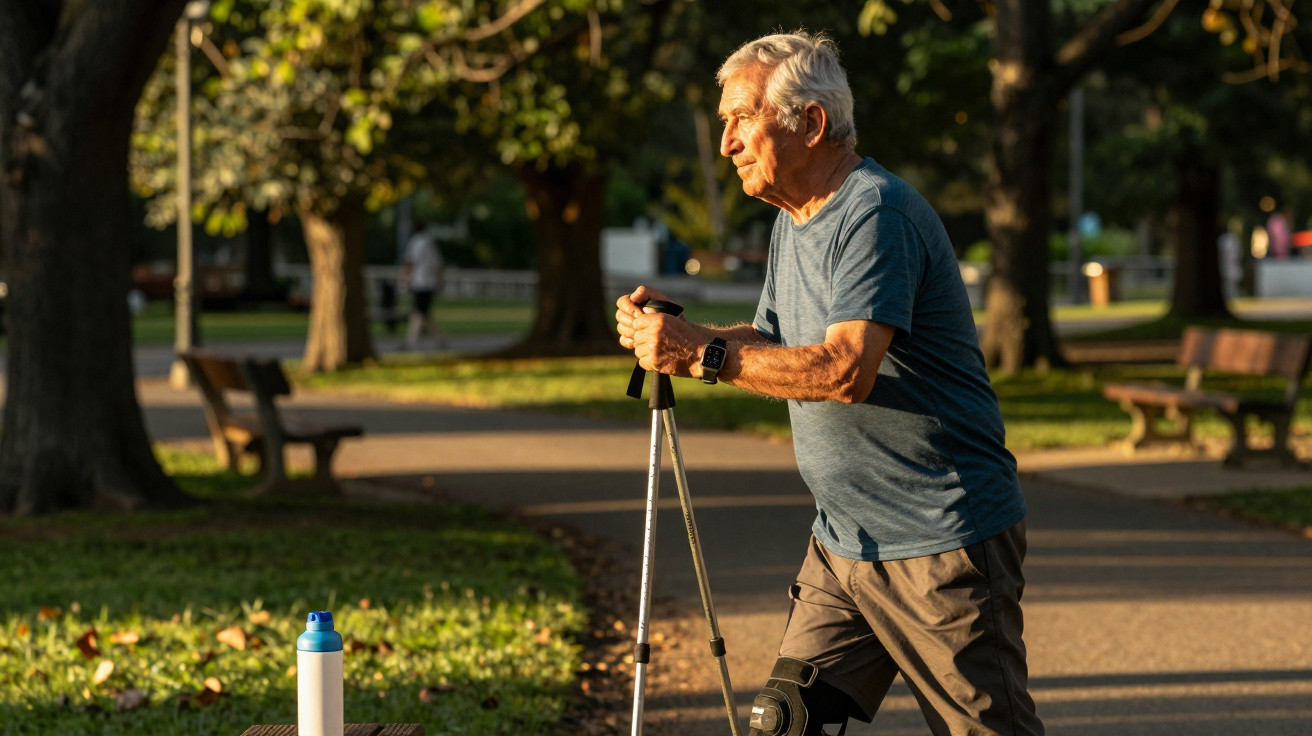
No treadmills thundering away. No water splashing. Instead, a group of people moved in a slow, deliberate circle, almost as though each held the same delicate truth: their knees were painful. Some had substantial braces on, while others massaged the joint whenever they paused. No one fit the usual image of a “gym person”, but everyone was exercising. And they were doing neither swimming nor Pilates.
The instructor signalled a change: shorten the steps, land more gently, keep your gaze forward. A man in his sixties smiled when he noticed he could squat slightly lower than he had the previous week. A woman in her late twenties tested her balance and remained steady. Somebody chuckled as their knee gave a small crack. Nobody was bothered.
This was neither swimming nor Pilates. It was far more straightforward - and, in an unexpected way, more transformative.
The surprising workout that loves your knees back
The “best activity for people with knee pain” is seldom featured in polished gym advertising. You do not need a bicycle, a swimming lane or a reformer. It is low-tech, occasionally a bit monotonous, and surprisingly liberating once you make peace with that. The answer is low-impact strength training: standing exercises performed slowly and with control, using light resistance.
Consider it a way of teaching your knees better habits. Rather than punishing them with jumping or lengthy runs, you invite the muscles in your thighs, hips, glutes and calves to become active and take on their share of the work. Each gentle squat, measured step-up and mini lunge is like sending your joints a courteous message: “I’ve got you, you don’t have to carry this alone anymore.”
Where swimming can allow muscles to remain underused, and Pilates can sometimes overlook the practical motions needed for stairs, kerbs and buses, this approach closely resembles everyday movement. It simply makes those movements more considered and kinder.
At a small Leeds community clinic, physiotherapist-led knee classes take place twice weekly. There is nothing elaborate about the space: stackable chairs, a stand of inexpensive resistance bands and several step platforms. Nevertheless, there is a lengthy waiting list. Many attendees had already tried swimming, only to find their knees still protested when they left the pool and climbed the steps. Others followed Pilates sessions online and felt brilliant - until it was time to carry the shopping home.
One former runner in her forties admitted that weights had put her off attending for months. After three weeks, she was not deadlifting anything dramatic. She was completing small chair squats, wall sits and side steps with a resistance band. The benefit was not spectacle; it was repetition. She began to realise that she no longer winced on every step when going downstairs. “I’m not fixed,” she said, “but I’m less scared of my own knees.” That is a significant change.
Research discreetly supports what is visible in these rooms every day. For many forms of knee pain - particularly osteoarthritis - progressive low-impact strength work frequently improves pain and function more effectively than cardio exercise performed solely in water or on a mat. As the muscles surrounding the knee and hip become stronger, the joint does not need to grind as much with every step. Less grinding means less swelling; less swelling means less pain. It is mechanics, not magic.
Swimming can certainly support general fitness and comfort. Pilates can likewise engage the core and improve posture. Yet if the walk to the bus stop feels like a small Everest, your knees may require something more targeted: supported practice of the precise activities that hurt, at a manageable intensity.
How to turn low-impact strength training into a knee-friendly ritual
Imagine a “knee session” in one small corner of your living room. There is no specialist equipment and no need for dramatic music. Begin with five minutes of gentle marching on the spot or a slow walk around the room. Then select three movements that reflect daily tasks: a shallow chair squat, a step-up using a low stair, and a controlled heel raise while holding the wall.
Complete 8–10 repetitions of each exercise, twice. That is all. The aim is not to end up drenched in sweat. Instead, pay attention: how does your knee feel midway through? How does it feel 24 hours afterwards? If pain rises sharply and remains high, reduce the challenge next time by limiting the movement range, doing fewer repetitions or choosing a higher chair. If it feels “worked but okay”, maintain that level for a week before progressing slightly. This is what progress can look like when a joint is already worn out.
Many people with knee pain try to leap from doing nothing to doing something heroic. They avoid gentle strength work for years, then abruptly attempt deep lunges or demanding online classes. A knee that is already grumpy responds like a teenager awakened at 5 a.m. by a megaphone: swelling, stiffness and another surge of pain follow. Then comes frustration, followed by avoidance.
A more compassionate approach is to think like a scientist. Alter only one small variable at once. You might add a resistance band, hold a 1–2 kg weight, or move from a high chair to one that is slightly lower. Do not make all three changes on the same day. If your knee is having a difficult day, do not punish it by doing more. Adapt instead. That could mean replacing squats with seated leg extensions using a band. You are not failing; you are adjusting.
Let’s be honest: nobody really does this every day.
The people who maintain the habit share one quality: they set a lower threshold for what qualifies as a workout. Ten minutes twice a week is better than an imaginary, flawless one-hour routine that never takes place.
There is a psychological element too - one few people enjoy acknowledging. During a painful flare-up, trusting your own knee can feel like standing on an unstable chair. Every staircase appears steeper, and every pavement edge seems dangerous. On better days, you may forget the knee exists for a few hours, only to feel almost resentful when the ache returns. That emotional swing can be draining.
Something also changes when people exercise together. One man in his seventies laughs whenever the physiotherapist asks the group to score their pain from 1 to 10. “Depends if Tottenham lost yesterday,” he says. Beneath the humour, that quick score makes people listen to their bodies rather than battle against them. In time, they spot their own patterns: “If I sleep badly and skip breakfast, my knee screams more.” “If I warm up longer, the stairs feel possible.”
One physiotherapist put it quietly between sets:
“Your knee is not the enemy. It’s just the loudest messenger. Strength gives you volume control.”
When your brain learns that the joint can tolerate a little load without catastrophe, fear eases slightly. That alone affects how you walk, sit down and rise from the floor. There is less protective guarding and more natural movement. Movement - even when small and imperfect - nourishes the cartilage and muscles that protect the knee in the first place.
- Begin from where you are now, rather than where you were five years ago.
- Pick three uncomplicated movements that resemble everyday activity.
- Monitor pain and improvement with curiosity rather than judgement.
- Increase the load gradually, changing only one thing at a time.
- Remember: for painful knees, consistency matters more than intensity.
Living with knee pain without shrinking your life
Most of us recognise the point at which we claim our knee is “fine” while quietly reshaping everything around it. You park nearer. You turn down lengthy walks with friends. You pretend to take a phone call so that you can avoid the stairs. Almost unnoticed, life becomes smaller through one minor choice after another. Gentle, regular low-impact strength work pushes back against that reduction.
When people discover they can get up from a chair while relying less on their hands, their journeys begin to feel different. A city break involving cobbled streets is no longer quite so frightening. A grandparent tries kneeling on the floor to play with a toddler and discovers they can stand back up - perhaps not elegantly, but independently. These achievements may look modest on paper, but in real life they can feel like fireworks.
Your routine may never resemble a fitness influencer’s social-media grid, and that is perfectly fine. You may still enjoy swimming, a weekly Pilates class or cycling on level ground. The purpose is not to crown one form of exercise “king” and prohibit everything else. It is to recognise that, for painful knees, the overlooked hero is this unglamorous but potent combination of slow strength and low impact. It is not glamorous or especially Instagrammable. Yet it is often what quietly restores people’s stairs, walks and confidence.
If you have spent months or years orbiting around your own knee, this may be the prompt to attempt something different. Not another miracle stretch or another “pain-free in 7 days” promise, but a simple trial: three movements, ten minutes, twice weekly, for one month. Observe what does change and what does not. Discuss it with somebody else who “gets it”. Say the small wins aloud.
Knee pain seldom vanishes overnight. What can shift remarkably quickly is the story you tell yourself about what your body is still capable of learning to do.
| Key point | Detail | Why it matters to the reader |
|---|---|---|
| Low-impact strength beats passive “gentle” exercise | Targeted standing exercises - squats, step-ups and heel raises - train the muscles that safeguard the knee during real-life movements. | Helps you select workouts that genuinely make walking, stairs and everyday tasks easier. |
| Progress needs to be slow and measurable | Change one variable at a time - repetitions, depth or resistance - and monitor pain over 24 hours. | Limits flare-ups and builds trust that your knee can manage gradual change. |
| Small, consistent doses matter more than perfection | Short sessions of 10–15 minutes, 2–3 times weekly often outperform intense but inconsistent efforts. | Makes the plan realistic in everyday life, including busy days or days with little motivation. |
FAQ:
- What is the single best exercise for knee pain? There is no miracle movement, but a shallow, controlled chair squat is a strong option. It mirrors the act of standing in everyday life, activates the thighs and glutes, and is easy to adapt by changing its depth and speed.
- How much pain is “okay” during exercise? A mild ache - around 3–4 out of 10 - that settles within 24 hours is generally acceptable. Sharp, stabbing pain or swelling that persists indicates that you should reduce the level.
- Is swimming bad if I have knee arthritis? No, swimming is not harmful. It may reduce stiffness and improve fitness. It should not, however, be your sole strategy if walking and stairs remain painful; you also need some land-based strength work.
- Can I do this if my knees are “bone on bone”? Often, yes, although supervision initially is advisable. Many people with severe arthritis tolerate low-impact strength work remarkably well when it begins gently and progresses gradually.
- How long before I notice real improvement? Many people spot small changes within 3–4 weeks, such as getting out of chairs more easily or experiencing fewer “bad” days. More substantial gains in strength and confidence usually develop after 8–12 weeks of regular practice.






Comments
No comments yet. Be the first to comment!
Leave a Comment