
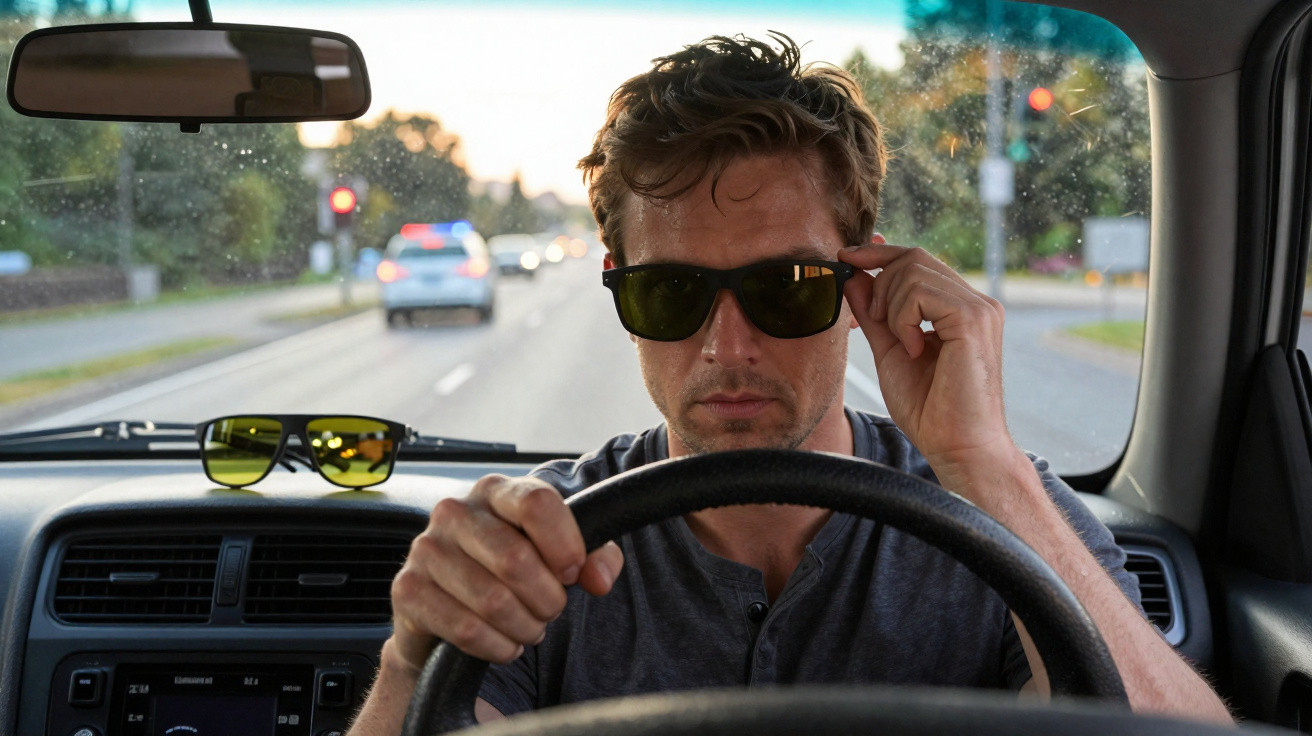
The driver wound down his window with a faint smirk still on his face, certain he had done nothing seriously wrong. He had not been speeding, had not touched his phone, and had only drunk one coffee - no beer. So what could the police possibly be stopping him for?
“Do you know why I’ve stopped you, sir?” the officer asked, leaning slightly towards him. The driver merely shrugged, gesturing towards the dashboard. Everything looked fine. Then the officer pointed to the side of his own face, beside his eyes. A moment later, the driver understood.
On his nose sat a fashionable pair of reflective, jet-black lenses: the sort constantly advertised on social media. They were the sort that look too stylish to be useful - and that, on an overcast weekday afternoon, can discreetly lead to hundreds of pounds in penalties and valuable points on your driving licence.
Why some “cool” glasses can quietly wreck your driving record
Most motorists do not consider their glasses a legal hazard. They are simply part of an outfit, an accessory picked up on the way out. But some lenses can turn an ordinary trip into a costly error, and many people are completely unaware of the risk.
Police forces across Europe and the UK have begun to look more carefully at what drivers have on their faces. Their attention is not limited to mobile phones: it also includes extremely dark lenses, fashion tints worn after dark, and glasses that interfere with contrast. Once you are driving, these choices are no longer just about appearance; they become a matter of safety. That is when fines - and penalty points - can enter the equation.
The underlying requirement appears straightforward: you need to see the road properly and respond quickly. In reality, there is very little room for error. Some glasses block excessive light, while others alter colours or reflections. It makes no difference whether they were bought from a major brand or through a TikTok advert. If the lenses impair your sight in a way that affects how you drive, you could face consequences.
A 32-year-old delivery driver in the Midlands discovered this for himself not long ago. He had ordered “tactical” polarised sunglasses online, promoted as being ideal for driving in every condition. They had a black mirror coating, an aggressive design and all the rest. During a sunny summer afternoon, they seemed brilliant. On a wet evening, they became a liability.
He continued wearing them as the sky shifted from grey to near darkness. Streetlights began to come on, while headlights spread across the wet tarmac in white smears. The glasses reduced the glare, but they also made pedestrians, signs and lane markings less visible. At a zebra crossing, he braked too late. There was no crash, only a sharp stop and a pedestrian left shaken.
A patrol car nearby had witnessed the incident. Officers inspected his glasses and recorded how dark the tint was in low-light conditions. He received a fine, points on his licence for driving without proper control and failing to have a clear view, plus a firm warning. From then on, those “tactical” lenses remained in his glove box, gathering dust.
Stories like this rest on a simple but uncompromising principle. Driving law is concerned with what you are able to see, rather than what you intended to do. When glasses reduce visible light transmission beyond safe limits, you are effectively driving half-blind. Many countries use standards comparable to EU categories: category 4 lenses, for example, are so dark that they are prohibited for driving entirely.
Yellow-tinted “night driving glasses” create another potential problem. They may make your surroundings seem clearer to your brain, but they still reduce the amount of light reaching your eyes and can slow your response to danger. At night or in tunnels, every reduction in light costs precious milliseconds of reaction time. That small gap is precisely where accidents can happen.
Mirrored lenses and cheap polarised imitations also deserve attention. Good-quality polarisation can reduce road glare in daytime, but poor-quality versions can sometimes make digital dashboards, sat-navs or head-up displays harder to read. If you have to squint to check your speed, you are not giving the traffic your full attention. That is the point at which both police and insurers may take notice.
How to choose glasses that keep you safe, legal and actually comfortable
The safest approach is bluntly simple: choose your glasses for the light conditions, not for your clothing. In bright sunshine, opt for certified driving sunglasses with a moderate tint and strong UV protection. Check that they are properly labelled, and avoid category 4 lenses or any pair marked “not suitable for driving and road use”. Those are for the beach, not the driver’s seat.
For people who normally wear prescription glasses, photochromic lenses that darken in sunlight can offer a useful middle ground, particularly when the weather changes frequently. However, bear in mind that they may react slowly behind a windscreen because car glass filters UV light. For this reason, many eye specialists still advise having dedicated prescription driving sunglasses instead of depending entirely on transitions.
At night and whenever visibility is poor, the best option is straightforward. Clear lenses with an anti-reflective coating are your strongest allies. They may not appear glamorous, but they reduce unwanted reflections from headlights and instrument panels. Your pupils are already fully open, trying to gather every available trace of light. Any additional tint at that point, even a supposedly “light” tint, works against them.
Drivers often make the same mistakes, and usually not through bad intentions. Advertising has a major influence. Promotions sell blue-blocking glasses for screens, yellow lenses for “HD night vision”, and heavy tints for “tactical driving”. They look impressive on social media. On a dark, wet motorway, though, they can quietly take away visibility. It is in that divide between the image and the reality that fines and near-misses increase.
There is also an element of pride and routine. If you have paid for an expensive designer pair of sunglasses, naturally you may want to wear them constantly. Or perhaps you have driven at night in tinted lenses for years and tell yourself, “I’m used to it; my eyes adapt.” The issue is that physics does not compromise. Less light entering your eyes means less information reaching your brain. You may not notice that delay until something unexpected appears in front of you.
On a more personal level, plenty of people feel that removing sunglasses makes them appear tired, exposed or somehow “less themselves”. That small touch of vanity can keep them wearing the glasses longer than they should. Let’s be honest: hardly anyone takes the time to test their glasses in every lighting condition before getting into a car.
“I’ve never had anyone thank their tinted lenses after a crash,” says one road safety officer in London. “But I’ve heard a lot of people say, ‘I just didn’t see them in time.’ That’s the sentence that haunts you.”
To avoid becoming one of those people, it is worth running through a short checklist each time you drive while wearing glasses:
- Can I clearly see pedestrians in dark clothing at 50–60 metres?
- Can I read my dashboard and sat-nav without squinting or tilting my head?
- Do traffic lights and brake lights look vivid and unmistakable?
- Do I feel any urge to lean forward, narrow my eyes, or “peer” through the lenses?
- Would I feel safe driving with these lenses if my child was in the back seat?
If the answer to any of these questions is no, the glasses are working against you. If the law then becomes involved, its reasoning is stark: you chose to restrict your own vision. A fine is one issue; the guilt of failing to see something - or someone - is something else altogether.
A small change on your nose, a big shift in how you drive
Once you begin noticing this issue, it is hard to ignore. At traffic lights, you see the motorist beside you wearing almost-black lenses in the early evening. You spot a parent on the school run in orange-tinted “sport” glasses beneath low cloud. You catch your own reflection in the rear-view mirror and suddenly question what colour the world really looks like without those lenses.
That small piece of plastic or glass on your nose filters every decision you make on the road. It influences how early you spot a cyclist near the kerb and how quickly you notice a car braking two vehicles ahead. It affects fatigue, headaches and your willingness to drive at night or in rain. Without drawing attention to itself, it can make you a calmer motorist - or a reckless one without intending to be.
At this stage, many readers pick up their glasses and view them differently. Some may try them at night in a safe, familiar place and feel a sudden shock at just how much darker everything becomes. Others may finally arrange the eye test they have been postponing for months. More broadly, these small reminders matter when they are shared. They are the sort of detail absent from major policy discussions, yet they shape thousands of journeys every day.
We have all experienced the moment after a near-miss when we sit silently in the car for a few seconds, heart racing, replaying the event. Often, nothing dramatic appears on the dash cam. There is simply a fraction of a second when you “didn’t quite see” a shape, movement or flash of colour. Sometimes the reason is on your face, rather than on the road.
| Key point | Detail | Why it matters to the reader |
|---|---|---|
| Tint too dark | Very dark or category 4 lenses can reduce visibility so much they’re banned for driving | Helps you avoid fines and choose glasses that keep your licence safe |
| Wrong glasses at night | Tinted or “HD night” lenses steal precious light and slow reaction times | Encourages clear, anti-reflective lenses when visibility is low |
| Legal and practical checks | Simple self-tests and proper labelling can reveal risky glasses before the police do | Gives you quick actions to protect yourself, your passengers and your wallet |
FAQ:
- Can I be fined just for wearing very dark sunglasses while driving? Yes, if your glasses are so dark they prevent a clear view of the road, police can treat it as driving without proper control or without a full view, which can lead to fines and points.
- Are mirrored sunglasses legal for driving? Mirrored lenses are allowed as long as the tint level is within legal limits and you can clearly see the road, signs and other users in all conditions.
- Do yellow “night driving” glasses really help? They can feel sharper, but they reduce overall light reaching your eyes, which can delay your response to hazards in low light or at night.
- How can I tell if my sunglasses are too dark to drive with? Check for proper certification, avoid category 4 lenses, and test whether you can clearly see pedestrians, road markings and dashboard details in shade or dull light.
- Is it illegal to drive with prescription glasses that are out of date? It can be an issue if your vision no longer meets the standard for driving; after an accident, outdated or unsuitable correction can count against you with insurers and investigators.





Comments
No comments yet. Be the first to comment!
Leave a Comment