
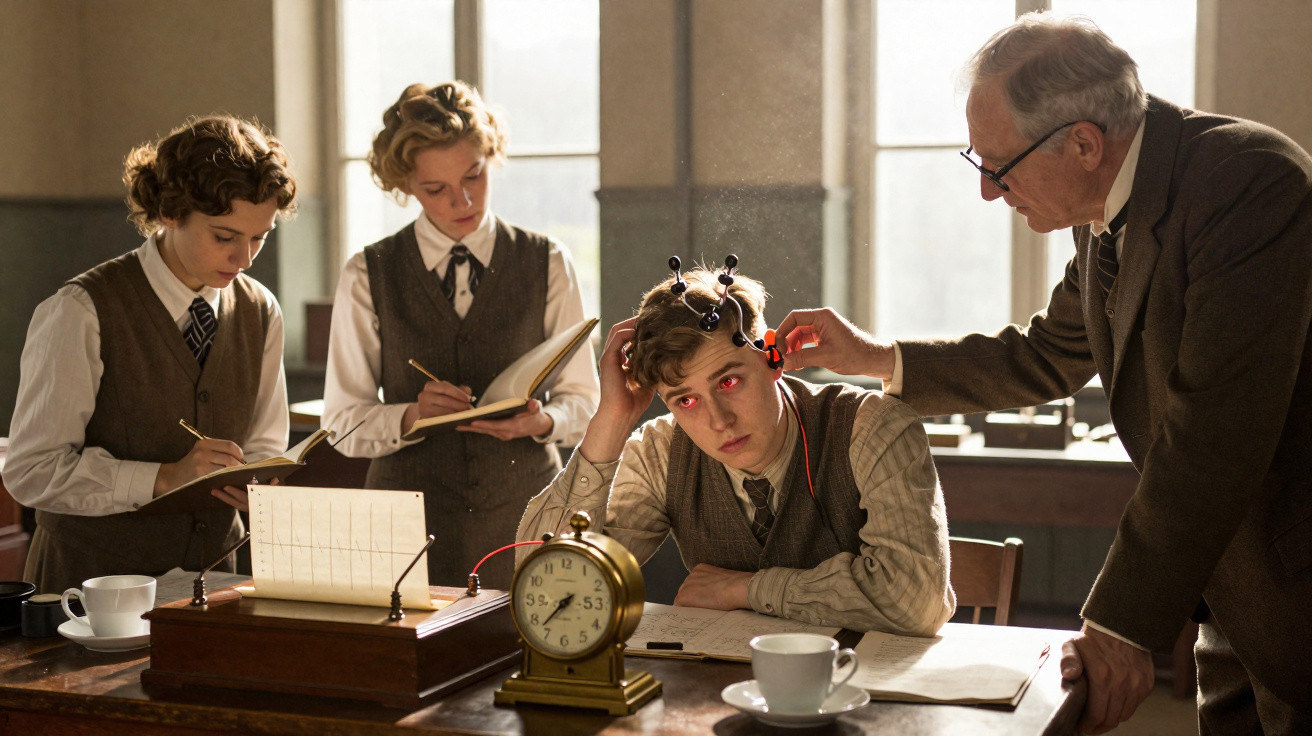
Frederick August Moss set out to prove that people could do without sleep. Equipped with a stopwatch, seven willing students and the distinctly 1920s belief that productivity could solve everything, he ran one of the earliest sleep-deprivation experiments to capture headlines. The trial was to run for only 60 hours, but its cultural after-effects would last a century.
When staying awake became a scientific stunt
Washington, summer 1925: seven George Washington University students entered a Foggy Bottom laboratory knowing they would not be in a bed again for two and a half days. Their psychology lecturer, Frederick August Moss, regarded sleep largely as a learned routine and, more troublingly, as an enormous drain on time.
To Moss, every hour spent asleep was an hour unavailable for labour and invention. In an industrialising America fascinated by speed, production lines and illuminated cities, the idea seemed daring rather than strange.
The experiment’s mission was stark: 60 hours awake, no naps, while their minds and reflexes were measured like machines on a factory floor.
He intended to observe how tiredness affected attention, memory and reasoning. Moss devised tests that appeared straightforward on paper but became punishing after an entire night without rest: reaction-time exercises, memory tasks, logic questions and precision-driving challenges, including parking a car without hitting the kerb.
The students relied on every available source of stimulation to remain awake. They debated ideas, drove through the Virginia countryside and played spontaneous baseball games. It was simultaneously science, an endurance event and a weekend challenge.
The women who turned a stunt into a career
The volunteers included Thelma Hunt, a 22-year-old psychology student, alongside her fellow student Louise Omwake. In an era when men dominated psychology, as they did most scientific fields, both women would later make significant contributions in their own right.
Hunt went on to become an influential figure in educational psychology and assessment. Omwake eventually led the psychology department at George Washington University. Taking part in Moss’s somewhat reckless study was not the defining moment of their lives, but an early indication of their readiness to challenge limits.
What began as a weekend without sleep helped propel two young women towards long careers shaping how Americans understood learning and behaviour.
What 60 hours without sleep really did to their brains
Moss kept detailed records. As the hours accumulated, the students’ hands became shakier, their reactions slowed and their memories faltered. Parking a car accurately began to demand intense focus. They remained upright and able to speak, yet the sharper elements of their mental ability gradually dulled.
Moss interpreted the lack of a spectacular physical breakdown in one way: people could train their bodies to operate with very little sleep. If the students could endure 60 hours, he reasoned, perhaps regularly sleeping for short periods could be feasible with enough practice and the right attitude.
Many other scientists were much less persuaded. That summer, Chicago researchers published results pointing in the opposite direction. They found no harmless way to reduce sleep without damaging health. Their research supported an emerging agreement that the brain requires rest to preserve its essential functions.
The 1925 standoff was clear: one camp framed sleep as a negotiable habit, the other as a non‑negotiable biological need.
From midnight marathons to brain waves
By the middle of the 20th century, the Chicago laboratories made another breakthrough, now using equipment Moss could scarcely have imagined. Nathaniel Kleitman, Eugene Aserinsky and their colleagues recorded brain waves and eye movements during sleep. They identified separate phases, including REM sleep, in which eyes move rapidly beneath shut eyelids while the brain is highly active.
Their findings overturned the older view of sleep as a simple switch-off. Instead, the brain actively organises memories, repairs neural links and restores chemical balance. The night began to resemble planned maintenance rather than inactivity.
- Non-REM sleep: deeper, calmer phases associated with physical recovery and growth.
- REM sleep: intense dreaming, memory consolidation and emotional processing.
- Repeated cycles: roughly 90 minutes apiece, recurring throughout the night.
Set against these discoveries, Moss’s belief that sleep could be “trained away” came to seem seriously outmoded.
From heroic sleeplessness to recognised health risk
A hundred years on, the 1925 study appears to reflect its own time. America celebrated the worker who never tired. Thomas Edison boasted of sleeping only a few hours each night and portrayed lengthy rest as idleness. Moss’s experiment suited that narrative perfectly: if sleep were optional, extra hours could go towards work, education and invention.
Contemporary research presents another account. Persistently inadequate sleep interferes with hormones controlling appetite and blood sugar. It raises blood pressure, reduces immune response and is linked with increased risks of depression, anxiety and cardiovascular disease. Severe sleep deprivation can impair driving in ways comparable to alcohol.
The supposed shortcut to productivity - shaving hours off the night - often leads straight to slower thinking, poorer decisions and higher medical bills.
Epidemiological research following millions of people has uncovered another complication: individuals who consistently sleep much longer than average, well above eight or nine hours, also tend to have higher illness and mortality rates. Sleep duration and health frequently follow a U-shaped curve, with people at both extremes generally doing worse than those in the middle.
Extended sleep is unlikely to cause illness by itself. More often, it may signal an underlying problem, such as sleep apnoea, metabolic disease or chronic inflammatory conditions, that leads someone to remain in bed longer.
What science now says about sleeping well
Researchers today are less interested in dramatic feats of wakefulness and more concerned with regularity. The brain operates on an internal clock shaped by light exposure and daily routine. When that clock remains steady, hormones, digestion and mood tend to follow a more consistent course.
| Habit | Effect on sleep |
|---|---|
| Going to bed and waking at fixed times | Supports a strong, reliable body clock |
| Screen use late at night | Blue light delays melatonin and sleep onset |
| Cool, dark bedroom | Helps the body drop core temperature for deeper sleep |
| Caffeine in late afternoon or evening | Blocks sleep pressure and reduces sleep depth |
| Regular daytime exercise | Builds sleep pressure and improves sleep quality |
These practices, commonly called “sleep hygiene”, are now standard guidance in clinics and GP surgeries. They stand in marked contrast to the 1925 method, which saw sleep as an obstacle to overcome rather than a process to value and encourage.
What 60 hours awake can actually feel like
For anyone considering recreating the Moss experiment in an era of energy drinks and streaming platforms, the probable sequence is reasonably clear. At approximately 16 to 18 hours without sleep, attention starts to weaken. Reaction times increase, while tasks needing judgement and creativity become more demanding.
Between around 24 and 36 hours, emotions often become less stable. People describe irritability, waves of anxiety and reduced control over emotional responses. Microsleeps - involuntary periods of sleep lasting a second or two - may begin, even while the eyes are open. This is one reason profound fatigue is so hazardous on motorways.
Past 48 hours, concentration, memory and coordination often break down to a point that would be unacceptable in most safety‑critical jobs.
Hallucinations may occur, and even simple jobs can become bewildering. Many people develop a strong urge not merely to lie down, but to cut themselves off from sensory stimulation altogether. Although Moss’s students were determined and monitored, they would almost certainly have encountered some of these effects.
Key concepts behind sleep and sleeplessness
Several technical concepts clarify what Moss was truly interfering with. One is “sleep pressure”: the accumulation of adenosine and other chemicals in the brain that creates an increasingly strong need for sleep the longer a person is awake. Caffeine partly works by blocking adenosine receptors, briefly concealing this pressure without eliminating it.
Another is “circadian rhythm”, the approximately 24-hour internal pattern linked to light and darkness. It influences when we feel awake or sleepy, when body temperature reaches its highest point and when hormones including melatonin rise. Moss forced his students to work against both systems at once: increasing sleep pressure and a body clock signalling that night should be reserved for rest.
Considering these two pressures together also shows why rapid solutions rarely succeed. One extended lie-in cannot completely compensate for a week of 5 am alarms and late-night emails. Brain and body benefit from stable routines, rather than occasional days of recovery.
Viewed this way, that 1925 Foggy Bottom weekend was not evidence that humans can forgo sleep, but an early stress test of a system that was barely understood at the time. The students made it through their 60 hours. Once scientific understanding advanced, however, the belief that sleep is optional did not survive nearly as well.






Comments
No comments yet. Be the first to comment!
Leave a Comment