
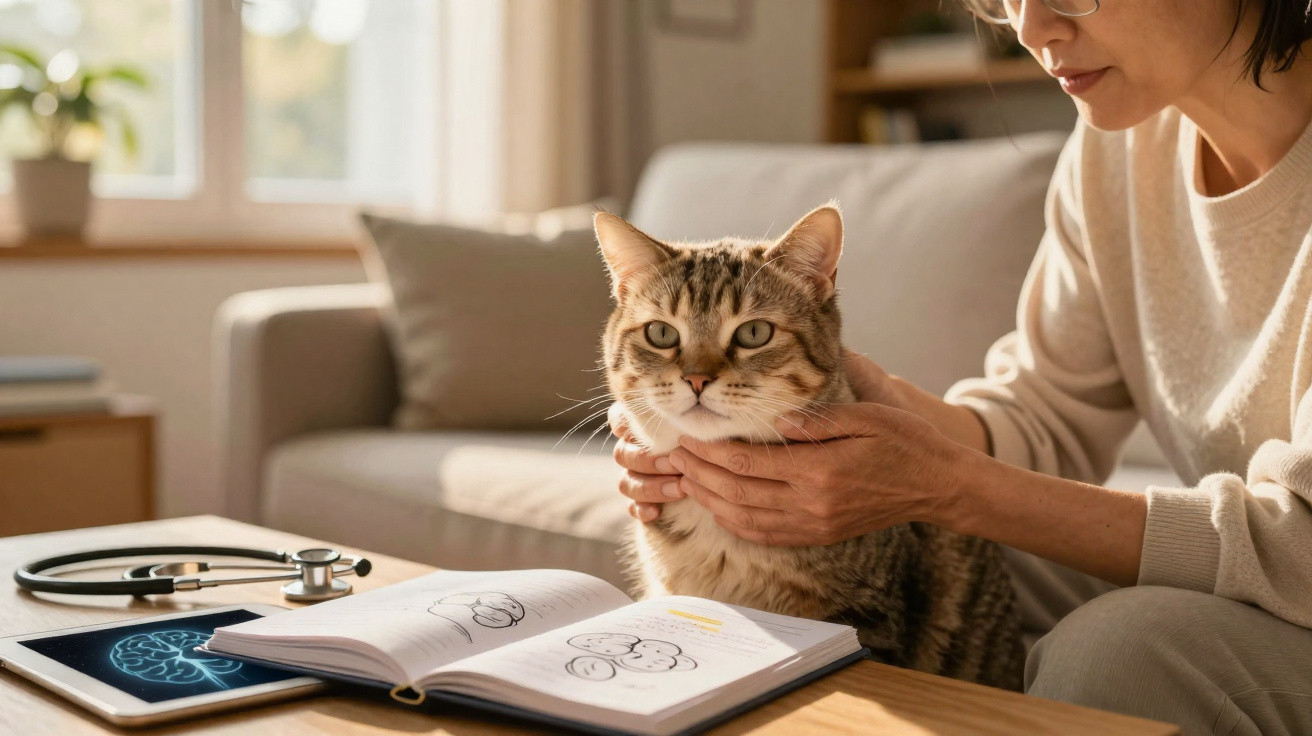
In a quiet corner of the house, an elderly cat begins behaving differently, as though the home it has always known has suddenly become unfamiliar.
Owners may put these changes down to age, the animal’s “temperament”, or poor nights of sleep. Researchers, however, are beginning to see a different picture: a brain undergoing profound change, with unsettling similarities to what happens in Alzheimer’s disease in people.
Elderly cats and signs often mistaken for “fussiness”
Veterinarians in several countries report the same pattern: cats aged 12, 14 or 15 and over beginning to display behaviours outside the expected range.
- Loud vocalising during the night, with no obvious cause
- Disorientation in familiar surroundings
- Loss of hygiene habits or inconsistent use of the litter tray
- Sudden changes in sleeping and waking patterns
- Unusual withdrawal, irritability or apathy
For years, these signs were regarded as “normal ageing”. New research led by the University of Edinburgh, supported by the UK Dementia Research Institute and the University of California, points to another possibility: some cats may be developing dementia through mechanisms similar to those involved in Alzheimer’s disease.
Among cats aged over 15, almost half show at least one symptom associated with cognitive decline, according to data cited by SciTechDaily.
Toxic protein accumulation in the cat brain
Researchers examined the brains of older cats, including some with clinical signs of dementia. Using confocal microscopy, a technique capable of producing high-resolution 3D images, they identified a phenomenon already familiar in people with Alzheimer’s: deposits of beta-amyloid protein plaques.
This protein builds up in nervous tissue and disrupts communication between neurones. Rather than simply forming scattered “plaques”, the researchers identified something even more concerning: beta-amyloid directly entering synapses, the contact points through which one neurone passes information to another.
When a synapse is overtaken by toxic protein, the brain loses its ability to send and receive signals with the same accuracy. Memory becomes fragmented, attention fails and unusual behaviours emerge.
The study, published in the European Journal of Neuroscience, shows that the ageing feline brain naturally reproduces the early stages of disease seen in human patients. In other words, these cats were not subjected to genetic manipulation or laboratory intervention to produce this condition: they aged, and the pathology developed on its own.
How the brain responds when neural “clean-up” becomes uncontrolled
The issue goes beyond protein build-up. The brain itself also reacts to this toxic excess. Two types of support cell are involved: astrocytes and microglia.
What is synaptic “pruning”?
During normal brain development, these cells help carry out a form of connection “pruning”: they remove weak or surplus synapses so that the network can work more efficiently. This process is known as synaptic pruning.
In feline dementia, the study suggests that this clean-up process becomes aggressive and selectively targets synapses contaminated with beta-amyloid. In three-dimensional images, scientists saw synapses carrying the toxic protein surrounded by microglia and astrocytes, as if they had been marked for destruction.
Synapses containing beta-amyloid were more often engulfed by microglia and astrocytes, indicating an active mechanism for removing contaminated connections rather than simple wear associated with age.
This pattern was not found with the same intensity in the brains of cats that were merely old and showed no signs of dementia. That strengthens the view that this is a distinct pathology, rather than “normal” ageing.
Why cats may become a key model for understanding Alzheimer’s
For decades, Alzheimer’s research has relied on mice genetically modified to develop beta-amyloid plaques. These models have contributed to many discoveries, but they have limitations: they are artificial, accelerated and do not always reflect the real course of human disease.
Cats offer something different: a natural model.
- Dementia develops without deliberate genetic manipulation
- The feline brain is more complex than that of rodents
- The animals live in domestic environments with a wide range of stimuli
- Their behavioural signs resemble disorientation seen in older people
For scientists, this could enable more faithful studies of:
| Research focus | What to observe in cats |
|---|---|
| Early stage of the disease | Initial changes in sleep, interaction and movement in elderly cats |
| The brain’s immune response | The behaviour of microglia and astrocytes around plaques |
| Drug testing | The effects of medicines that modulate inflammation and synaptic pruning |
From a human perspective, this creates a kind of bridge: understanding what happens in cats may reveal fine details about the onset of Alzheimer’s and point towards new therapeutic targets.
What changes for people living with elderly cats
For owners, the research is both a warning and a route forward. Many behaviours dismissed as “fussiness” or “jealousy” may actually indicate neurological distress.
Several practical measures can help people monitor the situation more closely:
- Keep written notes or videos of sudden behavioural changes
- Mention any frequent disorientation around the home to a vet
- Pay attention to sleep quality and activity times
- Avoid major changes to an elderly cat’s environment
- Make sure water, food and the litter tray are easy to reach and free from obstacles
There is still no cure for feline dementia, but routine adjustments, gentle environmental enrichment and specific medicines can reduce anxiety, regulate sleep and improve the animal’s quality of life.
Terms and mechanisms worth understanding
What exactly is beta-amyloid?
Beta-amyloid is a protein fragment naturally produced by the body. In healthy conditions, it is cleared away. In brains affected by Alzheimer’s, this fragment starts to accumulate and cluster into plaques. These plaques alter neurone function, inflame brain tissue and, over time, cause the loss of synapses.
In cats with dementia, the pattern appears very similar: progressive deposits, invasion of synapses and an inflammatory response from glial cells, which then begin removing whole connections.
One possible scenario: from the first unusual cry to cognitive decline
Imagine a 16-year-old cat that has always slept by the window. Over the past few months, it has started crying loudly at three o’clock in the morning, as though lost in its own flat. During the day, it stands still staring at the wall. Sometimes it misses the litter tray, something it never used to do.
Its owner believes it has “become old and grumpy”. Behind these changes, the brain may be going through a silent cascade: plaques form, synapses containing beta-amyloid are marked, microglia engulf them and circuits responsible for spatial orientation become disorganised. The behaviour is merely the visible tip of that process.
Risks, benefits and the next steps in feline research
Using cats as a natural model of dementia brings both benefits and challenges. On one hand, it offers a more faithful picture of disease progression and makes it possible to test interventions that take account of a complete organism in a real environment. On the other, it raises ethical questions: these animals are first and foremost family companions, not research “objects”.
Researchers argue for an approach based on mutual benefit. Studies should aim simultaneously to uncover new clues about Alzheimer’s in people and develop ways to improve care for elderly cats: more accurate diagnoses, adapted imaging examinations, management protocols for homes and clinics, and medicines that do not cause additional suffering.
If this work progresses, the ageing of cats may cease to be a silent mystery and instead become a valuable source of knowledge about the brain, its vulnerabilities and, perhaps, more humane ways of dealing with dementia in every species affected by it.






Comments
No comments yet. Be the first to comment!
Leave a Comment