
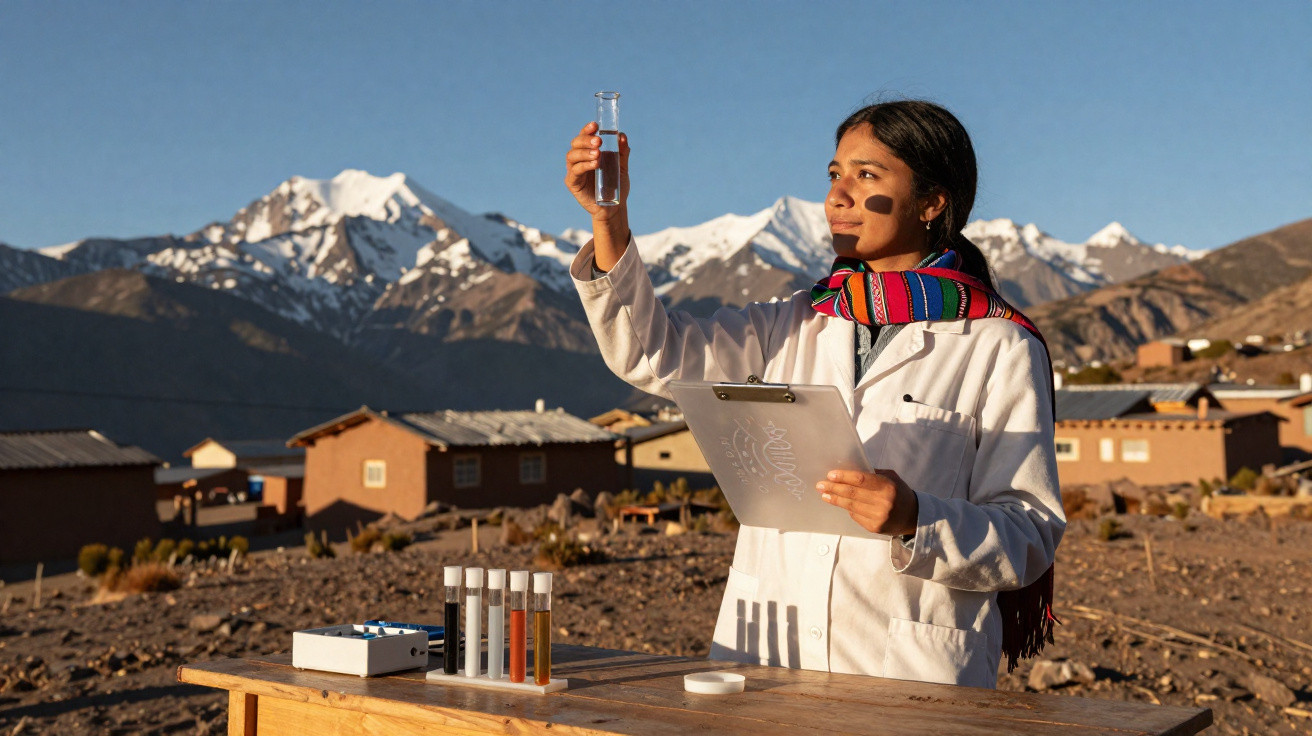
For millennia, people living at high altitude in the Argentinian Andes have depended on drinking water that would leave most people seriously unwell.
In this region, arsenic occurring naturally in volcanic bedrock seeps into groundwater, polluting local supplies with concentrations of the toxic metalloid that would create major health dangers for most human groups.
Yet research indicates that natural selection may have given one northern Argentinian population an uncommon genetic benefit.
DNA analysis involving people from across western South America suggests that a population in the Argentinian Andes possesses a gene variant that probably enables them to process arsenic more safely.
Arsenic tolerance in the Argentinian Andes
"Adaptation drives genomic changes; however, evidence of specific adaptations in humans remains limited," wrote a team led by evolutionary biologists Carina Schlebusch and Lucie Gattepaille of Uppsala University in a 2015 study.
"Our data show that adaptation to tolerate the environmental stressor arsenic has likely driven an increase in the frequencies of protective variants of AS3MT, providing the first evidence of human adaptation to a toxic chemical."
With sufficient time and exposure to a threat that is gradual enough, life has repeatedly shown an extraordinary capacity to adjust to extreme circumstances, including intense heat, a total absence of oxygen and hazardous radiation levels.
Even so, scientists know comparatively little about the ways human populations adjust to poisonous chemicals in their surroundings. Arsenic is extremely toxic and is linked to cancer, skin lesions, birth defects and premature death.
It is also common, naturally occurring at elevated concentrations in groundwater across many parts of the world.
The World Health Organization's current recommended maximum for arsenic in drinking water is 10 micrograms per litre.
Before a filtration system was introduced in 2012, drinking water in San Antonio de los Cobres, a remote high-altitude town on Argentina's Puna de Atacama plateau, held roughly 200 micrograms of arsenic per litre - approximately 20 times the recommended limit.
Still, the area has supported human communities for thousands of years: at least 7,000 years, and possibly as many as 11,000.
For decades, scientists were perplexed by this seeming capacity to withstand perilously high arsenic concentrations.
How the AS3MT gene variant processes arsenic
In 1995, scientists observed that women in the Argentinian Andes had a "unique" capacity to metabolise arsenic, demonstrated by the metabolites found in their urine.
After arsenic enters the body, enzymes transform it through several chemical forms. One intermediate form, known as monomethylated arsenic (MMA), is especially poisonous. Dimethylated arsenic (DMA), which appears later in the process, can be more readily eliminated in urine.
People from San Antonio de los Cobres generally produced lower amounts of the toxic intermediate and greater amounts of the form that is easily excreted, indicating that their bodies processed arsenic with unusual efficiency.
Keen to resolve the mystery genetically, Schlebusch, Gattepaille and their colleagues investigated further.
Using cheek swabs, the researchers gathered DNA from 124 women in San Antonio de los Cobres. Their urine samples displayed the same arsenic-metabolite pattern identified in the 1995 research. The team then examined millions of genetic markers throughout the genome.
To establish whether this gene variant was exclusive to the Argentinian population, they compared the findings with publicly available genome data from Peru and Colombia from the international 1000 Genomes Project.
Earlier studies had indicated that an enzyme known as arsenic (+3 oxidation state) methyltransferase (AS3MT) might be central to arsenic metabolism, so the team concentrated on this area.
They identified a group of genetic variants close to the AS3MT gene that had a strong effect on the way the body processes arsenic. These variants occurred much more frequently among people in San Antonio de los Cobres than in genetically comparable populations in Peru and Colombia.
The variants seem to improve the body's ability to convert arsenic into forms that can be safely passed out in urine. This limits the accumulation of the most toxic intermediate compounds, closely matching previous research into arsenic metabolites in urine.
Natural selection and long-term arsenic exposure
Although arsenic contamination occurs worldwide, very few communities have experienced such intense exposure over extended periods.
People in San Antonio de los Cobres have been exposed to arsenic in their groundwater for thousands of years, a timespan sufficient for natural selection to favour characteristics that lessen susceptibility to arsenic's toxic effects.
Subsequent research indicates that comparable genetic signals may be present in other Andean populations exposed to arsenic across generations. This supports the conclusion that prolonged exposure can produce genetic tolerance, while suggesting the adaptation could extend more widely through the region.
"Given the severe deleterious health effects of arsenic in both children and adults," the researchers wrote, "individuals who carry the arsenic-tolerance haplotype… could have a very strong selective advantage in high-arsenic environments."
The study appeared in Molecular Biology and Evolution.
An earlier version of this article was published in March 2026.






Comments
No comments yet. Be the first to comment!
Leave a Comment