
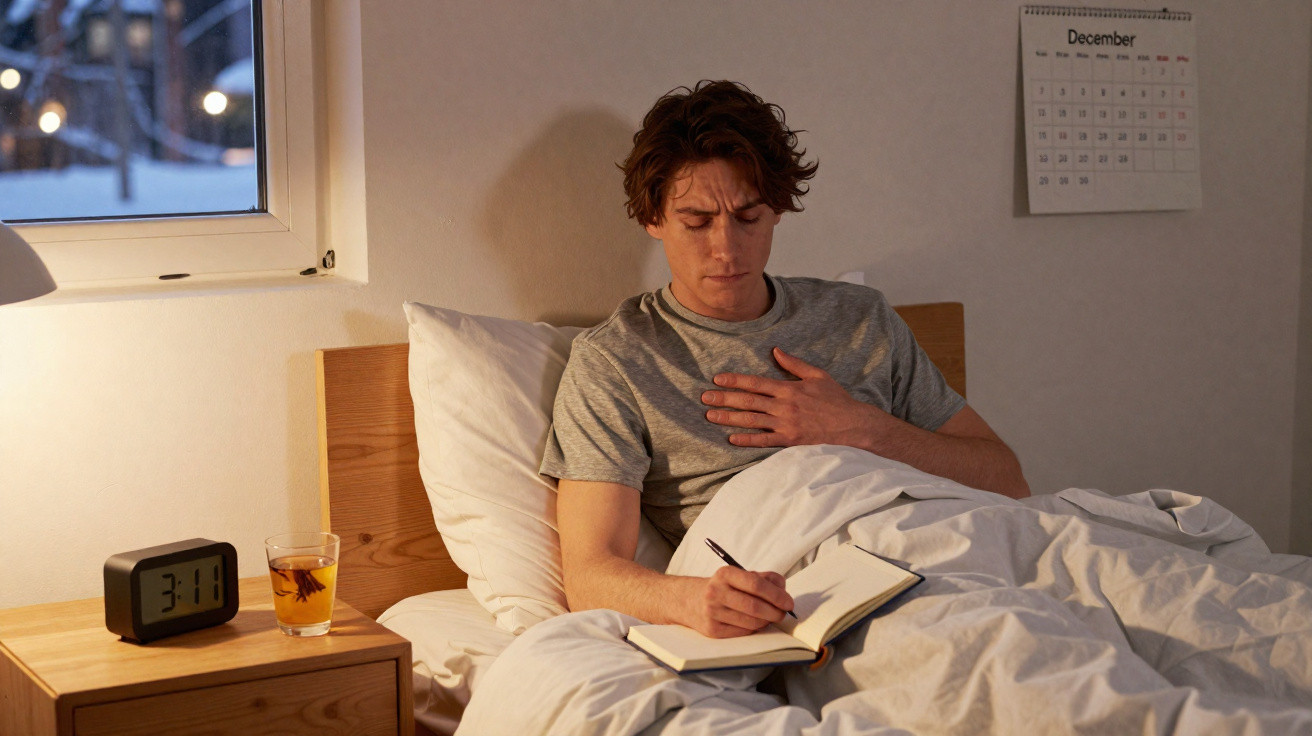
It is always the same hour, isn’t it? That hazy, blue-tinged part of the night when everything is still, the boiler gives off a faint hum and, for no apparent reason, your eyes fly open. You turn over and tap your phone: 3:17 am. Every. Single. Time. Your mind immediately begins a panicked inventory – work emails, money, that odd remark you made in a meeting two weeks ago – while everyone else in the house remains deeply asleep and unaware. You assure yourself you will nod off again in a minute. But you do not.
This winter, a December sleep study quietly moved from academic circles into everyday conversation, suggesting that this unsettling “3:17 moment” may not be chance after all. Instead, it may point to something much more commonplace, yet much less apparent: a stress cycle running beneath the surface of many adult lives. Once you understand its workings, the lit-up 3:17 am display seems less mysterious. It starts to resemble a warning light that has gone unnoticed.
The December study that caught sleep researchers’ attention
On the surface, the fresh research from a European sleep laboratory appeared familiar: hundreds of adults wore activity trackers and heart-rate monitors, while keeping sleep diaries throughout the cold, hectic month of December. Standard sleep-science territory. Yet the data contained an unusual trend. A notably high number of participants were waking repeatedly between 3:15 and 3:20 am, even when they insisted they “slept through”. Their bodies suggested otherwise.
The devices recorded raised heart rates and slight breathing changes during that period. These were not complete awakenings people would necessarily recall, but “micro-arousals” – partial waking moments in which the mind rises just far enough to register the darkened room before dropping back under. A fair proportion of volunteers did remember waking, however. When researchers compared their sleep records with their everyday stress diaries, the pattern became clearer. Those waking at 3:17 am shared a characteristic: they were carrying stress as though it were an additional organ.
They were not always the participants working longest hours or appearing most anxious. They included parents, managers and students, as well as people quietly keeping their families going. What connected them was not workload in the usual sense, but a specific kind of stress that had not been released during the day. It simply continued in silence, like a bill left unpaid. This is where 3:17 am entered the picture.
Why 3:17 am rather than, for example, 1:42?
Naturally, not everyone wakes at precisely 3:17 am. Your own difficult hour may be 2:58 or 4:03. The important point is not the exact time displayed, but the sleep stage your body is likely to occupy at that point. For most adults with a “normal” bedtime and six to eight hours’ sleep, the period around 3 am falls into a vulnerable stretch, when light sleep, body temperature and hormones converge. It is a narrow crossing between deeper sleep and the approach of morning alertness.
The December study found that cortisol – the stress hormone – commonly begins to rise around this time as the body gets ready to wake. In people with a stable, lower stress burden, this increase is gradual: a gentle slope towards daylight. For people caught in the hidden stress cycle, it is more like a jagged cliff edge. Rather than rising steadily, cortisol surges. That surge can arrive at exactly the right time to pull someone from a delicate sleep stage at… about 3:17 am.
There is a body-temperature element too. Core temperature reaches its lowest point during the early morning, before slowly increasing again. Stress can alter this internal thermostat, causing tiny changes to feel unexpectedly significant. You may not register cold feet or tight shoulders when you collapse into bed. Yet, three sleep cycles later, those details may be enough to bring your brain towards consciousness. You wake slightly uncomfortable, with a dry mouth and a racing mind, sure that there is a major issue requiring attention even though you cannot identify it.
The hidden stress cycle that most of us act as though we do not have
This is the uncomfortable part: the stress cycle identified by the study is not necessarily caused by obvious crises. It is not only divorce, redundancy or serious illness, although all of these are major factors. It is also the constant, smaller pressure: the endless inbox, background money concerns, WhatsApp family conflict that you mute but continue to think about, and the feeling that you are permanently behind and about to make a mistake. That quiet drone of strain becomes the background music to daytime life.
Researchers found the same theme returning in the diaries of people who woke at 3:17 am. Their days were full of unprocessed irritation, anger swallowed during meetings, performed cheerfulness around children and emotional multitasking that never paused. Again and again, people wrote things such as “I’ll deal with this later” or “I don’t have time to think about that now”. Later did not truly arrive. Their bodies, it seems, eventually tired of waiting for them to pause and feel. The night took over.
The unfinished business your body refuses to let go
Most of us have experienced lying down, switching off the light and having our brain immediately replay an argument from five years ago in HD quality. The December study indicates that this may not be random subconscious cruelty. It may be an attempt to complete a stress cycle left unfinished during the day. Emotions follow a physical arc – they build, peak and settle – but only when we actually recognise them. Otherwise, they linger. They form a queue. They wait for a quieter opportunity.
At around 3:17 am, with no emails, notifications, partner talking or tasks demanding attention, that unfinished queue finally gets its turn. The nervous system enters a partly alert state. Heart rate rises just enough, and muscles retain a little extra tension. You wake with a mind that feels crowded yet indistinct, full of “something” that you cannot quite locate. That is the hidden stress cycle at work: unprocessed in daylight, replayed overnight.
Why it can feel much worse in December
The choice to run the study in December was deliberate. Sleep researchers have long suspected that winter quietly intensifies stress. Shorter days bring less daylight and a greater disruption to the circadian rhythm – the internal clock that determines when we feel sleepy and when we feel mentally sharp. Many study participants were going to bed a little later than normal, drinking more, eating richer food and attending more evening events. Bedtimes shifted, while waking times stayed fixed. Sleep became compressed, disturbed and gradually broken up.
December also has emotional weight. There are expectations of “a lovely Christmas”, pressure to appear happy in office photographs and the private pain of missing people who are not at the table this year. Those feelings often do not receive a straightforward, honest outlet. Instead, they are covered with sugar and packaged as jokes. Let us be truthful: few people spend every December evening sitting with a journal and a cup of tea, calmly processing the day’s emotions. We hurry, scroll and collapse.
The result can be a perfect storm for the hidden stress cycle. Your body is a little unsettled by late nights and heavy meals. Your brain is overstimulated by social activity and expectation. Your feelings pile up like unwashed plates, waiting in the sink of your nervous system. By 3:17 am, as melatonin recedes and cortisol begins its gradual rise, the pile topples. You wake with your heart beating slightly too fast, looking at the weak streetlight glow on the curtains and wondering why you feel so tense when “nothing is wrong”.
The thoughts you have at 3:17 am are not facts
One of the most disturbing features of waking in the early hours is how persuasive your thoughts become. At 3:17 am, a minor email error from yesterday can suddenly seem like the end of your career. A slightly strange comment from a friend can become evidence of an approaching rift. In a dark room carrying a faint smell of yesterday’s coffee, you begin drafting worst-case scenarios in your head. Everything appears more immediate, more intense and more urgent.
The December study used follow-up interviews to examine what participants did with their “3:17 thoughts” the following day. Once properly awake, most described those nighttime concerns as “dramatic”, “exaggerated”, or simply “not true”. Daylight changed their perspective. The very same brain catastrophising at 3:17 am was often merely shrugging by 3:17 pm. Researchers believe this happens because the thoughts are not truly about their apparent subject matter – the messages or conversations – but about the condition of the body. A stressed nervous system searches for an explanation, then attaches too strongly to whatever it finds.
In other words, these thoughts are less like useful information and more like smoke from an internal fire. They indicate that something is burning – persistent stress, unspoken resentment or overwhelm – but they are poor at identifying the real source. Recognising this can feel surprisingly liberating. The next time you wake during that particular part of the night convinced your life is about to unravel, it may help to tell yourself: these thoughts are a side-effect, not a prophecy.
Small, ordinary changes that can ease the cycle
The study did not conclude with laboratory charts alone. Researchers trialled modest interventions, with results that were almost strikingly simple. Participants who spent only ten deliberate minutes “emotionally offloading” before bed – through journalling, voice notes, an honest conversation or even a brief walk without a podcast – reported fewer 3 am awakenings within two weeks. Their daytime stress had not magically disappeared. What changed was when they processed it. Some of the burden moved from the night into the evening.
Another group attempted brief “completion rituals” after stressful events. Following a difficult meeting, they might walk around the block, stretch or simply stand alone in the toilet, take three deep breaths and identify what they were feeling. It may sound daft. Yet the data suggested that their bodies responded: heart rates settled sooner and sleep became less fragmented. By dealing with micro-stressors as they happened, they were closing loops before bed rather than taking them beneath the duvet.
What to do when you are awake at 3:17 am
Understanding why you wake at 3:17 am will not, of course, instantly send you back to sleep. You are still there, hearing the radiator creak and trying not to check the time again. The study tested several straightforward tools for these moments. The most successful was not a complicated breathing technique, but a three-part mental script: notice, normalise, redirect. Participants were encouraged to think something like this: “My body is stressed, so it woke me. That’s what bodies do. Nothing urgent is happening right now. I can give my brain something softer to chew on.”
They were then encouraged to shift attention gently towards something neutral: the sheet against their legs, the rhythm of breathing or an undemanding mental task, such as counting backwards in sevens. The aim was not to force thoughts into silence, but to stop treating the 3:17 am narrative as completely true. Over time, many said their awakenings became briefer and less overwhelming. Some continued to see the clock, but the moment no longer had the same bite.
What your 3:17 am wake-up may really be telling you
This leaves an uncomfortable but gently hopeful idea. If you regularly wake in the middle of the night, especially during dark December weeks, it does not automatically mean you are “broken” or “bad at sleeping”. It may mean your body is raising a small but persistent flag. Something needs attention, and you are too occupied to hear it while daylight lasts. That “something” will not always be obvious. It may be gradual burnout, grief or simply the pressure of trying to appear capable and pleasant every waking minute.
The hidden stress cycle depends on pretence. Pretending you are not angry. Pretending you are not worn out. Pretending the quiet message that “this pace isn’t working” can be pushed aside for a little longer. Night removes the props: the laptop, bright lighting and social mask. What remains is you, your nervous system and a brain that finally has space to shout. Waking at 3:17 am might be less of a failure, and more of a message that your daytime self keeps deleting.
You do not need to repair your entire life before New Year’s, nor must you wake at 5 am to meditate for an hour. Begin on a smaller scale instead: five truthful minutes with a notebook; one conversation in which you say “I’m not actually fine”; three deep breaths in a toilet cubicle after a meeting that made your jaw ache. These are private, unglamorous acts. Nobody will applaud them. Yet, a few weeks later, your 3:17 am self may quietly thank you by remaining asleep.
Stress will not disappear from adult life. Work will remain chaotic, families will remain complicated and bills will still land on the doormat with a soft thud. The difference is whether your body needs to ambush you halfway through the night simply to be heard. If that December study showed anything, it’s this: the clock glowing 3:17 am isn’t cursed. It’s a mirror. Once you are no longer frightened to look at it, you may find your way back to the sort of sleep that does not have to wake you to reveal how you truly are.






Comments
No comments yet. Be the first to comment!
Leave a Comment