
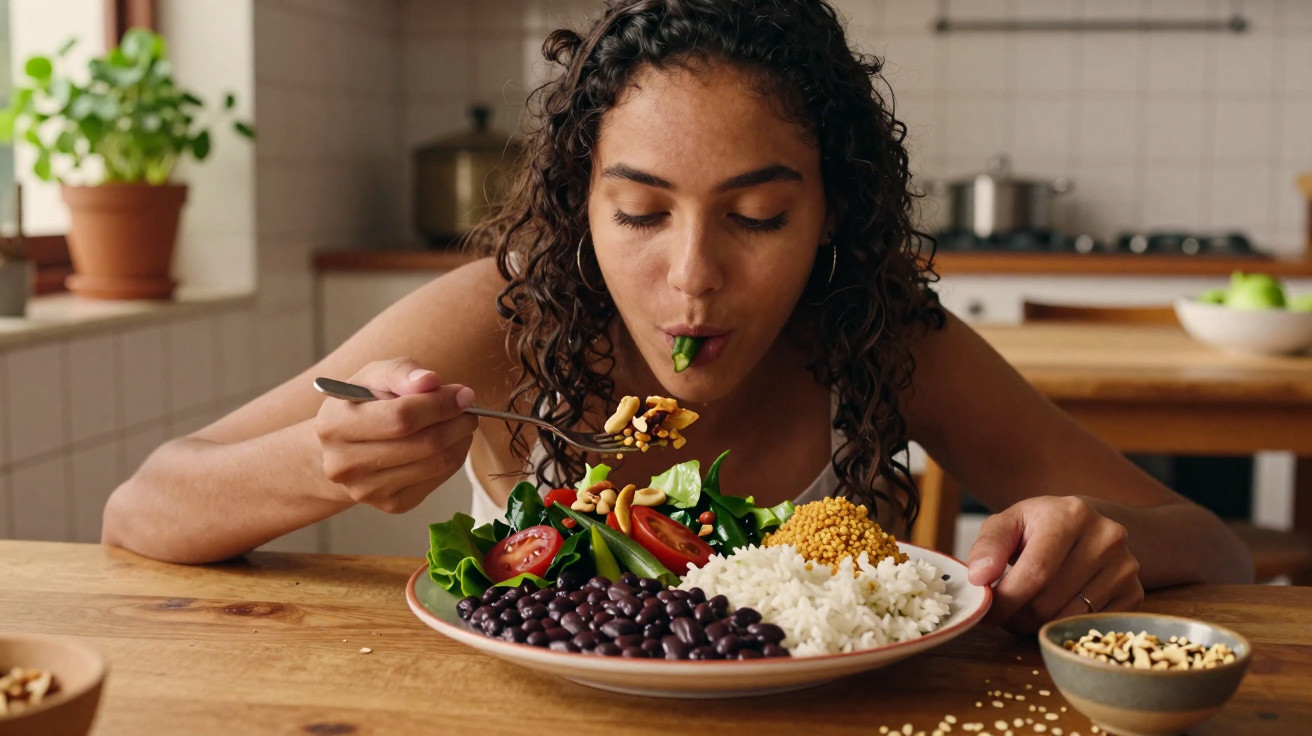
On the plate sits tender salmon, almost melting, beside a mound of roasted carrots that give a faint crackle when touched. The person opposite me shuts their eyes after the first mouthful, then laughs: “This is weird, I’m full faster… but I want to keep eating just for the crunch.”
At the neighbouring table, a man scrolls on his phone as he absent-mindedly eats a silky pasta dish with the same texture throughout. There is no challenge to chew, no contrast. He glances up, a little irritated, then reaches for the bread basket as though something is absent but impossible to identify.
Texture seldom features on nutrition labels or meal plans. Even so, it quietly shapes our cravings, our sense of fullness and even those late-night trips to the kitchen. How food feels in your mouth can influence both what you choose to eat and the amount you eat.
The hidden power of crunch and softness in everyday meals
When planning meals, most of us focus on flavour and calories: fat, sugar, protein and perhaps fibre. Hardly anyone thinks, “I need something crunchy and something soft on this plate.” Yet our brains are continually looking for precisely that kind of balance.
A bowl of plain mashed potato can feel soothing initially, but it soon becomes monotonous. A salad containing nothing but firm raw vegetables can tire your jaw and still leave you oddly dissatisfied. The real appeal often comes from bringing the two together: smooth hummus and crisp cucumber, tender chicken with punchy slaw, or velvety yoghurt topped with toasted nuts.
Your mouth looks for contrast, while your brain seeks variety. When each gets what it wants, cravings tend to settle in a way that willpower alone rarely achieves.
One wet Tuesday evening, I watched a friend finish an enormous bowl of soft risotto. It was tasty, rich and impeccably seasoned. Twenty minutes later, he was in the cupboard reaching for a packet of crisps “just for something crunchy”. He was not truly hungry; he was pursuing a different texture.
Later that same week, he made the risotto again, this time finishing it with roasted chickpeas and a scattering of toasted seeds. The dish itself had barely altered, but the eating experience had. He ate more slowly, stopped between mouthfuls and then moved the plate aside halfway through, saying the unusual words: “That was enough.”
A small Dutch study found that participants served meals with mixed textures generally chewed for longer and felt more satisfied than people eating food that was equally enjoyable but uniform in texture. The figures were not striking, but the trend was consistent: greater textural variety meant fewer cravings that lingered.
The principle behind texture balance is straightforward. Soft food is easy to swallow, so it can disappear quickly and almost without notice. Crunchy food requires chewing, attention and a few extra seconds of presence. That added time allows your brain and hormones to recognise: “Hey, food is arriving.”
Combining soft proteins, such as fish, tofu, eggs or beans, with crunchy vegetables or nuts creates a small reset with every bite. There is a fresh sensation, a new sound and a changed rhythm. This tiny variety helps prevent automatic eating, when your plate is suddenly clear and you can barely recall the first forkful.
Your cravings aren’t just about flavor, they’re about experience. Experience is rooted in texture: a carrot’s snap, the yielding centre of a poached egg, and the gratifying crunch that signals to your brain, at a deep animal level, that you are eating something substantial.
How to design texture-balanced meals without turning into a chef
The simplest starting point is to treat your plate as a brief exchange between textures. Start with a soft or tender foundation: lentils, beans in sauce, scrambled eggs, baked fish, marinated tofu or Greek yoghurt. This is the comforting layer, the element that feels warm and reassuring.
Next, intentionally include one crunchy companion. Try raw carrot batons, sliced radishes, roasted chickpeas, chopped nuts, shredded cabbage or even a handful of crisp salad leaves. The aim is not to create an Instagram-worthy plate. You are just offering your brain the chewing sensation it quietly expects.
To finish, add a small accent with a slightly chewy or gently crisp texture. Toasted seeds, torn croutons, granola scattered over yoghurt or crushed tortilla chips on chilli all work well. That third note can transform an unremarkable dish into one your mouth remembers for hours.
Most people either lean entirely into soft comfort food or compensate too far with nothing but “healthy crunch” and no tenderness. Neither approach works well. With only soft food, you may find yourself searching the kitchen for crisps or biscuits. With food that is all raw and hard, dinner can feel like an obligation to chew through rather than a meal to enjoy.
A frequent error is treating “crunchy” as synonymous with “ultra-processed”. Crisps, sugary cereals and mass-produced crackers certainly provide crunch, but they are designed to make you want “just one more”. Pairing them with soft foods does not moderate cravings; it makes them stronger.
Let’s be honest: nobody really does this every day. No one measures the nuts they scatter over a meal or times the roasting of carrots. Instead, notice your own habits: when do you start seeking crunch, and when do you get lost in softness? Small adjustments rather than flawless plans can transform the way meals feel.
Nutritionist Laura M., who has spent years reviewing clients’ food diaries, shared something that stayed with me:
“When people add even one crunchy vegetable or a handful of nuts next to their soft protein, late‑night snacking often drops without them trying. Their brain just whispers, ‘We’re good’ a little earlier.”
That quiet signal is the goal. It is not about rules or guilt, but about feeling calmer in your body once you have eaten.
- Make crunch easy: keep a jar of roasted seeds or nuts on the worktop, along with a container of pre-cut crunchy vegetables in the fridge.
- Honour your comfort: keep your favourite soft proteins in regular rotation rather than making yourself eat joyless “healthy” meals.
- Use texture deliberately later in the day, when cravings are at their strongest and willpower is running low.
Living with cravings instead of fighting them
Once you begin paying attention to texture, your relationship with food can look different. That late-afternoon urge to snack becomes less puzzling. You may remember that lunch was a smooth soup with bread, all soft, so it makes sense that your mouth is demanding something crunchy at 4 pm.
You may start serving sliced peppers beside leftover pasta or scattering crushed walnuts over curry without giving it much thought. These are not dieting tricks. They are small acts of respect for the way your body genuinely functions, rather than the way you think you should eat in theory.
We all recognise the experience of standing in front of an open fridge, not quite hungry but unsettled. Texture-balanced meals will not eliminate that experience, but they can take the sharpness out of it. Cravings shift from a roar to a murmur. Rather than losing every time, you can negotiate with them.
| Key point | Detail | Benefit for the reader |
|---|---|---|
| Vary textures | Combine crunchy vegetables with tender proteins at every meal | Soothe cravings without feeling deprived |
| Slow down chewing | Crunchy foods require you to chew for longer | Support fullness and avoid automatically eating too much |
| Prepare “ready-to-crunch” options | Keep seeds, nuts and washed raw vegetables close at hand | Make better choices easier than impulsive snacking |
FAQ:
- Do I need crunch at every single meal for this to work? Not necessarily. Try to include some contrast in most main meals. A smooth breakfast, a mixed-texture lunch and a crunchy snack can still create balance across the day.
- What if I have sensitive teeth and struggle with very hard foods? Choose a gentler crunch: lightly steamed vegetables, softly toasted seeds, or thin slices of apple or pear. You do not need jaw-breaking hardness, only a little resistance.
- Can balanced textures really reduce emotional eating? They will not resolve deep emotional triggers, but they may remove one major driver: the vague feeling of dissatisfaction after eating. When meals feel complete, emotional snacking often becomes less compelling.
- Is this compatible with weight loss or specific diets? Yes. Texture contrast can be created within almost any eating pattern, including vegan, low-carb and Mediterranean diets. Prioritise whole foods, using vegetables, seeds and nuts for most of your crunch.
- How do I start if my usual meals are very “mushy” or uniform? Choose one meal each day and add just one crunchy ingredient for a week: raw carrots with stew, cabbage slaw alongside fish, or nuts on soup. Pay attention to how you feel before changing anything else.




Comments
No comments yet. Be the first to comment!
Leave a Comment