
For many decades, top-level runners have gone abroad to train at altitude.
Because the air contains less oxygen at altitude, the body adapts by making additional red blood cells, which transport oxygen throughout the body.
Once athletes return to sea level, this increased capacity to carry oxygen may improve their endurance performance.
Altitude training, however, has drawbacks. It involves time away from home, considerable expense and long-distance flights. For most runners taking part in this year's London Marathon, it is not a realistic possibility.
Our research therefore set out to find a more readily available option. We focused on a different environmental challenge: heat.
Athletes often undertake brief heat-exposure programmes – usually lasting seven to 14 days – before events held in hot conditions. But we investigated whether sustained heat exposure for four to five weeks could produce physiological adaptations resembling those achieved through altitude training.
Hot baths as heat exposure training
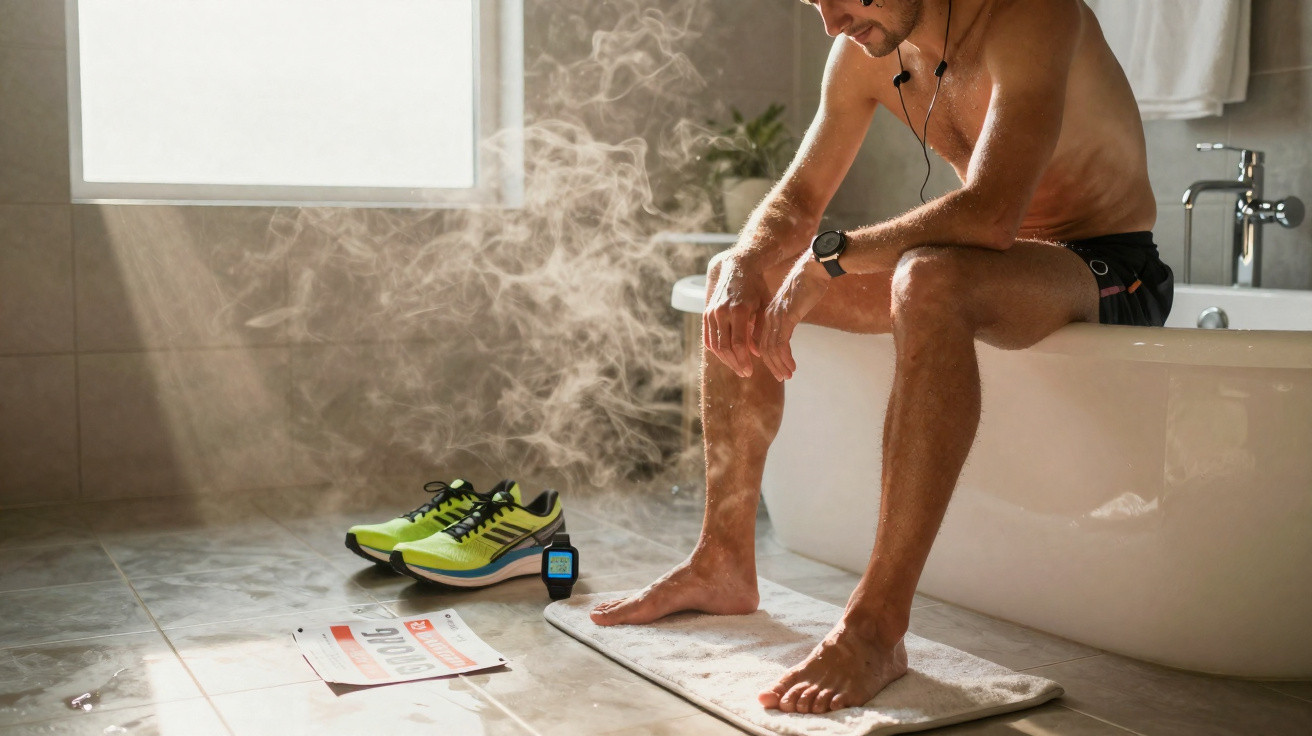
We enlisted well-trained endurance runners, who continued with their usual training programmes. Their sole extra activity was taking five hot baths each week for five weeks.
These baths did not require specialised laboratory equipment; ordinary domestic bathtubs were used.
The water was kept at 40°C with a low-cost thermometer, adding hot water where necessary. Participants bathed for 45 minutes shortly after each training session.
We assessed a range of endurance-related physiological measures before and after the five-week intervention. These included red blood cell volume, heart structure and maximal oxygen uptake (VO₂max), which is widely considered the benchmark measure of aerobic fitness.
What we found
After five weeks of frequent hot baths, the runners showed a significant rise in red blood cell volume. Put simply, their blood contained more cells able to carry oxygen.
Initially, this finding may appear unexpected. At altitude, the lower oxygen content of the air drives increased red blood cell production. Heat does not restrict oxygen availability, but it influences the blood through another mechanism.
Even one heat-exposure session causes plasma, the fluid element of blood, to increase.
This added plasma dilutes red blood cells, temporarily reducing the amount of oxygen transported by the blood.
The body detects this shift and compensates by generating extra red blood cells to re-establish balance.
In time, both plasma volume and the overall number of red blood cells rise. This means a greater total blood volume and an enhanced ability to transport oxygen.
We also recorded alterations in the heart. Endurance exercise is already known to increase the size of the left ventricle, the heart's primary pumping chamber, enabling it to push out more blood with every beat.
The volume of this chamber increased further after the heat intervention. The extra blood generated by heat exposure probably helped drive this enlargement.
Combined, these adaptations raised aerobic capacity. The runners' VO₂max rose by roughly 4% on average, while they could also attain faster speeds in maximal treadmill tests.
Laboratory assessments are not equivalent to race performances, but changes of this size are important for trained athletes – especially because the improvements were achieved without adding training intensity or mileage.
Why this matters for marathon training
The findings have potentially interesting implications for runners and coaches.
Firstly, heat exposure may provide a low-impact means of producing useful bodily adaptations without the extra load of additional exercise. Raising mileage or training intensity invariably brings some injury risk.
By comparison, hot baths stress the cardiovascular system without adding impact to muscles and joints.
Secondly, the method is comparatively accessible. As most people can use a bath, it has very low financial and environmental costs compared with altitude camps.
This could make performance-enhancing – and wholly legal – training methods available more equitably.
As with any research, the study has limitations. We used one particular protocol: water at 40°C, sessions lasting 45 minutes, five times weekly for five weeks. It remains unclear whether briefer baths, cooler water or alternative heat sources, including saunas and steam rooms, would have identical effects.
Safety must also be considered. Extended heat exposure may raise the likelihood of dehydration, dizziness and heat illness.
Anyone trying a comparable method should stay adequately hydrated, prevent overheating and complete sessions with suitable supervision.
Those with existing health conditions should obtain medical advice before trying this sort of protocol.
Finally, we assessed physiological indicators and treadmill performance rather than marathon finishing times. While higher VO₂max is closely associated with endurance performance, further research must establish how these adaptations affect real-world competition.
Nevertheless, our results indicate that improved performance does not necessarily depend on running more miles or travelling overseas. Adaptation can sometimes be prompted through unexpectedly simple methods.
For marathon runners seeking a practical way to complement their training, passive heat exposure could be a remarkably simple option to investigate.
Mike Stembridge, Professor of Cardiovascular and Environmental Physiology, Cardiff School of Sport & Health Sciences, Cardiff Metropolitan University, and Elliott Jenkins, PhD Candidate in Exercise and Environmental Physiology, Cardiff Metropolitan University
This article is republished from The Conversation under a Creative Commons licence. Read the original article.





Comments
No comments yet. Be the first to comment!
Leave a Comment