
Despite the swift progress artificial intelligence has made in recent years, the human brain still surpasses computers when it comes to transferring skills and learning between tasks. A new study offers an explanation for how this is likely achieved.
Researchers led by a team at Princeton University did not test people directly. Instead, they studied rhesus macaques (Macaca mulatta), animals that are biologically and neurologically very similar to humans.
The monkeys were shown shapes and colours on a screen and had to indicate their answers by looking in specific directions. As they completed the tasks, brain scans tracked overlapping patterns and shared regions of neural activity.
Cognitive Legos in rhesus macaque brains
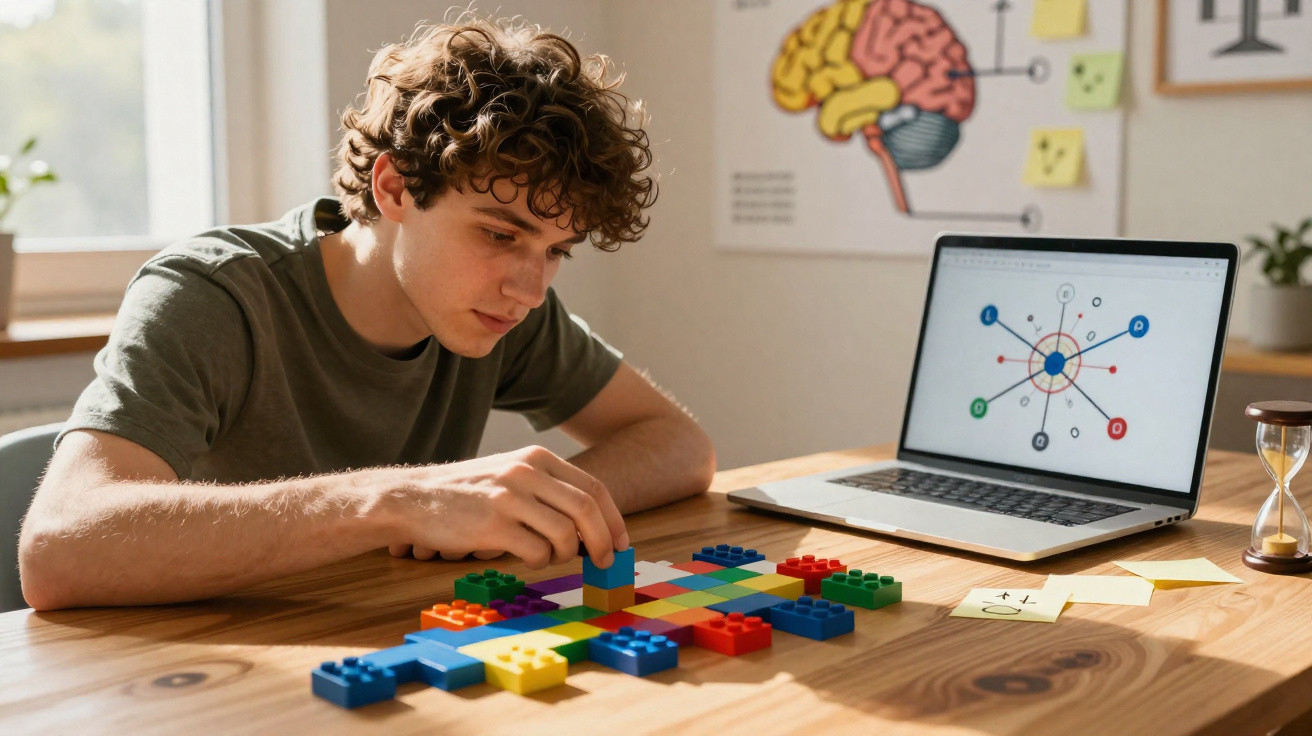
The scans revealed that the monkeys' brains drew on distinct groups of neurons across different tasks. The researchers describe these groups as “cognitive Legos”: existing neural blocks that can be reused and rearranged for unfamiliar tasks. This flexibility is something even the strongest AI models cannot match.
"State-of-the-art AI models can reach human, or even super-human, performance on individual tasks," says neuroscientist Tim Buschman, from Princeton University. "But they struggle to learn and perform many different tasks."
"We found that the brain is flexible because it can reuse components of cognition in many different tasks. By snapping together these 'cognitive Legos', the brain is able to build new tasks."
As shown in the video below, the animals had to distinguish between shapes and colours in three separate yet connected tasks. The exercises required them to keep learning and to apply knowledge gained in one task to the next.
How the brain reuses neural components
The cognitive Lego blocks identified by the team were mainly located in the prefrontal cortex. This brain area is associated with higher cognition, including problem-solving, planning and decision-making, and appears to have a key role in cognitive flexibility.
When particular cognitive blocks were not required, activity within them decreased. This suggests the brain can set aside neural Legos it does not currently need, allowing it to concentrate more effectively on the immediate task.
"I think about a cognitive block like a function in a computer program," says Buschman.
"One set of neurons might discriminate color, and its output can be mapped onto another function that drives an action. That organization allows the brain to perform a task by sequentially performing each component of that task."
This may explain how monkeys, and perhaps humans, can respond to new challenges and tasks by using knowledge they already possess - an ability with which artificial intelligence in its current form still struggles.
Implications for artificial intelligence and treatment
In the longer term, the researchers say their results may help train AI systems to adapt more readily to new tasks. The findings could also support the development of treatments for neurological and psychiatric disorders that make it difficult for people to use skills in unfamiliar situations.
At a basic level, these cognitive Legos demonstrate why brains are more adaptable and flexible than AI models. Such models can display so-called catastrophic forgetting, a limitation in which neural networks cannot learn tasks consecutively without losing the ability to carry out the previous task on which they trained.
Although switching between tasks is not especially beneficial for our brains, transferring what we know from one task to another can provide a helpful shortcut.
"If, as suggested by our results, the brain can reuse representations and computations across tasks, then this could allow one to rapidly adapt to changes in the environment, either by learning the appropriate task representation through reward feedback or by recalling it from long-term memory," the researchers conclude.
The research has been published in Nature.






Comments
No comments yet. Be the first to comment!
Leave a Comment