
At a Saturday morning farmers’ market, a woman in a yellow raincoat lifts a flawless punnet of strawberries.
They are deep red and shiny, carrying a light scent of summer that somehow reaches through the autumn cold. She smiles, then pauses. “You think just rinsing is enough?” she asks the stallholder, partly in jest and partly in earnest. Nearby shoppers look over. One says quietly, “I use vinegar.” Someone else responds with a shrug: “Tap water, always has been fine.”
The stallholder laughs, without offering a real answer. She closes the punnet again. In a moment, the strawberries have changed from an easy treat into a question. Pesticides, soil, bacteria, and every pair of hands involved in getting them from field to crate all come to mind. The fruit has not changed, but it no longer seems quite so innocent.
The woman in the raincoat buys it regardless and walks away, looking at the berries as though they have something to answer for. The real story lies somewhere between the market and her kitchen sink.
Why washing strawberries “as usual” no longer seems sufficient
Strawberries may appear delicate, but they are among the most heavily treated fruits on sale. Their fine skin, tiny seeds and many grooves create ideal places for pesticide residues to stick. When people briefly hold them beneath the tap, almost automatically, they mainly remove dust and a little surface dirt.
It is an action that feels comforting. The tap goes on, water runs over the fruit, and the berries are moved between your hands for a few seconds. Finished. Clean. Safe. Yet the science of pesticide residues is rather more resistant than that casual rinse suggests. Water by itself is not a magic eraser.
The unease begins in the difference between what we assume has been removed and what remains on the fruit.
Each year, reports such as the Environmental Working Group’s “Dirty Dozen” place strawberries close to the top of the list for pesticide contamination. In 2024, laboratory tests once again identified multiple residues in one berry sample, even following a standard rinse. It may sound alarming, but it reflects the reality of contemporary farming and lengthy supply chains.
Think, more personally, of the last time you saw a child take strawberries straight from the punnet. No washing, no kitchen towel, just red lips and sticky fingers. Their sweetness conceals the unseen element: the combination of chemicals used to stop mould, defend crops against insects and ensure the fruit looks perfect in the shop.
That tension between the idea of fruit being “fresh from the field” and what testing reveals is leading more people to reconsider familiar habits at the sink.
Scientists studying washing methods have a slightly ruthless task: they intentionally contaminate fruit before attempting to remove as much as possible. Comparisons between plain tap water and other solutions repeatedly show the same pattern. Water rinses do help, but their effect quickly reaches a limit. Vinegar solutions can perform slightly better against certain microbes, but they do not fully address oily or systemic pesticide residues and may alter the flavour.
Strawberries are especially challenging. Rather than being smooth like an apple, their surface resembles a miniature landscape. Water droplets collect, move away and leave certain areas barely touched. A fast rinse often means areas are missed quickly. Looking at strawberries under a microscope after different washes reveals pockets where residues remain undisturbed, as though the water never reached them.
The reasoning is straightforward: pesticides are made to withstand rain in the field, so a few seconds beneath a tap at home will not be their greatest test.
The baking soda method that outperforms tap water and vinegar
The strongest alternative relies on something remarkably ordinary: baking soda. A mildly alkaline solution using everyday sodium bicarbonate can help break down certain pesticide molecules or release them from the fruit’s surface more effectively than water alone. Unlike vinegar, it does not fill the kitchen with a sharp smell or sting your nose.
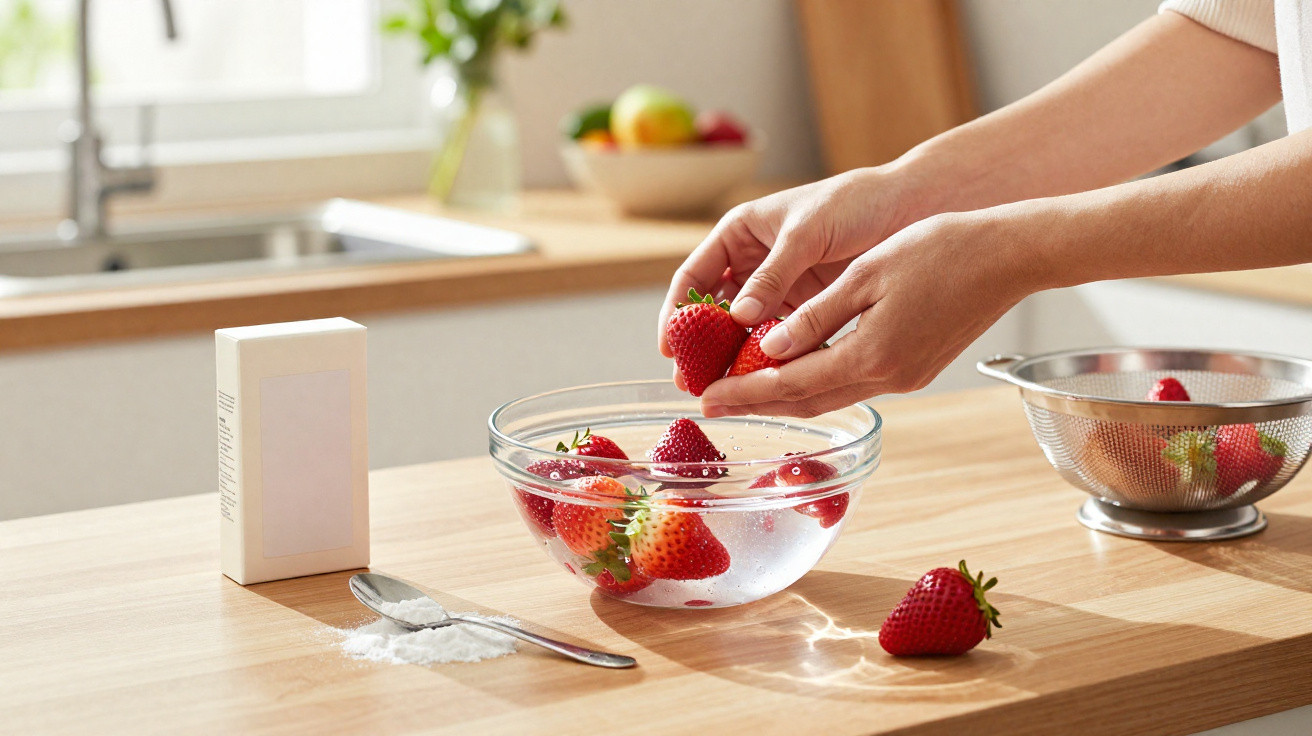
This is the straightforward approach many food scientists now recommend: fill a large bowl with cold water, add roughly 1 teaspoon of baking soda per litre, stir it, and carefully place the strawberries in the water. There is no need to rub or scrub them. Leave them to soak for 12 to 15 minutes, gently swirling the bowl once or twice. Afterwards, drain the berries and give them a short rinse with fresh water.
It may seem almost too simple, but laboratory tests have shown that this mixture can remove a greater proportion of common pesticide residues than either tap water or vinegar-only rinses.
Methods like this meet a very human obstacle: routine and time. People often buy strawberries at the last minute for a pudding or snack, rather than planning for a 15-minute soak. Using a bowl feels like another job. The baking soda may be hidden in a cupboard behind three unused jars. Meanwhile, vinegar has been suggested for years by grandmothers and wellness blogs alike, helped by its pungent scent and “natural” reputation.
During a hectic weekday, the familiar quick rinse is far more likely. Let’s be honest: hardly anyone really does this every day. This is why small shortcuts can help. Measure baking soda into a small jar in advance and leave it by the sink. Store a dedicated washing bowl inside your colander. Begin the soak while putting away the rest of the shopping.
The aim is not flawless behaviour. It is to move your usual wash from something “symbolic” to something genuinely effective, while keeping it practical enough to do.
“The best wash is the one you’ll actually use every week, not just the perfect protocol you read about once and then forget,” says a nutritionist who teaches food safety workshops to parents. “Baking soda doesn’t sound glamorous, but it works quietly in the background while you live your life.”
In practical terms, that quietness is important. Baking soda does not leave the strong aftertaste vinegar sometimes can, and it is kind to fragile berries, helping them retain their shape and flavour. You are not transforming the kitchen into a chemistry laboratory; you are simply adjusting the water in a way your palate will scarcely detect, but your health may.
- Use cold rather than warm water to help the strawberries stay firm.
- Soak them before removing the green tops, which limits water getting inside.
- Dry them by patting with a clean cloth or kitchen paper to prevent them becoming mushy.
Strawberries, food safety and the balance between concern and enjoyment
Food safety can sometimes be turned into a source of fear. Every mouthful becomes a danger and every pleasure becomes a calculation. That is not the purpose here. Strawberries should not become a cause of ongoing worry: they are for sharing, eating with your fingers, baking into cakes and slicing over weekend pancakes. The question is not alarmist but more honest: how can you preserve that enjoyment while quietly reducing the unseen load on your plate?
We all recognise the moment when a punnet of fruit sits on the worktop, changing from bright to slightly weary as we think too much about what to do with it. Perhaps the real change comes when washing becomes a small ritual rather than a chore. Berries sit in the bowl as water and baking soda swirl around them; for a few minutes, you lay the table or make packed lunches while the science works slowly. It is ordinary, almost dull. Even so, it changes the story those strawberries bring to your mouth.
Some people may take additional steps, buying organic when possible, choosing frozen berries from trusted brands or reducing purchases outside the growing season. Others will not, or cannot, and that is fine. What matters is that the way you wash your fruit matches the way you want to eat and live, not someone else’s perfect lifestyle on social media. Once that is the case, there is no need to keep debating tap water versus vinegar in your mind. You simply know what you do and why.
| Key point | Detail | Benefit for the reader |
|---|---|---|
| Tap water is not enough | A quick rinse mostly removes dust and some surface microbes, rather than deeper pesticide residues | Helps you reconsider automatic washing habits that seem safe but have limited effectiveness |
| Vinegar has limits | It may help with some bacteria, but does not consistently break down common pesticide molecules on strawberries | Prevents reliance on a method that can alter flavour without providing the strongest protection |
| A baking soda soak stands out | About 1 tsp per litre, soaking for 12–15 minutes and a brief rinse afterwards can reduce residues more effectively | Provides a practical, realistic technique to use at home for cleaner, safer strawberries |
FAQ
- Can I just wash strawberries with plain tap water? Plain water is better than nothing and removes some dirt and microbes, but it does not reliably reduce pesticide residues as much as a baking soda soak.
- Does vinegar work for cleaning strawberries? Vinegar can help with certain bacteria and mould spores, yet tests show it does not consistently outperform a mild baking soda solution for pesticides, and it can leave a lingering taste.
- How exactly should I use baking soda to wash strawberries? Fill a bowl with cold water, add about 1 teaspoon of baking soda per litre, stir, soak the berries for 12–15 minutes, then rinse briefly with fresh water and pat dry.
- Will baking soda change the flavour or texture? If you respect small quantities and soak time, it should not affect taste or make berries mushy; using cold water and gentle handling helps keep them firm.
- Is it still worth buying non-organic strawberries? For many people, yes: washing them effectively with a baking soda soak can significantly cut residues, letting you enjoy strawberries even when organic options are limited or too expensive.





Comments
No comments yet. Be the first to comment!
Leave a Comment