
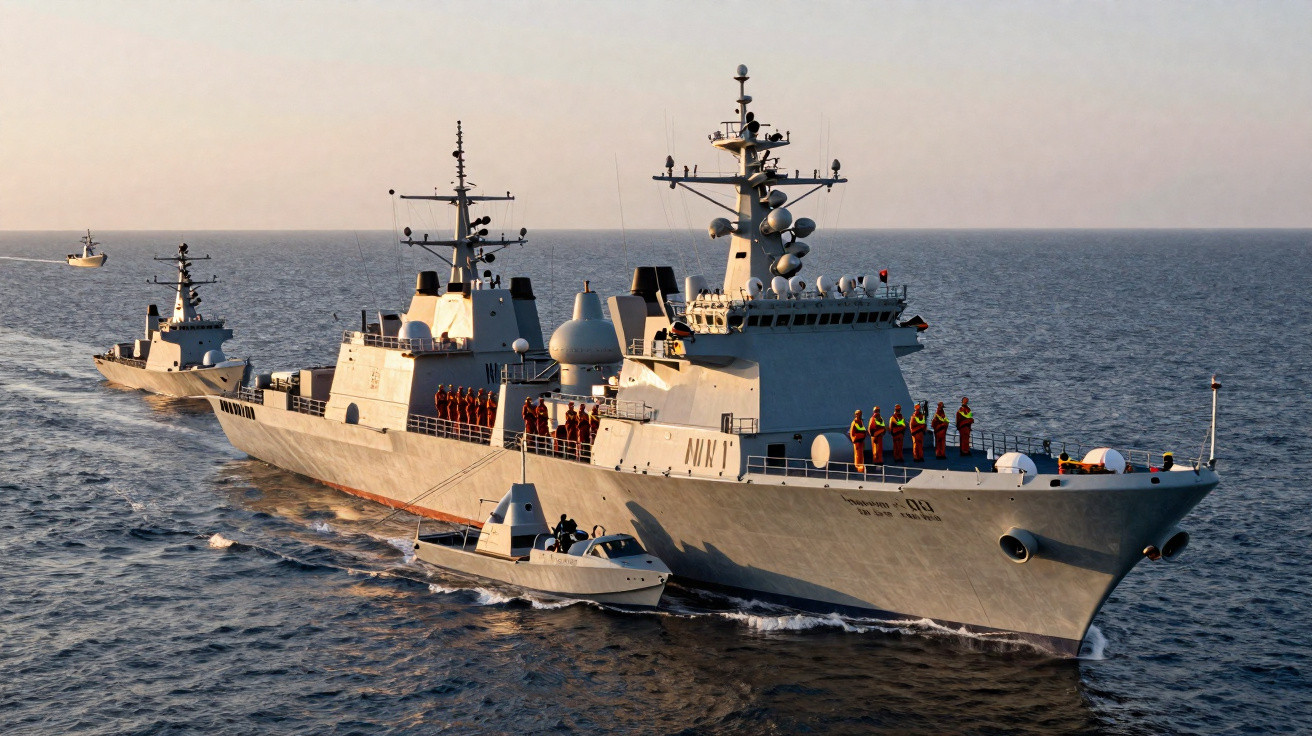
The French Navy has discreetly deployed its flagship nuclear-powered aircraft carrier, Charles de Gaulle, to the Atlantic Ocean for a war game lasting several months. The exercise is intended to assess how France and its allies would fight - and maintain - a major modern conflict close to Europe.
France’s flagship moves west for a high-stakes drill
On 5 February 2026, the French Navy announced that the Charles de Gaulle carrier strike group had moved from the Mediterranean into the Atlantic for ORION 26, France’s biggest high-intensity joint and allied exercise.
The deployment came after the group sailed from its Toulon home port on 27 January. Having completed an initial Mediterranean training period, the force has now joined a national operational manoeuvre spanning French territory, airspace, nearby waters, cyberspace and space-based capabilities.
ORION 26 is designed to rehearse how France would lead and sustain a multinational coalition in a major conventional conflict on European soil.
The Atlantic is a key part of this scenario. It provides the principal setting for naval, air and amphibious activity, as well as for defending reinforcement routes from North America and other European allies.
Inside ORION 26: a fictional war with real-world echoes
ORION 26 is based on an invented storyline that will seem notably familiar to European security planners.
Under the scenario, an expansionist country named Mercure seeks to control its neighbour, Arnland, and prevent it from progressing towards European Union membership. During 2025, Mercure is portrayed as employing hybrid methods, including online information pressure, political coercion and backing for armed militias operating within Arnland.
The crisis subsequently develops into outright war.
On 6 January 2026, France assumes the political and military leadership of a coalition intervening to protect Arnland’s sovereignty, following a request from the smaller state. That decision begins ORION 26’s military stages, which are structured around several levels of conflict:
- Sub-threshold friction and hybrid actions
- Escalation and deterrence failure
- High-intensity conventional warfare
French and allied troops are required to operate simultaneously across land, sea, air, cyber and space domains. The script also incorporates civilian dimensions, including pressure on critical infrastructure, public services and national resilience.
The exercise deliberately mirrors current patterns in Eastern Europe, without naming any real country, to keep planning both realistic and politically manageable.
Scale of the exercise: preparing for a NATO-level conflict
ORION 26 takes place between 8 February and 30 April 2026. It brings together 24 countries and approximately 10,000 personnel across several areas of France and its surrounding maritime approaches.
Forces deployed on land, at sea and in the air
The forces assigned demonstrate that this is far beyond a standard training event:
- 1 carrier strike group centred on Charles de Gaulle
- 2 amphibious helicopter carriers
- 25 major surface combatants
- 50 fixed-wing combat aircraft
- 1 army corps-level headquarters commanding 3 combined-arms brigades
- Around 2,150 tactical vehicles
- 40 helicopters and roughly 1,200 combat and specialist drones
- 2 medium-altitude long-endurance (MALE) drones
- 6 ground-based air defence systems
- 20 space sensors linked into the SparteX 2026 space command network
Cyber activity runs throughout the exercise, connecting simulated and real incidents with their effects on the battlefield. French cyber forces train both in network defence and in controlled offensive or influence operations.
Four linked phases of ORION 26
| Phase | Main focus |
|---|---|
| O.1 | Operational planning and the conversion of political objectives into a joint campaign led by France |
| O.2 | Coalition deployment and entry into a contested theatre, including the first high-intensity engagements |
| O.3 | An interministerial wargame examining home-front resilience, civil protection and continuity of state functions |
| O.4 | Integration of French forces within a NATO command structure and practice of alliance-level decision-making |
The exercise is designed to emphasise endurance rather than short, isolated drills. Over several weeks, commanders must sustain logistics, rebuild combat capability and continuously coordinate large formations.
French headquarters are placed in a role similar to a NATO joint force command, testing their ability to run a coalition fight under real pressure.
The Charles de Gaulle carrier strike group’s Atlantic role
Within ORION 26, the Charles de Gaulle carrier strike group forms a major element of the maritime component. Its responsibilities include fleet air defence, anti-submarine warfare, long-range strike missions and air support for forces ashore.
Before deploying into the Atlantic, the group undertook an intensive programme of Mediterranean training, including:
- Air-defence drills involving French Air and Space Force jets and French Navy aircraft
- Anti-submarine and surface-warfare training against simulated threats
- A replenishment at sea with the Italian destroyer Andrea Doria
- A cross-deck helicopter evolution in which an Italian SH-90 landed on the French carrier
Although less eye-catching than combat imagery, these activities are essential for refining procedures, radio discipline and the human aspects of interoperability between navies.
Which ships and aircraft make up the group?
The French Navy has not disclosed the complete order of battle. However, units reported to have left Toulon on 27 January included:
- Aircraft carrier Charles de Gaulle
- Air-defence frigate Alsace
- Horizon-class destroyer Chevalier Paul
- Italian destroyer Andrea Doria
- Replenishment ship Jacques Chevallier
- A nuclear-powered attack submarine, acting as an unnamed escort
This force package combines air-defence capability, anti-submarine protection and logistical support. The carrier is operating around 20 Rafale Marine fighter jets, tasked in the exercise scenario with air policing, escort operations and precision strikes.
For many NATO planners, Charles de Gaulle is a rare European asset: a CATOBAR carrier able to launch heavy, fully armed jets with catapults.
Charles de Gaulle: the technical foundation of French power projection
Commissioned in 2001, Charles de Gaulle is still France’s sole nuclear-powered aircraft carrier.
Its principal specifications are:
- Full-load displacement: roughly 42,500 tonnes
- Length: 261.5 metres
- Flight deck beam: 64.4 metres
- Draught at full load: about 9.5 metres
- Propulsion: two K15 pressurised-water nuclear reactors driving two shafts
- Maximum speed: around 27 knots
- Air group capacity: up to 40 aircraft (Rafale Marine, E-2C Hawkeye and helicopters)
The vessel operates a CATOBAR system - catapult assisted take-off but arrested recovery - using two 75-metre steam catapults and arresting wires. This arrangement permits the launch of fully armed fighters and early-warning aircraft, a capability that remains uncommon outside the US Navy.
Its defensive fit includes Aster 15 surface-to-air missiles, Mistral short-range missiles fired from Sadral launchers, Narwhal 20mm remote guns, and an electronic-warfare suite integrated with the SENIT 8 combat management system. The ship’s company and embarked air wing can together number about 2,000 personnel.
In operational terms, the carrier has previously conducted combat deployments over Afghanistan, Libya, Iraq and Syria. These missions have given French commanders practical experience of managing complex sea-based air campaigns.
Why ORION 26 matters to NATO and European defence
ORION 26 does not carry NATO branding, but its structure is plainly designed with the alliance in view. By placing French headquarters at the centre of coalition command, Paris is indicating that it can offer a credible operational framework during a crisis.
The exercise also examines the practical matters that seldom attract public attention: ammunition supplies, maintenance cycles, maritime fuel provision and the political tensions arising from shared command. Such factors can determine whether a coalition operation endures or breaks down after its initial weeks.
For allies watching from London, Washington or Warsaw, ORION 26 is a live laboratory for how a European-led response to a serious crisis might actually function.
Key concepts behind the ORION 26 exercise
Several terms associated with ORION 26 merit explanation:
- High-intensity warfare: combat against a capable state adversary equipped with modern air defences, electronic warfare, long-range missiles and substantial ground forces. Casualties, ammunition expenditure and equipment attrition are much greater than in counterinsurgency operations.
- Hybrid actions: approaches that fall between peace and open conflict, including cyberattacks against infrastructure, disinformation campaigns, covert support for militias and focused economic coercion.
- Multi-domain operations: coordinated activity across land, sea, air, cyber and space, in which developments in one domain - such as a cyberattack - can affect outcomes in another, including air-defence performance.
Realistic simulation of these conditions requires armed forces to move beyond habits developed during more limited operations. Aircrews, for instance, must work on the basis that their communications may be jammed, GPS signals spoofed or bases attacked by long-range missiles.
Exercises of this size also bring risks: greater costs, substantial pressure on equipment and the possibility that rivals or observers misunderstand military signals. They nevertheless provide political leaders with a clearer understanding of what their forces could genuinely deliver if deterrence fails, as well as identifying where additional investment or allied reinforcements would be required.






Comments
No comments yet. Be the first to comment!
Leave a Comment