
From checking emails in the morning to driving late at night, glasses sit between our eyes and the outside world for many hours each day. Such constant wear inevitably leaves traces: fine scratches, a cloudy film and greasy residue that seems impossible to shift. Faced with this, many people reach for whichever cleaner is nearest, which is often when the genuine harm starts.
The overlooked problem of scratched lenses
Optical organisations throughout Europe describe the same trend: millions of pairs are bought annually, while most wearers report scratched or hazy lenses within their first few months of use. Usually, this is not caused by one major mishap. Instead, it results from everyday routines, such as rubbing lenses with a T-shirt, using window-cleaning spray or leaving spectacles lens-down on a table.
Most lens damage starts at home, not at the optician: the wrong cloth, the wrong liquid, repeated hundreds of times.
Today’s prescription spectacles and sunglasses generally pair lightweight plastic lens materials with exceptionally thin coatings, including anti-reflective layers, scratch-resistant films and blue-light and UV filters. While these coatings improve visual clarity and eye protection, they are vulnerable to heat and aggressive chemicals. A lens may cope with one or two unsuitable cleans, but doing this daily for six months can cause its coatings to become dull, peel away or crack.
Why cleaning can cause more damage than scratches
Opticians make an important distinction between mineral, or glass, lenses and plastic ones. Glass is more scratch-resistant but heavier, whereas plastic is lighter and accommodates a wider range of coatings, although it tends to show wear sooner. Yet both have the same vulnerability: their surface treatments.
Domestic cleaning products frequently include alcohol, ammonia, powerful degreasers or polishing compounds. They may be highly effective on car windscreens and kitchen tiles, but on spectacle lenses they gradually break down the protective films designed to reduce glare and fingerprints.
That “perfect shine” after using window cleaner usually means the top layer has already started to dissolve.
Figures from repair centres indicate that many expensive lens replacements are caused not by accidents, but by prolonged overly harsh cleaning. The actual lenses are still structurally sound; it is their coatings that deteriorate, leaving people to replace their glasses much earlier than expected.
The baking soda method for scratched glasses
In response, a straightforward and inexpensive approach has gained quiet backing from independent laboratories and numerous opticians: a baking soda and water paste. When correctly applied to plastic lenses with minor surface scratches, it may noticeably improve clarity without removing the coatings.
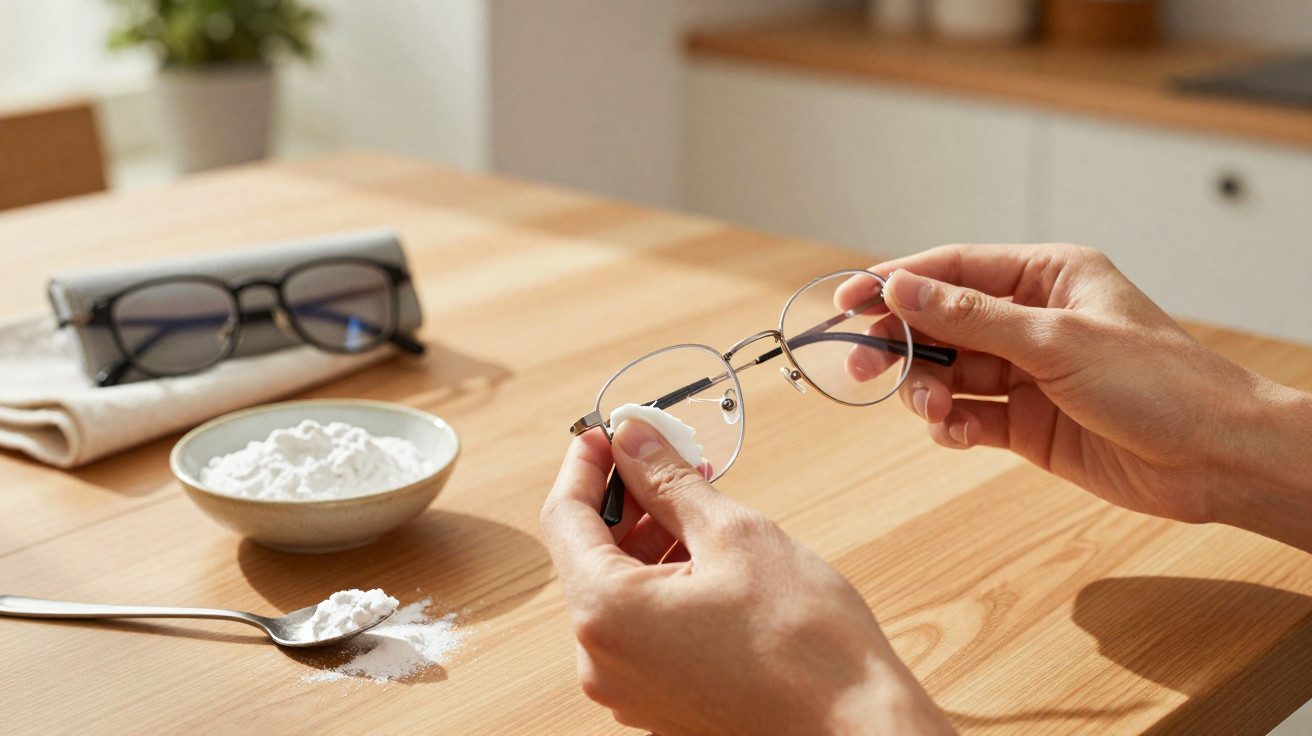
Using baking soda on scratched spectacles
- Combine two parts baking soda with one part cold water to form a smooth, creamy paste.
- Apply a small quantity to each lens.
- With a clean microfibre cloth, gently work the paste in small circular motions for approximately 10 seconds.
- Rinse the lenses completely under cold water.
- Use a second clean microfibre cloth to dry them, again with gentle circular movements.
Its usefulness comes from the carefully limited abrasive action of baking soda crystals mixed with water. They buff the uppermost plastic surface, reducing micro-scratches and lifting persistent residue that standard lens sprays can leave behind.
When used sparingly, baking soda behaves like a micro-polisher: it refreshes the surface instead of grinding through it.
The cost of each use is far below that of one lens-cleaning wipe, making it attractive for households managing energy bills, travel costs and healthcare charges. Opticians nevertheless emphasise two restrictions: it is suitable only for light, surface-level marks, and it must not become an everyday treatment. Consider it an occasional refresh rather than a regular cleaning method.
Neutral toothpaste: a riskier version of the same approach
Toothpaste is often presented on social media as a miracle treatment for scratched sunglasses. The thinking resembles the baking soda method: a mildly abrasive paste should polish the lens surface. In reality, outcomes range dramatically from “pretty good” to “permanently ruined”.
Tests conducted independently on retail toothpastes reveal three distinctly different results according to the formulation:
| Method | Effect on light scratches | Risk to coatings |
|---|---|---|
| Baking soda + water | Noticeable visual improvement | Low |
| White, non-gel toothpaste | Moderate improvement | Medium |
| Soap or glass cleaner | Little or negative effect | High |
Only a small selection of toothpastes containing low levels of calcium carbonate or fine silica can polish lenses without making modern UV and anti-blue-light coatings cloudy. Many whitening and “extra-fresh” formulas include more abrasive ingredients and additives, which can leave a lens dull, streaky or permanently hazy.
Toothpaste can work in theory, but the margin between “slight improvement” and “irreversible haze” is thin.
Consequently, many optical specialists regard baking soda as a careful at-home option but remain doubtful about toothpaste, except for very inexpensive sunglasses without coatings, where the consequences are less significant.
The oil illusion: tidy-looking lenses for one short afternoon
A further common trick is to rub an extremely small amount of petroleum jelly or olive oil over scratched glasses. This works in an entirely different manner. Rather than polishing the material, oil briefly fills the grooves, refracting light more evenly and making the scratches less visible.
This can appear strikingly effective in a mirror, particularly in gentle indoor light. The coating is delicate, however, and within hours it collects dust, natural skin oils and fingerprints, leaving lenses looking greasy and misted.
Oil doesn’t heal the wound; it simply puts make-up over it, then gathers every speck of dirt in the room.
Technicians consider it no more than a temporary measure. If sunglasses are scratched while on holiday and suitable cleaning equipment is unavailable, the smallest amount of oil could make a long drive easier. On returning home, the lenses need a thorough clean and assessment: deep scratches that interfere with vision require professional attention rather than a cosmetic disguise.
Five habits that stop most new scratches
Insurance figures indicate that roughly seven in ten accidental lens-damage incidents happen not while travelling or playing sport, but during ordinary handling: putting glasses down on a bedside table, dropping them unprotected into a bag or wiping them with abrasive paper towels.
- Store spectacles in a hard, padded case at all times, rather than a soft pouch or an unprotected pocket.
- Take them off using both hands, preventing the frame from twisting and the lenses from being stressed.
- Set them down only on clean, level surfaces, with the lenses facing upwards.
- Choose microfibre cloths intended for optical use, never tissues, kitchen roll or clothing.
- Do not leave them on dashboards, near radiators or by heat sources exceeding approximately 40°C.
Repeating these modest actions every day can readily extend the comfortable life of one pair of spectacles by several years. This is significant when prescription lenses may cost as much as a short weekend getaway.
The unseen cost of clear vision
In the UK, the US and much of Europe, replacing mid-range prescription lenses commonly costs the equivalent of £80 to £220, depending on their thickness, coatings and brand. For households with several people who wear spectacles, the expense rises quickly, particularly where children need a new prescription every year or two.
Good lens care functions like routine boiler servicing or tyre checks: dull but quietly effective at avoiding big bills later.
Preventative maintenance also means less waste. Scratched lenses are often sent to landfill despite the fact that only their surface layers have failed. Making each pair last longer reduces the plastic, chemical coatings and packaging entering the environment. Lens care may seem a small consideration for households seeking a more sustainable lifestyle, but it has a meaningful environmental benefit.
When an at-home treatment is insufficient
Certain signs indicate that DIY solutions should end and professional advice is needed. Scratches deep enough to catch a fingernail are normally beyond the scope of baking soda polishing. Rainbow effects, lifting edges or surface “bubbles” can mean that the coating itself is separating from the lens.
Changes to vision are equally important. Headaches, eye strain and stronger glare when driving at night may indicate damage more serious than a purely cosmetic defect. In these situations, an optician can determine whether professional re-polishing, recoating or complete replacement is the better option, as well as whether warranty or insurance covers any of the expense.
Beyond spectacles: using the same principles elsewhere
The principles behind the baking soda approach also apply to other everyday items. Mobile phone screens with plastic protectors, watch faces and even certain camera filters can react similarly: a very gentle abrasive may buff out fine surface marks, while harsh cleaning agents can destroy coatings. Manufacturer guidance should always be checked first, as camera lenses and coated screens are often more sensitive than spectacles.
For people who depend heavily on clear sight, including drivers, screen-based workers and students, the balance is straightforward. Spending a few careful minutes using suitable materials, while avoiding shortcut products such as glass cleaner and harsh soap, can keep lenses functional for much longer. This simple practice protects visual comfort and the household budget alike, without the frustration of finding another scratched, cloudy pair of glasses at the back of a drawer.




Comments
No comments yet. Be the first to comment!
Leave a Comment