

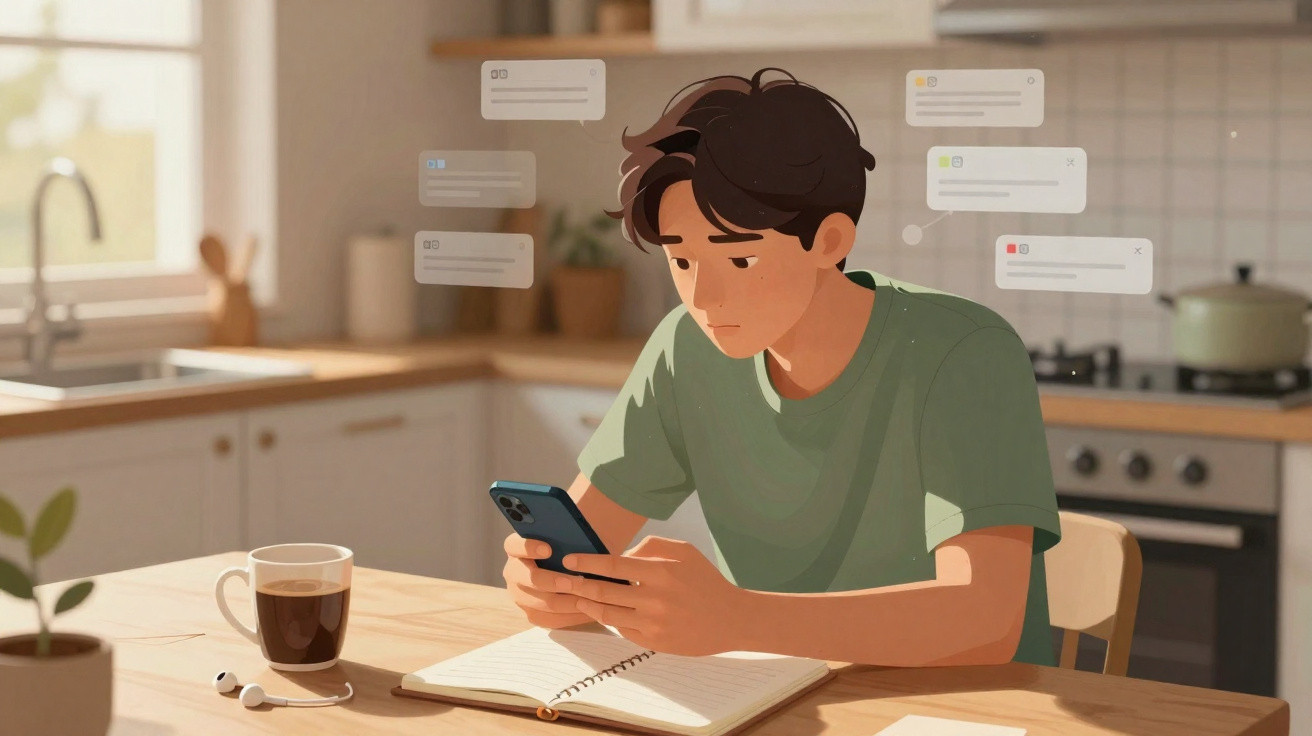
The kettle switches itself off in an otherwise empty kitchen. Your phone flashes with another notification, only for it to be a promotional email and an unrelated meme from the group chat. You keep scrolling regardless. Not because it matters to you, but because the quiet is beginning to feel unbearably loud.
You tell yourself you are simply “tired”. You say you are in your quiet era, perhaps even make a joke of it. But each evening, you listen out for a message alert that does not arrive, repeatedly refreshing your apps as though one more tap could alter something.
By most measures, you are not alone. Online, you are constantly surrounded.
So why does it feel this way?
When “I’m just tired” is actually loneliness in disguise
One of the earliest, less obvious signs of loneliness is beginning to decline invitations without a clear reason. A friend suggests going for a drink after work, and you find yourself saying you are exhausted or have too much on.
Then you remain at home, partly relieved and partly sorry you said no, scrolling while the television provides background sound. The day takes on a strangely indistinct quality. Nothing is clearly wrong, but something still feels off.
It is not the kind of sadness that feels dramatic. It is closer to a quiet, ongoing hum.
Consider the last time you cancelled plans you genuinely wanted to attend. Not because you were ill or overwhelmed, but because leaving the house seemed like too much. Perhaps you looked through your wardrobe, tried on two shirts, and then abruptly decided you “wasn’t in the mood anymore.”
One woman I interviewed explained that she regularly made up “late work calls” so she could avoid dinner plans. Her colleagues assumed she was busy and flourishing. Instead, she would return home, eat cereal at the counter and act as though it had been her decision.
On Instagram, she appeared to be constantly out and about. At home in her living room, she had not had a meaningful conversation for days.
This is the quiet calculation of loneliness: fewer brief encounters with others and more unexplained empty hours. You begin to play it down in your own mind.
You might tell yourself that other people have it worse, meaning you do not “deserve” to describe your experience as loneliness. Instead, you call it stress, introversion or low energy - anything except what it may be.
The problem with subtle loneliness is that it doesn’t shout, it seeps. By the time you recognise it, it may already have shaped the rhythm of your days.
The strange small habits that signal “I feel alone”
One particularly telling sign is speaking to screens more than you speak to people. You may binge a series not because you particularly enjoy it, but because the characters feel oddly companionable. You leave YouTube playing as you cook, not to take anything in, but simply to hear people talking.
You might even notice yourself narrating your evening aloud, commenting on your own life as if somebody else were present. That does not make you “strange”. It may simply mean your brain wants connection and is making do with what is available.
Another sign is that conversations start to remain unusually superficial. You may see colleagues, neighbours or even relatives, but every exchange stays at the “How are you? - Fine, you?” level. You do not take the chance of saying, “Actually, I’m not great.”
One reader told me that he visited the same café every Saturday morning. The barista knew both his name and his order, and they would talk about the weather and football. It was the most meaningful connection he had that week. He held on to that ritual like a lifeline, before returning home and wondering why Sundays felt so difficult.
No one would have described him as “lonely”. On paper, he was “out and about”.
Your inner voice can change too. When you think about messaging someone, you may catch yourself saying, “I don’t want to bother anyone”. You pause before sharing a photo, then conclude that nobody cares anyway.
Social invitations can begin to resemble tests you expect to fail. You imagine yourself alone at a party, so decide to stay in “just this once”. Honestly, no one repeats this every day and genuinely calls it freedom.
Loneliness can disguise itself as “I’m better off alone”, while beneath it sits the quiet wish that somebody will make sure you come.
How to gently answer what your loneliness is asking for
A straightforward approach is to restore connection in its smallest possible form. You do not need to build a complete social life overnight; aim for one daily human interaction that feels a little more genuine than a like or heart reaction.
It might mean chatting with the cashier for 30 seconds rather than offering a hurried “hi”. It could be sending a voice note rather than another “haha” message, or sitting in a park with a book instead of staying indoors with your headphones on. These are tiny steps, almost unnoticeable to anyone watching from outside.
You are not trying to become “social”. You are showing your nervous system that the world is not shut off from you.
Many of us fall into the same trap: waiting to feel better before making contact. We tell ourselves we will ring someone once we are “less weird”, “less sad”, or “more fun.”
In practice, the reverse is often true. Reaching out is what gradually helps you feel better. You do not need a TED talk in your DMs; a reply reminding you that you exist in another person’s thoughts may be enough.
Treat yourself as you would a friend who admitted they were lonely. You would not say, “Yeah, hide and wait until you feel perfect first.” You would say, “Text me anyway.”
Sometimes the most radical thing you can do for your mental health is to send a message that feels slightly too honest and hit “send” before you overthink it.
- Begin with people who already feel safe, even if months have passed since you last spoke.
- Choose a specific opener, such as “This made me think of you”, rather than “Hey, how are you?”.
- Arrange one easy, low-pressure ritual: a weekly walk, game night or co-working session at a café.
- Keep expectations manageable: a ten-minute call is still genuine connection.
- Pay attention when you censor yourself, and gently challenge the urge to do so.
Letting loneliness say what it needs to say
Loneliness is not a personal failing. Like hunger or thirst, it is a signal that something within you needs attention. You may have a partner, children and a full-time job while still feeling emotionally undernourished. You can be surrounded by people and still feel unseen.
At times, that signal may point towards friendships that have remained on the surface. At others, it may reflect living in a city that has never felt like home, or becoming a version of yourself that no longer fits with the people you once belonged with.
You do not need to solve everything at once, nor do you have to turn it into a drama. You can begin by saying it plainly: “I’ve been feeling lonely lately.”
From that point, small experiments can open up. Try a new hobby where nobody knows you. Message the person whose company you always enjoy but rarely see. Consider a therapist, support group, club, choir or a casual game in the park. Connection doesn’t have to be big to be real.
The subtle signs you have noticed - cancelled plans, endless scrolling and talking more to programmes than friends - are not the entire story. They are the beginning. What happens next is where things can quietly start to shift.
| Key point | Detail | Value for the reader |
|---|---|---|
| Recognise quiet loneliness | Identify behaviours such as cancelling plans, constant scrolling and superficial conversations | Gives a name to a feeling you may have minimised |
| Begin with micro-connections | One authentic moment of human contact each day, online or offline | Makes change seem achievable rather than overwhelming |
| Reach out before you “feel ready” | Send simple, honest messages to people who feel safe | Interrupts the cycle of isolation and self-doubt |
FAQ:
- How do I know if I’m lonely or just introverted? Introverts regain energy alone, while still feeling sustained by a small number of close relationships. Loneliness feels like an ache or a sense of emptiness, even when you technically have “enough” people around.
- Can I feel lonely in a relationship? Yes. Loneliness concerns feeling unseen or unsupported, rather than only being physically alone. Couples often experience loneliness when their communication becomes purely logistical.
- Does social media make loneliness worse? It can, particularly when you consume content without interacting. Passive scrolling often draws attention to what you lack instead of the people already in your life.
- What’s one thing I can do tonight? Send one honest message to somebody you trust: a simple “Hey, I’ve been feeling a bit off lately, can we catch up soon?” is enough.
- Should I be worried about feeling lonely often? Ongoing loneliness can affect both mental and physical health, so it warrants attention. Speaking with a therapist, doctor or counsellor is not overreacting; it is preventive care.





Comments
No comments yet. Be the first to comment!
Leave a Comment