
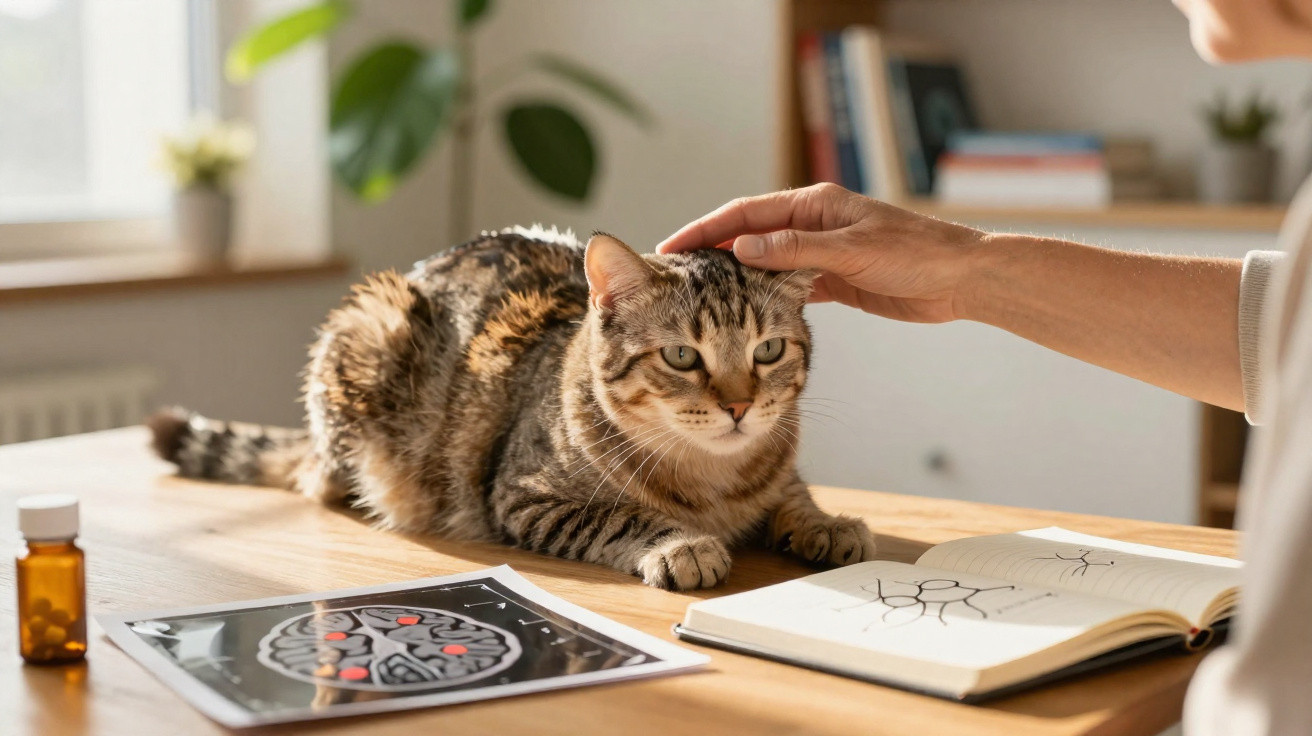
In sitting rooms and along window sills, a subtle medical puzzle may be developing in plain sight - complete with whiskers.
As pet cats reach older ages, veterinary professionals are increasingly seeing puzzling behaviours that seem to be more than ordinary ageing. Fresh research indicates that these changes could resemble the earliest phases of Alzheimer’s disease in humans, making the household cat an unexpected natural model for human dementia.
When an older cat begins behaving differently
Many cat owners will recognise the situation: an elderly cat starts yowling at 3am, gazes at walls, or appears unable to find its way around a flat it has lived in for ten years. Such incidents are frequently put down to “just getting old”. However, a new investigation led by the University of Edinburgh, the UK Dementia Research Institute and the University of California suggests a more complex explanation.
The researchers found that as many as half of cats aged over 15 show at least one behaviour associated with cognitive decline. These changes may involve:
- Unusual vocalising during the night
- Disorientation in well-known surroundings
- Abrupt withdrawal or hiding
- Altered sleep–wake patterns
- Forgetting litter tray routines
For many older cats, these behavioural shifts are linked to measurable changes in the brain rather than simple ageing.
The result is important both for the care of ageing pets and for scientific efforts to understand one of the most persistent diseases affecting humans.
Amyloid plaques in cats' brains
Published in the European Journal of Neuroscience, the study analysed the brains of elderly cats, including cats that had displayed dementia-related signs while alive. Using powerful confocal microscopes, the researchers identified deposits of toxic beta-amyloid protein.
In humans, these sticky protein clusters are a defining feature of Alzheimer’s disease. Amyloid accumulates in the brain, disrupting signalling between nerve cells and causing inflammation. A comparable process now appears to be occurring in cats.
The researchers found beta-amyloid plaques lodged right inside synapses, the tiny junctions where nerve cells pass signals.
These obstructed synapses are not merely passive effects of the disease. Instead, they appear to initiate a chain of events that causes brain connections to disappear and ultimately produces observable behavioural changes.
Synapses under attack
The researchers then examined events following beta-amyloid contamination of synapses. Two types of supporting cells - astrocytes and microglia - become involved. In a healthy brain, these cells remove surplus synapses during development, helping neural networks remain efficient.
Among cats showing dementia-like behaviour, this synapse-removal mechanism seems to become excessively active. Microglia and astrocytes were observed engulfing synapses, particularly those carrying amyloid markers.
Near the plaques, glial cells were actively engulfing connections, accelerating the loss of communication circuits in the brain.
Three-dimensional imaging revealed a pronounced three-way overlap: amyloid-marked synapses surrounded by glial cells. This was substantially more evident in cats with behavioural symptoms than in elderly cats that had aged without clear cognitive decline.
The contrast adds support to the view that feline dementia is not simply “more years on the clock”, but a separate neurodegenerative condition resembling early Alzheimer’s disease in humans.
Cats as a natural model for Alzheimer’s research
For many years, Alzheimer’s research has depended largely on genetically engineered mice. Researchers alter mouse genes so that the animals develop amyloid plaques quickly, before using them to assess possible treatments. While these models have generated valuable findings, they do not fully reproduce the gradual and complex progression of human disease.
Older cats provide a different option. They develop brain changes and behavioural symptoms naturally, with no laboratory intervention. This makes them a more comparable model for human patients, who likewise do not have modified genes or severe mutations.
| Research model | How plaques form | Resemblance to human Alzheimer’s |
|---|---|---|
| Genetically modified mice | Artificially driven by added mutations | Partial, often faster and more aggressive |
| Ageing cats | Spontaneous with natural ageing | Closer to typical, late-onset disease |
Because cats develop dementia-like changes naturally, they may bridge the gap between lab rodents and human patients.
Scientists hope that examining feline brains can enable them to follow the earliest phases of amyloid build-up and excessive glial activity. This period is particularly difficult to observe in humans because most people receive a diagnosis only after symptoms have become advanced.
What this could mean for treatments
Cats could be useful for testing therapies designed to preserve synapses, rather than treatments focused solely on removing plaques. Should medicines or antibodies reduce excessive microglia and astrocyte activity in cats, a similar strategy could potentially apply to humans.
The research could also improve the ways in which doctors and vets assess early cognitive change. Pet behaviour scales may help inform more effective questionnaires or at-home monitoring methods for older adults, well before severe memory loss becomes apparent.
What cat owners should watch for
For those who share their homes with elderly cats, the study offers a practical point: unusual behaviour should be treated seriously. A veterinary examination can exclude pain, thyroid disorders and kidney disease, all of which may also alter behaviour.
Possible signs of cognitive decline in an older cat include:
- Becoming trapped behind furniture or looking into corners
- Pacing or meowing without purpose at night
- Appearing not to recognise familiar people or animals
- Sleeping much more in daytime than previously
- Missing the litter tray despite having no physical problem
Although no approved “Alzheimer’s drug” exists for cats, vets may recommend dietary adjustments, environmental enrichment and regular routines to lower stress and help keep the cat engaged. Straightforward changes - such as additional lighting overnight or more consistent feeding schedules - may reduce confusion.
Key terms behind the science
The research uses terms that are also common in studies of human dementia. Knowing their meaning can make the results easier to understand.
Beta-amyloid: A piece of a larger protein that the body usually clears away. If clearance does not occur, it may gather into sticky brain plaques and disrupt communication between cells.
Synapse: The point of connection between two nerve cells, through which chemical signals are transmitted. Synapse loss often has a closer relationship with memory decline than the total number of plaques.
Microglia and astrocytes: Supporting cells responsible for maintaining brain health. They clear debris, adjust neural connections and respond to injury. If excessively stimulated by toxins such as amyloid, they can begin to damage healthy connections.
Scenarios for future research and daily life
One possibility already being considered by scientists is early cognitive screening for older cats. Within a few years, vets may be able to pair behavioural checklists with blood tests or eye tests that identify amyloid markers. This could identify cats at risk and, indirectly, reveal new methods appropriate for screening humans.
A further prospect is the assessment of lifestyle measures in pets. Indoor cats commonly have comparatively controlled lifestyles, which makes it easier to examine how diet, play and sleep patterns affect brain ageing. If enriched settings delay decline in cats, equivalent ideas could reinforce guidance for people at risk of dementia.
For families, the findings subtly reshape how a confused elderly cat may be understood. Rather than describing the animal as “grumpy” or “losing it”, owners can identify possible evidence of a real brain disease. This change in perspective could encourage earlier veterinary appointments, more compassionate expectations and, indirectly, improved research for both species.






Comments
No comments yet. Be the first to comment!
Leave a Comment