
At first, the waiting room seemed peaceful: late-morning sunshine, cushioned chairs and magazines that no one was truly reading. But then the positions of people’s bodies began to stand out. A woman in her late sixties sat with her chin dropped towards her chest and her shoulders curved around her like a shawl. A man in his seventies had his hands clasped over his stomach, his back pressed into the chair, taking breaths through only a narrow space at the top of his chest.
They appeared comfortable. At rest.
But their ribs scarcely moved, while their necks took on all the effort. When the nurse called the woman’s name and she got to her feet, she paused for another breath, as though the air itself had become heavy.
One everyday posture quietly reduces the oxygen available to people over 60.
Most people never realise it is happening.
The quiet slump that shrinks your lungs a little every day
Visit any café at 4 p.m. and it is easy to spot. Older people bent over screens, newspapers, knitting or simply the accumulated tiredness of the day. Their pelvises slip forwards, their lower backs flatten and their upper backs curve. Their heads move ahead of the spine, as though curiosity alone had drawn them forwards.
It is not an obvious stoop. It is the slight, familiar slouch most of us adopt without noticing.
For ten minutes, it can feel restful.
For hours each day, it gradually puts the lungs in a cage.
Speak to a group of people over 60 and the same comment comes up repeatedly.
“I get out of breath more easily now. Must be age, right?”
A retired teacher I spoke to, aged 68, was convinced her lungs were “done” after a winter of coughing. She began avoiding stairs and gave up singing with her community choir because holding the long notes felt impossible.
Her doctor examined her lungs and found nothing concerning. Instead, he drew attention to how she was sitting. “Try to sit up for a second,” he said. As she did, she gave a small gasp, startled by how much more freely the air seemed to move.
The simple reality is that most people do not connect posture with breathing until the problem becomes severe.
As the upper back rounds and the chest caves in, the rib cage cannot move as freely as it should. The diaphragm - the large breathing muscle beneath the lungs - becomes compressed and cannot travel fully downwards. The body then compensates by relying on shallow breathing in the upper chest, making the muscles in the neck and shoulders work harder.
That is when walking uphill can make you feel “old”, even when your heart remains in reasonably good condition.
How a small daily posture adjustment can create more room for your lungs
One straightforward practice can make more difference than it appears: the “two-point reset.”
Wherever you are sitting - on the sofa, at the table or in the car - focus on just two points. The first is your sit bones, the bony parts at the bottom of your pelvis. The second is the crown of your head.
Carefully roll your pelvis until you can clearly feel those bones bearing weight on the chair rather than sliding forwards towards your tailbone. Next, picture a light thread gently lifting the crown of your head, without pulling your shoulders backwards. Breathe in, allowing the chest to open softly, like blinds lifting over a window.
Stay there for three breaths, then ease off slightly without sinking back into a collapse.
When people hear “sit up straight”, they often tighten their whole body like a soldier on parade. That is not the aim. A stiff back is simply another restriction for the ribs.
Instead, imagine a buoy on the sea: upright but free to move. If your back begins aching after a minute, it generally means the muscles that support you have lost practice, not that you are “too old” to improve your posture.
Most of us know the moment when we realise that the sofa we adore is quietly winning its battle with our spine.
Be kind to yourself. Begin with ten seconds, then try fifteen. The body retains more memory than we often allow for.
“I thought my breath was just getting old,” said Lucien, 72. “Turned out I was just living folded in half.”
Use this brief check-in once or twice daily:
- Check your pelvis: is it rolled backwards, or balanced on your sit bones?
- Allow your shoulders to fall rather than forcefully pulling them back.
- Picture your chest becoming softer and wider, rather than puffed out.
- Direct your breath downwards, as if filling the lower part of your ribs first.
- Stop before fatigue sets in; repeat later instead of pushing through.
You do not need to “sit perfectly” all day for this to help.
Repeated regularly, this small reset gradually teaches your body a different normal.
When everyday movements support your breathing - or quietly take it away
Consider how often life after 60 encourages a curled-forward position. Preparing vegetables. Looking down at a phone. Reading in bed. Watching television from a soft armchair that you sink into. Every one of these positions is ordinary and can feel comforting. The issue develops when they are the only positions your body regularly experiences.
When your spine never extends, your ribs are never invited to lift fully. With time, the muscles between the ribs become tighter, the chest wall loses flexibility and breathing can begin to resemble stretching an old elastic band.
You are not necessarily “unfit”. Your body may simply not be stretched enough in the directions that make space for air.
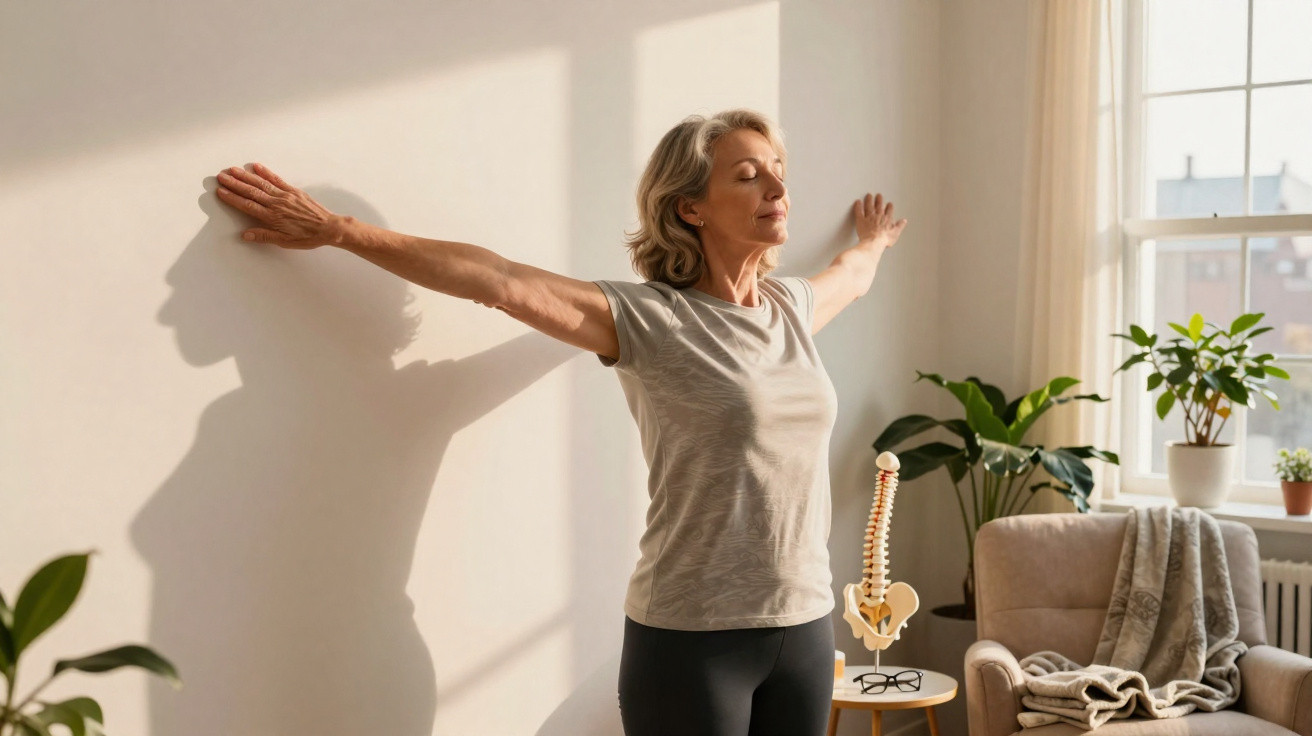
A notably useful practice is what some physiotherapists call the “wall angel for grown-ups.”
Stand with your back close to a wall, placing your heels slightly forwards if your balance feels unsteady. Let your upper back make gentle contact with the wall, but not your lower back. Slowly move your arms upwards against the wall, as if making a snow angel, with palms facing forwards. Stop when your shoulders say “enough”, rather than when an imaginary rulebook demands “ninety degrees.”
Bring your arms back down, breathe out and notice whether your chest feels slightly more open.
To be honest, no one truly manages this every day.
Doing it three or four times a week, however, can genuinely alter the way your ribs move.
The emotional trap, particularly after 60, is the quiet inner voice saying, “This is just how things are now.”
But the lungs and ribs can still respond to movement later in life. Small, regular stretches that raise the chest, release the upper back and give the diaphragm more freedom will not make you a gymnast. They can, however, provide a few extra seconds of easy breathing on the stairs, a longer note in that favourite song or a steadier voice while reading to a child.
These are not merely cosmetic changes. They are dignity in motion, and evidence that the shape of your day still belongs, at least in part, to you.
Breathing space after 60 is not a luxury - it is everyday strength
Once you notice that familiar forward slump, it becomes difficult not to see it everywhere: on buses, in living rooms and at family meals where the oldest relatives quietly withdraw from discussion. Not because they have nothing to contribute, but because speaking while breathing has become demanding.
The posture may look restful, yet it acts like a slow squeeze on the lungs.
Even so, the body is remarkably ready to meet you halfway. A little more length through the top of the spine, a little more room for the ribs and a little more confidence in the diaphragm can prompt the breath to return with greater depth.
This is not about pursuing the perfect alignment shown in a health magazine. It is about taking back a basic freedom: walking without that abrupt tightening in the chest, laughing without coughing or carrying a shopping bag without needing to stop every ten steps. These are modest but meaningful wins.
They often start with something as ordinary as the way you sit over breakfast, relax in your armchair or stand at the sink. The daily posture that takes away your breath does not shout; it whispers. The posture that restores it does the same.
Sharing this awareness with partners, friends or neighbours at the gym can make the difference between viewing breathlessness as inevitable and recognising it as something you may still influence, shape and ease.
| Key point | Detail | Value for the reader |
|---|---|---|
| Slumped sitting limits lung expansion | A rounded upper back and forward head compress the rib cage and diaphragm | Helps explain why breathing can feel harder even without lung disease |
| Small posture resets are effective | Balancing on the sit bones and gently lifting the crown of the head for a few breaths | Offers an easy, low-effort way to improve daily breathing capacity |
| Regular chest-opening moves keep ribs flexible | Simple exercises like wall angels support rib mobility and deeper breaths | Gives practical tools to feel less breathless during daily activities |
FAQ:
- Question 1 Isn’t shortness of breath after 60 just normal ageing?
- Question 2 Can changing my posture really make a difference if I already have COPD or asthma?
- Question 3 How long do I need to sit “better” each day to notice any change?
- Question 4 What if my back hurts when I try to straighten up?
- Question 5 Are there times when breathlessness is a warning sign, not a posture issue?





Comments
No comments yet. Be the first to comment!
Leave a Comment