
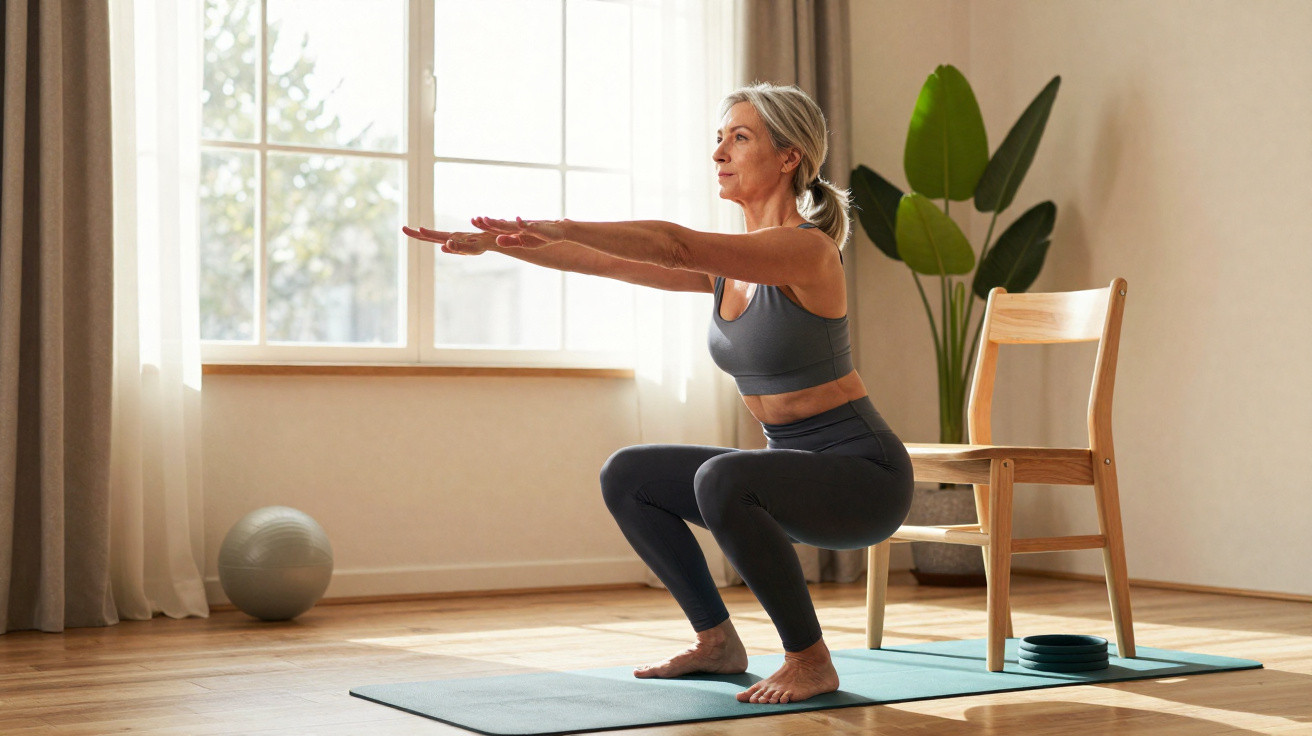
A movement repeated every day can determine whether you can still get up from the sofa independently at 70 – or need assistance.
Once people pass 50, everyday tasks can begin to feel unexpectedly demanding: getting out of the car, rising from an armchair or lifting a shopping bag from the floor. Sports medicine specialists have stressed for years that independence in later life depends not only on endurance exercise, but above all on targeted strength and mobility training. One understated Pilates classic is attracting growing attention: the bodyweight squat, often simply called a “Bodyweight Squat”.
Why the Pilates squat is so valuable for people aged 50+
In daily life, we perform a version of a squat countless times without giving it a thought. Sitting down and standing back up both rely on the same movement pattern. As the years pass, this ability is often among the first to decline – not because the body “suddenly becomes old”, but because muscle mass gradually reduces and joints become stiffer.
The Pilates-based squat addresses precisely this issue. It practises the same movements needed for using a chair, sofa, toilet or car. Regular practice develops strength, balance and coordination at the same time.
The squat repeated each day is a kind of insurance policy for the legs, buttocks, core and joints – with no equipment and no gym.
Sports coaches report that people over 60 who consistently practise squats with good form often remain independent for noticeably longer. They fall less often, rely less on furniture for support and feel more confident, both physically and mentally.
Muscle groups used in the Pilates squat
This movement works several areas of the body simultaneously, making it a highly practical form of what is known as functional training.
- Front of the thighs: straightens the knee and provides stability when sitting down and getting up.
- Gluteal muscles: provide the main force for pushing the body upwards.
- Back of the thighs: helps control the descent and keeps the pelvis stable.
- Deep abdominal and back muscles (core): supports the spine and keeps the torso upright.
- Calves and foot muscles: stabilise the ankles and improve balance.
Because of this combination, the squat improves more than muscle strength: it also develops the fine coordination between nerves and muscles. This takes pressure off the joints and helps movements feel smoother again.
How beginners over 50 can perform the Pilates squat correctly
For results, technique matters more than speed. Good form protects the joints and ensures every repetition delivers the greatest benefit.
Set up the starting position
- Stand tall with your feet roughly hip-width apart.
- Spread your weight evenly through both feet, keeping the whole sole in contact with the floor.
- Place your pelvis and spine in a neutral, natural position: neither an exaggerated arch nor a rounded back.
- Let your arms hang loosely by your sides.
- Gently draw your abdomen in without holding your breath – this engages the deep core muscles.
Coordinate movement and breathing
Conscious breathing is a typical Pilates element. It supports control and helps prevent tension.
- Breathe in: Keep your upper body as still as possible while slowly bending at the hips, knees and ankles. Send your buttocks backwards as though sitting onto an invisible chair.
- Bring your arms forwards: If you start to tip backwards or feel unsteady, extend both arms in front of you. This shifts your centre of gravity slightly and gives you more balance.
- Choose your depth: Lower only as far as feels stable and pain-free. A shallow squat is entirely sufficient at the beginning.
- Breathe out: As you rise, press your feet firmly into the floor, deliberately engage your glutes and thighs, and return to standing. Let your arms lower back to your sides.
A guide for beginners: three sets of 12 to 15 repetitions, on two to four days per week.
Common mistakes that put unnecessary strain on joints and the back
People with knee or back issues in particular are often wary of squats. However, sound technique can remove a great deal of pressure from the joints.
| Common mistake | Better approach |
|---|---|
| The knees collapse markedly inwards. | Think of gently pressing the knees outwards; toes and knees should point in the same direction. |
| The heels lift from the floor. | Keep the full foot on the floor, placing more weight through the mid-foot and heel. |
| The back rounds and the head drops forwards. | Lift the breastbone slightly, look ahead and keep the spine long. |
| Moving too fast or bouncing at the lowest point. | Work slowly and with control, pausing briefly at both the bottom and the top. |
At what age is the Pilates squat worthwhile – and how can you progress?
This move is suitable from the age of 40, but it becomes a genuine game changer after 50 and especially beyond 60. Anyone starting at this age should remember a few simple progression stages:
- Stage 1 – chair for security: Place a sturdy chair behind you. Lightly touch the seat with your buttocks, then stand up again. This helps you learn the movement.
- Stage 2 – free squat: Once you feel secure, practise without the chair, initially using a shallower range.
- Stage 3 – variations: Crossing the arms over the chest, slowing the lowering phase or pausing briefly halfway through the movement increases the training stimulus.
- Stage 4 – integrating it into daily life: Perform every sitting and standing movement consciously and slowly, without pushing off from a table or armrest.
How the squat slows the ageing process
From a biological perspective, people lose some muscle mass every decade from around the age of 30 unless they take action. This loss accelerates in later life and directly affects metabolism, balance and bone density.
Regular bodyweight squats tackle these factors directly:
- More muscle: The body builds active muscle mass again, the resting metabolic rate rises slightly and fat is stored less readily.
- Better joint alignment: Stronger muscles keep the hips, knees and ankles tracking more effectively. This reduces signs of wear and tear.
- Fall prevention: Those who can bend confidently and push themselves up from a crouched position can recover more easily after a trip.
- Psychological effect: Feeling stronger and steadier in movement often reduces the fear of being active in later life.
Strength training using your own bodyweight is one of the simplest ways to slow natural muscle loss in later life – entirely without a gym.
Combining the Pilates squat effectively with other activities
Anyone who already walks, power walks or cycles regularly has a solid foundation for heart and circulation health. The squat specifically adds strength and stability to these activities.
A practical weekly structure for people over 50:
- Two to three days with 3 x 12–15 squats, supplemented by simple core exercises such as a forearm plank or glute bridge.
- Two days of brisk walking, Nordic walking or gentle cycling, lasting 20 to 40 minutes each.
- One day focused on mobility: gentle stretching, a relaxed Pilates session or yoga practice.
If you are unsure, begin with very few repetitions – for example, 2 x 5 – and build up gradually. Mild muscle fatigue is fine, but sharp pain is a warning sign. In that case, consult your GP or a physiotherapist to have the exercise adapted to your individual needs.
What people with knee or back problems should consider
Many older people already live with osteoarthritis or chronic back pain. The squat may still be useful for them, provided a few rules are followed:
- Do not force the movement into painful ranges; choose a smaller range of motion instead.
- With more severe osteoarthritis, do not let the knees travel beyond the toes; lean the torso slightly further forwards.
- If your balance feels uncertain, initially hold lightly onto the edge of a table or the back of a chair.
- If needed, have your personal variation adjusted in physiotherapy or rehabilitation exercise sessions.
In many cases, people affected report that after several weeks of regular, measured loading, their joints actually feel more stable and less stiff.
Pilates principles that make the squat even more effective
The squat becomes particularly effective when key ideas from Pilates training are included:
- Control rather than momentum: Complete each repetition deliberately and without jerking.
- Lead with the breath: Breathe in on the way down and out as you rise – this provides rhythm and strength.
- Precise alignment: Keep the hip, knee and foot in line to protect the joints.
- Quality over quantity: A small number of clean repetitions achieves more than many rushed ones.
Anyone who internalises these principles benefits not only during the squat, but in every everyday movement. Carrying doors becomes easier, steps feel less intimidating and even standing for longer is less tiring.
Comments
No comments yet. Be the first to comment!
Leave a Comment