
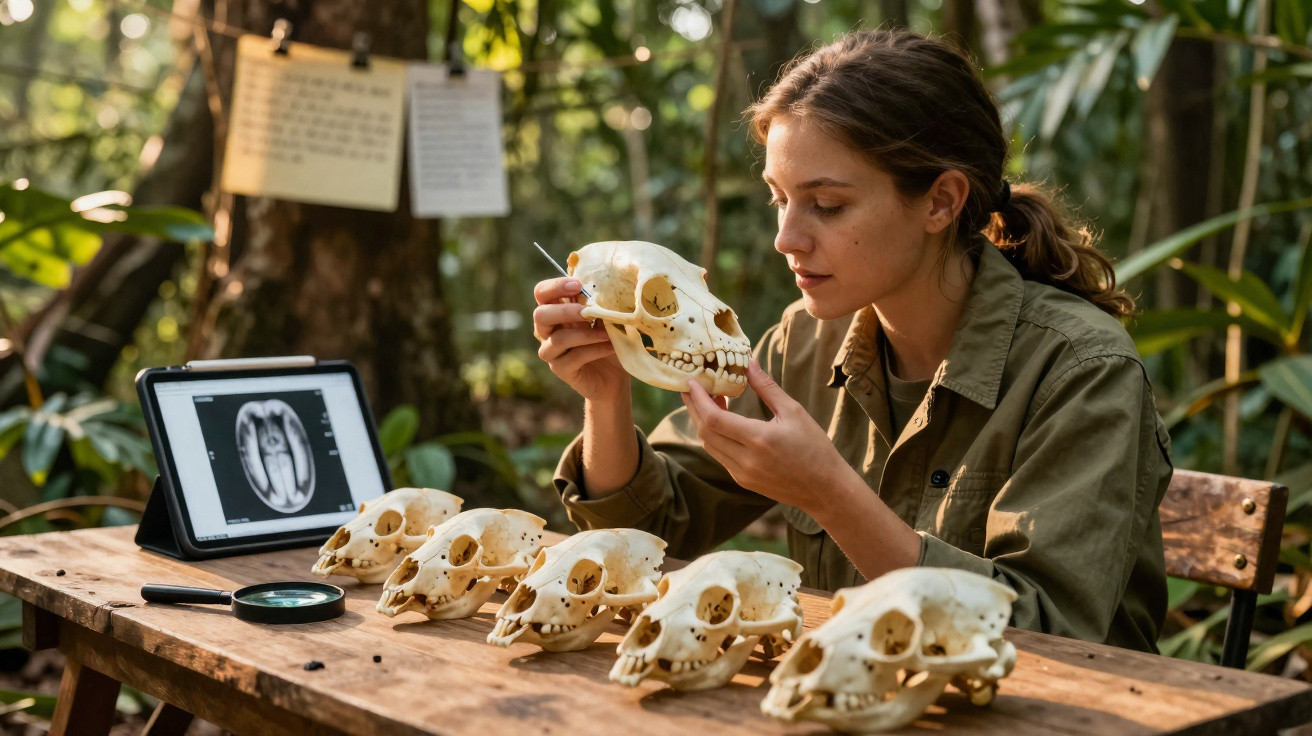
For decades, small grooves in ancient human teeth were thought to demonstrate deliberate tool use – with people cleaning between their teeth using twigs or fibres, or easing gum pain with improvised “toothpicks”. Some researchers even regarded this as humanity’s oldest habit.
However, our new findings, published in the American Journal of Biological Anthropology, challenge this longstanding view of human evolution. We found that such grooves can also arise naturally in wild primates, with little evidence to support the idea that they result from using objects such as toothpicks.
Even more strikingly, among more than 500 wild primates representing 27 species, both living and fossil, we found no trace of a common modern dental condition: deep V-shaped grooves at the gum line known as abfraction lesions.
Taken together, these findings may change how we read the fossil record and prompt new questions about the distinctly human ways in which teeth are damaged today.
Why are teeth important in human evolution?
Teeth are the toughest component of the skeleton and often endure long after the rest of the body has decayed. Anthropologists rely on them to reconstruct the diets, lifestyles and health conditions of ancient populations.
Even very small marks can hold important meaning. One repeatedly observed feature is a narrow groove running across exposed tooth roots, particularly in the spaces between teeth. Since the early 20th century, these marks have been described as “toothpick grooves” and interpreted as evidence of tool use or oral hygiene.
They have been recorded throughout recent human evolutionary history, from 2-million-year-old fossils to Neanderthals. Until now, however, no one had properly examined whether other primates also develop them.
A separate condition, abfraction, looks very different: deep, wedge-shaped grooves close to the gum line. Such grooves are widespread in modern dentistry and are often linked to tooth grinding, vigorous brushing or acidic drinks. Their absence from the fossil record has long puzzled researchers. Could it be that other primates simply never experienced them?
How was the primate teeth study carried out?
To examine these ideas, researchers assessed more than 500 teeth from 27 extinct and living primate species. The sample included gorillas, orangutans, monkeys, colobus monkeys, fossil great apes and others.
Crucially, every specimen came from a wild population, meaning that tooth wear could not have been affected by toothbrushes, fizzy drinks or processed food.
The team looked for non-carious cervical lesions – a term for tissue loss around the neck of a tooth that is not caused by decay. Using microscopes, 3D scans and measurements of tissue loss, they recorded even the smallest lesions.
What did the researchers find?
Around 4% of individuals had lesions. Some closely resembled the classic fossil-human “toothpick grooves”, featuring fine parallel scratches and tapered shapes.
Others were shallow and smooth, particularly on front teeth, and were probably caused by acidic fruits that many primates eat in large quantities.
Yet one absence stood out. No abfraction lesion was identified. Despite examining species with exceptionally tough diets and powerful biting forces, not a single primate showed the wedge-shaped defects that are so common in modern dental clinics.
What do these findings mean for human evolution?
First, grooves resembling toothpick marks do not necessarily prove that tools were used. Natural chewing, abrasive foods and even consuming sand can create similar patterns. In certain cases, specialised behaviours – such as stripping vegetation with the teeth – may also play a part. Caution is therefore needed before interpreting every fossilised groove as a toothpick mark.
Second, the complete lack of abfraction lesions in primates strongly suggests that this is an exclusively human problem associated with modern habits. Vigorous toothbrushing, acidic drinks and processed diets are far more likely causes than the natural force of chewing.
This places abfraction alongside other dental problems, including impacted wisdom teeth and misaligned teeth, which are rare in wild primates but common in people today. Together, these findings are shaping a growing field known as evolutionary dentistry, which uses our evolutionary past to understand present-day dental problems.






Comments
No comments yet. Be the first to comment!
Leave a Comment