
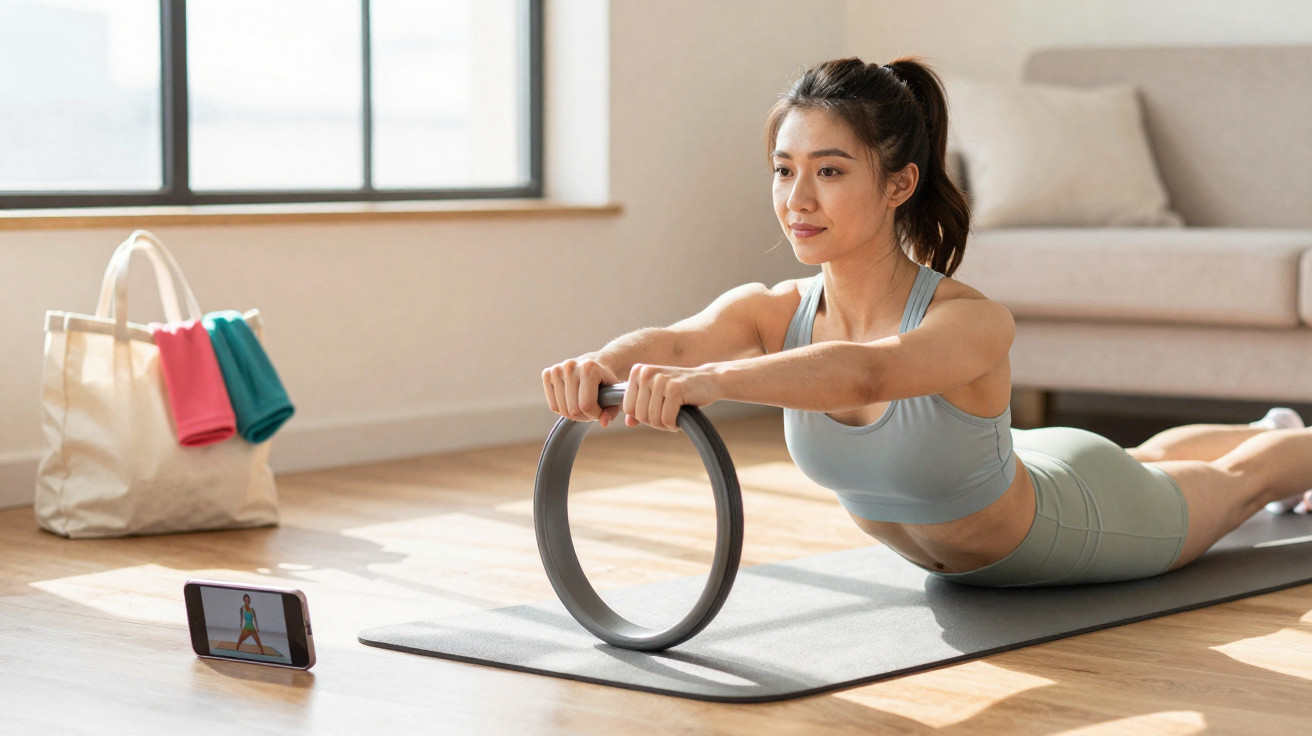
Many people want to tone their stomachs but have no desire to join a gym or buy costly equipment – a simple ring tool from the discount retailer is currently generating plenty of discussion.
A compact fitness accessory costing less than £4 is currently appearing throughout social media feeds: a Pilates ring from the Action range. There is no advanced technology, subscription or app involved – simply a flexible plastic ring with two handles. Even so, a growing number of women swear by it because it lets them work specifically on their stomach, legs and bottom at home, without having to completely reorganise their daily routine.
What is driving the hype around Action’s Pilates ring
At first glance, the ring looks unremarkable: a lightweight circle with two padded handles, and nothing more. Yet this simplicity is precisely what makes it appealing. You need no prior experience, elaborate training programme or dedicated workout room. The ring can be stored beneath the sofa or in a wardrobe and is ready to use within seconds.
The Pilates ring comes from traditional Pilates training, where it is used to activate the so-called deep muscles. These muscles stabilise the torso, support the spine and help maintain an upright posture in everyday life. Strengthening them makes a difference not only during exercise, but also when sitting at a desk, carrying shopping bags or climbing stairs.
“The ring works through resistance: every squeeze makes your core engage and remain stable.”
The method is straightforward: squeeze the ring between your hands, knees, ankles or arms. Its resistance challenges the body without placing excessive strain on it. This can feel like a more comfortable alternative to jumping exercises or heavy weights, particularly for people returning after a long break from exercise or those with joint problems.
Why the Pilates ring is particularly beneficial for the stomach
When people think of abdominal training, sit-ups and crunches tend to come to mind immediately. While these target the surface abdominal muscles, they often neglect an especially important one: the transverse abdominal muscle, also known as the transversus. It acts like a natural corset.
During Pilates ring exercises, the core must stabilise continuously to stop the body collapsing or arching the lower back excessively. This is exactly when the transversus is working, which can lead to a more toned silhouette over time.
“Strong deep core muscles can make the stomach look flatter in everyday life – even without significant weight loss.”
One important point: the ring does not “melt” fat on its own. Ultimately, that requires a calorie deficit through diet and movement. However, the ring can visibly tone the stomach because the muscles underneath become more defined and the torso appears more upright. Many users say their trousers fit better and that their stomach feels more “supported” when walking and standing.
Small routine, big impact: what a Pilates ring workout can look like
Anyone who assumes this requires an hour on the mat is mistaken. Brief, consistent sessions are more realistic – and usually more effective than a one-off extra-long workout that is never repeated. A possible mini routine at home could include:
- 5–10 minutes daily, for example after brushing your teeth or before an evening programme
- 3–5 exercises, with 10–15 repetitions of each
- Slow, controlled movements, without jerking or using momentum
Typical Pilates ring exercises include:
- Seated chest presses: Sit upright, hold the ring in front of your chest and keep your elbows slightly bent. Slowly squeeze the ring, hold the tension briefly, then release.
- Lying leg presses: Lie on your back, position the ring between your thighs just above the knees, and bend your legs with your feet on the floor. As you exhale, squeeze the ring and gently draw your navel towards your spine.
- Side support with the ring: Lie on your side, place the ring between your ankles and lift your legs slightly. Squeeze it repeatedly while keeping your waist engaged.
It may not look particularly dramatic from the outside. But when performed correctly, you can clearly feel your stomach and core working after just a few repetitions. That is exactly what appeals to people who otherwise find intense core training difficult.
More than just the stomach: these areas benefit too
The ring’s key advantage is that one piece of equipment offers many possible uses. Alongside the core, it can also train other problem areas:
| Training area | Typical benefit |
|---|---|
| Inner thighs | Tones the inner legs and improves how the legs feel while walking |
| Arms and chest | More strength for carrying and more defined upper arms |
| Back | A more stable posture and less tension caused by sedentary work |
| Pelvic floor | Gentle activation through tension work in the pelvic area |
It can be especially useful for people who work from home and spend much of the day seated. Many ring exercises can even be done on an office chair, without needing to turn up in workout clothes.
Why Action’s affordable ring is so popular
Price is a major factor: at around £4, it represents a far lower barrier than a monthly gym membership or an expensive weights bench. Anyone previously reluctant to invest in fitness equipment is therefore more likely to give a tool like this a try.
Convenience is another benefit. The device can be kept within reach while watching a programme, then put back in the cupboard afterwards. There is no long trip to a sports hall, no complicated plans and no pressure from appointments. People with busy lives in particular need simple, realistic options that fit into short pockets of time.
“The ring captures the spirit of the moment: small steps, little pressure and regular movement as part of everyday life.”
On social media, users share short clips of themselves using the ring in front of the television, at their desks or straight after getting up in the morning. The message is that it does not have to look perfect; it simply has to happen.
What the ring can – and cannot – do
As useful as the Pilates ring is, it is not a miracle solution. Anyone aiming to reduce a substantial amount of body fat will need a long-term combination of an adjusted diet, cardiovascular exercise and full-body strength training. The ring is better suited as a starting point, an addition to other exercise, and a gentle way to become more mobile and stronger.
Still, its side effects are worth considering. Many people report less back pain after a few weeks, greater awareness of their posture and more motivation to move in general. The ring can therefore act as a gateway – taking someone from “I really should” to a regular routine.
What to keep in mind when training with a Pilates ring
To ensure the ring delivers the desired effects without causing discomfort, a few basic rules apply:
- Do not hold your breath: Exhale during exertion and inhale as you release. This helps stabilise the core.
- Keep the back neutral: Avoid an excessive lower-back arch or a rounded back. Keep the spine as long as possible.
- Quality before quantity: Ten clean repetitions are better than 30 poorly performed ones.
- Build up gradually: Begin with only a few minutes, then steadily increase the duration and difficulty.
- Stop if you feel pain: Sharp pain is a warning sign, particularly in the back or joints.
Anyone who already has back problems or a recent injury should ideally check briefly with a doctor or physiotherapist about which exercises are suitable. Similar equipment is used in many rehabilitation programmes, so the ring can be incorporated well into gentle training plans.
Why the core has such a strong effect on posture
Focusing on the deep muscles is not merely a fitness trend; it makes physiological sense. The muscles of the torso form a stable “centre” from which the arms and legs extend. If they are weak, other muscle groups compensate – often resulting in tension and pain.
A strong abdominal and back area takes pressure off the neck and shoulders, while helping the spine remain better aligned. As a result, people not only look more athletic but also feel more capable in everyday life. Many underestimate just how much an upright posture changes the overall appearance of the figure, regardless of the number on the scales.
Action’s affordable Pilates ring makes use of exactly this principle. In almost every exercise, it forces the body to stabilise itself. Those who use it regularly are training not only visibly defined muscles, but also the internal support system that literally keeps us upright throughout life.
Comments
No comments yet. Be the first to comment!
Leave a Comment