
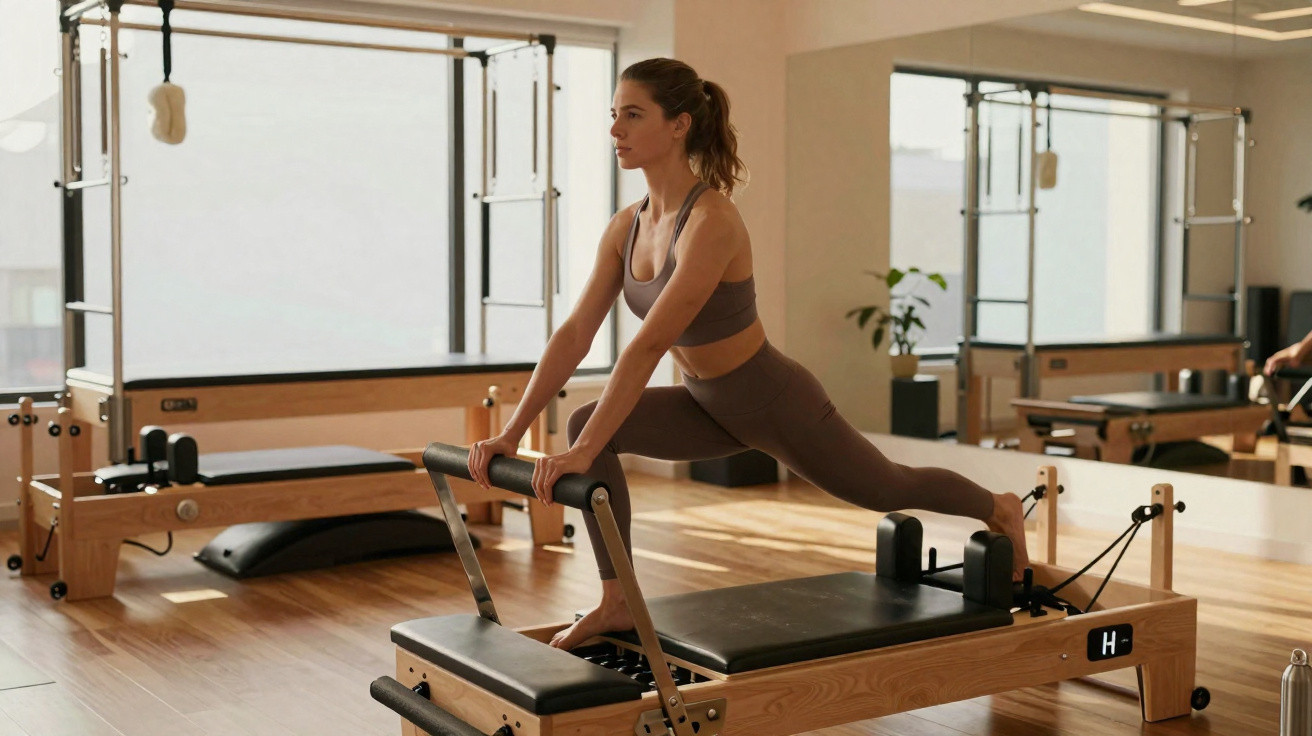
A new approach that is slow yet exceptionally intense promises to change exactly that.
Many people who take up Pilates praise its benefits for posture and reduced back pain – until progress suddenly stalls. Their muscles have adapted, the exercises feel “nice” rather than challenging, and anyone looking for more definition often turns to punishing HIIT or CrossFit, only to develop knee or back issues. This is precisely where Lagree Fitness fits in: a workout that feels brutally effective while remaining remarkably kind to the joints.
When traditional Pilates is no longer enough
At first, Pilates can bring major changes: the body stands taller, breathing becomes more conscious and tension eases. After a few months, however, many people notice that there is little further visible change.
Without increasing intensity, the body stops adapting – and visible change stops with it.
From a physiological perspective, this makes sense. The body favours efficiency. Once it has mastered a particular load, it conserves energy, burns fewer calories and builds very little additional muscle. Movements that once felt demanding can suddenly seem more like a warm-up.
Why your body reaches a plateau
Mat Pilates generally lacks two elements:
- variable resistance that can genuinely be felt
- an extended period of continuous muscle tension
As a result, the deeper muscle fibres responsible for defined contours and toned lines receive only limited stimulation. Posture may remain good, but the stomach, glutes, arms and shoulders often show very little further visual change. Frustration is almost guaranteed.
Why HIIT can seem like the obvious answer
In their search for “more”, many people end up doing high-intensity intervals, sprints, jumping exercises or CrossFit workouts. These certainly send the heart rate soaring. But tendons, joints and often the pelvic floor can pay the price.
Anyone who is no longer in their early twenties, or already has minor aches, soon finds that this level of intensity is difficult to sustain healthily over time. This is where Lagree Fitness becomes interesting: it promises the best of both worlds, combining high intensity with no jumping impact and the controlled precision associated with Pilates.
Lagree Fitness: not “Pilates on steroids”, but a system in its own right
Lagree Fitness originated in California and, in Europe, is offered mainly by specialist studios. At first glance, the space may resemble a contemporary Pilates studio. Yet within minutes of stepping onto the machine, it becomes clear that this is on another level.
The concept is high intensity with minimal impact. Muscles are worked to genuine muscular failure, meaning the point at which another controlled repetition is no longer possible. Meanwhile, joints, ligaments and the spine are protected because there are no jumps or hard landings.
The Megaformer: the centrepiece of the workout
At the heart of the method is a large machine called the Megaformer. It resembles the familiar Pilates Reformer, but is sturdier, more complex and designed to maintain continual loading.
Typical Megaformer features include:
- a moving carriage in the centre
- two platforms at either end for different standing and supported positions
- fixed and adjustable handles
- springs with varying tension levels to create resistance
Unlike a traditional Reformer, which is often used for rehabilitation, the Megaformer offers no easy ride through the movements. It delivers constant resistance in every direction. Any pause happens only if the person training chooses to take one.
A full-body workout in one session
Lagree brings strength work, endurance training and core work together in a single session. Many movements involve several joints. For example, you may perform a lunge variation on the unstable carriage while keeping your torso steady and pulling cables to work your arms and shoulders.
Your heart rate rises not because you are sprinting, but because large muscle chains are working at once and require vast amounts of oxygen.
This creates a blend of strength training and “hidden” cardio. The heart works hard without a single jump.
The power of slowness: why tempo shapes your body
Perhaps the most surprising aspect of Lagree is that success is not measured by how many repetitions you complete in 30 seconds. What matters is how slowly you can perform them without losing control.
Four seconds that change everything
The basic rule is that every phase of a movement lasts at least four seconds – four seconds into the stretch and four seconds back. There is no momentum, bouncing or “cutting corners”.
Anyone who follows this properly soon discovers that one well-executed repetition can feel like an entire gym set.
Slow movements remove momentum from the exercise and force every muscle fibre to do the real work.
This controlled execution recruits the slow-twitch muscle fibres that contribute to a lean, defined appearance and improve overall muscular endurance.
Continuous tension rather than pauses between repetitions
Unlike conventional strength training, there is barely any of the familiar “relaxation point” at the top or bottom of a movement. Muscles remain under tension throughout – often for 60 to 120 seconds without a true break.
This sustained stress creates:
- intense burning in the muscle
- a strong stimulus for muscle building and fat reduction
- a noticeably greater afterburn effect following the workout
People training for the first time are often surprised that such a calm, almost meditative pace can “grill” the body so intensely.
How the Megaformer activates muscles you never knew existed
Even experienced exercisers often get a small shock on the Megaformer. Deep muscles around the spine, hips and shoulders suddenly make themselves known, despite barely being noticed previously at the gym or while jogging.
Instability as a route to a flat, strong stomach
The moving carriage always remains slightly unstable. To avoid sliding away, the body must continuously engage the core. This involves more than the six-pack muscle: it particularly targets the deep abdominal muscles, the waist and the small stabilising muscles running alongside the spine.
Instead of doing hundreds of crunches, you hold your body steady – and that challenges your stomach far more intensely.
This approach is more likely to create a flat, firm midsection than a pumped-up stomach. Many people report that their lower back feels more stable, their waist looks narrower, and their posture becomes more upright and confident.
Quick transitions keep the heart rate elevated
The exercises themselves are performed slowly. Between exercises, the opposite applies: within seconds, you move from a leg exercise to one for the arms or core. Long water breaks are rare.
This keeps the heart rate within a range in which the body burns fat efficiently without leaving you completely exhausted. You sweat heavily, but the experience feels more like a highly focused strength session than a chaotic interval workout.
The famous shake: why muscles need to tremble
One word comes up quickly in Lagree studios: “shake”. It refers to the visible trembling of the muscles towards the end of an exercise block.
When the muscle shakes, change begins
This trembling occurs when the muscles and nervous system reach their current performance limit. The body desperately tries to maintain tension and recruits more and more fibres.
The shake is not an alarm, but a signal: this is exactly when your muscles become stronger and adapt.
Those who accept the shaking instead of stopping also train their mind alongside their muscles. Endurance, concentration and trust in their own body grow noticeably.
High intensity, minimal strain on the joints
Despite the demanding intensity, hands and feet remain in contact with the machine almost all the time. There are no landing impacts as there are with running, no repeated squat jumps and no abrupt changes of direction on a hard floor.
This makes Lagree especially suitable for people who:
- want to protect their knees, hips and ankles over the long term
- already notice mild joint problems
- want to return to exercise after pregnancy or a prolonged break from sport (after clearance from their doctor)
The surrounding muscles become stronger while the cartilage is protected from unnecessary wear.
Leaner, more defined, not drained: what attracts so many people to Lagree
Lagree relies on long periods of tension and stretching under load. The aim is not bulky muscle growth, but a toned, athletic body with defined lines.
Results that may become visible after just a few weeks
With two to three sessions a week, many studios report similar effects:
- noticeably improved everyday posture
- contours appearing more quickly on the shoulders, arms and legs
- a visibly firmer core
- less need for “extra” abdominal training
Many compare the silhouette to that of a dancer or Pilates professional – but with more pronounced definition and slightly more functional strength for daily life and sport.
Why many people do not want to go back after their first class
Anyone who has experienced how efficient a 45-minute Megaformer session can be may quickly find traditional machine circuits or lengthy endurance training slow and unfocused. One session can leave the legs, glutes, stomach, back and arms all feeling worked – without leaving you completely depleted afterwards.
Many leave class with trembling muscles but a surprisingly clear mind and a light, alert feeling in their body. This combination of intense results and retained energy is exactly what makes Lagree a favourite routine for so many.
What beginners should know and who can benefit from the method
Lagree is demanding, but studios generally run small classes with close instruction. Beginners start with lighter spring tensions and first learn proper technique. Those with Pilates experience usually find their way around quickly, even though the intensity is considerably higher.
Some useful tips for getting started:
- do not schedule too many classes back to back at first – muscle soreness is virtually guaranteed
- keep both movement speed and range slightly smaller until control develops
- focus on clean breathing rather than holding your breath
- speak up if something hurts in your joints rather than your muscles
Anyone who sensibly combines the workout with walking, moderate cardio or gentle yoga can further support recovery and mobility. This creates a sustainable mix: a stronger, more defined body, healthy joints and enough energy for work, family and leisure time.

Comments
No comments yet. Be the first to comment!
Leave a Comment