
His hand rests heavily on the mouse, while his shoulders creep upwards millimetre by millimetre, as though trying to shield his ears. At some point, there is a faint crack in his neck. Nothing dramatic – simply that familiar pull which begins as a whisper before turning into a saw-like ache. The colleague opposite discreetly rolls her head, as if secretly performing a tiny gymnastic routine. Nobody mentions it, yet everyone feels it: the neck that seems made of concrete, the head that suddenly feels twice as heavy. Still, we keep typing, keep sitting, shrug off the shoulder pain. Until someone whispers: “I’ve got a yoga sequence that saves my evening every single day.”
Why your neck does not hurt “for no reason”
We all know that moment when we look up from the laptop and our vision takes a second to settle. The head feels bolted in place, and turning to the side suddenly takes effort. Your neck does not announce itself with one dramatic bang, but through a thousand tiny tensions. Like dust building up unnoticed over several days. A meeting here, a voice message on the phone there, then quickly replying to emails from the sofa – and the cervical spine quietly carries the entire burden. The muscles tighten as if holding up a sign saying: “Break!” We are simply practised at ignoring it.
Let’s be honest: hardly anyone actually does this every day. Taking ten minutes to stretch after work? It sounds wonderful, but rarely happens in real life. A yoga teacher from Berlin once told me that she can recognise “desk neck” at first glance: the slightly forward-tilted head, rounded shoulders and shallow breathing. Her evening classes often bring together the same mix: freelancers with laptop shoulders, young parents with phone necks, and carers with tension from being “constantly bent forwards”. She says that many people only come once the pain is already radiating into the jaw or arm. By then, a quiet pulling sensation has become the dominant background soundtrack of everyday life.
From a medical perspective, the neck is a delicate marvel of vertebrae, discs, muscles and tiny joints. The head weighs around five to six kilograms – and if it shifts just slightly forwards, the load on the cervical spine multiplies. When you sit looking down at your phone, your neck can soon be carrying the equivalent of a small rucksack full of stones. The muscles respond with constant tension; they shorten and the fascia sticks together. The body is not offended; it is overwhelmed. This is precisely where a targeted yoga sequence comes in: it creates length in tight structures, activates the deep stabilising muscles and signals to the nervous system that it can lower the alarm level.
The 12-minute yoga sequence for a freer neck
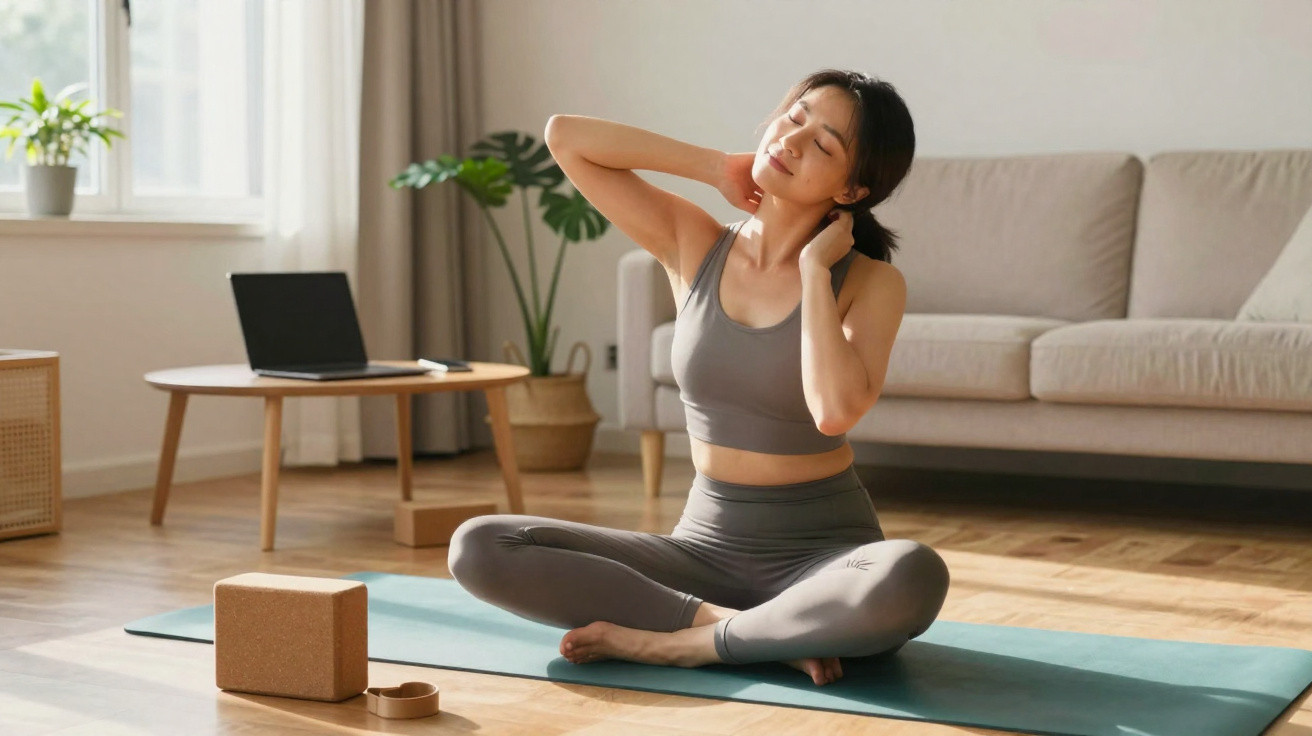
Imagine arriving home in the evening, putting aside your laptop and phone, and unrolling a mat. No incense, no perfect outfit – just you and these twelve minutes. Begin seated, either cross-legged or on a chair. Rest your hands loosely on your thighs, lengthen your spine and draw your chin very slightly towards your chest. Take three deep breaths: inhale through your nose and exhale through your mouth. Then make slow head half-circles from one shoulder to the other, without dropping your head fully backwards. Stay on each side for a few breaths and let the weight of your head do the work. This sequence is not a performance; it is more like a quiet agreement with yourself.
The second part is gentle seated shoulder rolls, first backwards and then forwards. Link breath and movement, as though your shoulders were painting the air. Next, come onto all fours for a mini version of cat-cow: round your spine as you exhale, then open it as you inhale. Let your gaze follow only slightly, and keep every movement soft and unhurried. Finish with a variation of child’s pose: place your forehead on the floor or a cushion, with your arms stretched forwards or resting beside your body. Remain there until your breathing deepens and your neck no longer shouts but merely murmurs. Many people notice that their head rests differently on the pillow when they go to bed afterwards.
The biggest trap is treating it as yet another task to tick off. Neck yoga does not work if your mind is already on the next email. The sequence depends on attention, not perfection. Many people pull their head too far back or force it into their neck because they have heard somewhere that this is what they should do. That is exactly what increases compression. Better still: make small, curious movements. Feeling a pull does not automatically mean it is “good”, and feeling nothing does not mean nothing is happening. An honest guide is this: on a scale from 1 to 10, a stretch may reach 4 to 5, but never 9. Your neck is not structural steel; it responds more like damp clay.
“Neck yoga is not a show. It is more like whispering to the body after a day when everyone has been shouting,” a yoga teacher who has worked with office workers for 20 years told me.
- Start seated: Take three deep breaths, then make slow head half-circles.
- Mobilise your shoulders: Make large, deliberate circles in time with your breathing.
- Cat-cow on all fours: gently roll the spine and allow the neck to move along with it.
- Seated side stretch: place one hand by your ear, gently tip your head to the side and push the other hand towards the floor.
- Child’s pose: stay for 6–10 breaths, let your back breathe and release your neck.
What changes when your neck can breathe again
People who try this short sequence for several days in a row often notice changes in places they had not even considered. Their concentration lasts longer, and their forehead feels less “panicked”, as if someone has removed an invisible helmet. Some say they can suddenly breathe more deeply, no longer only into their chest but down into their abdomen. Neck tension is rarely a local issue; it sends threads through the whole system. When you relieve the neck, you also ease the jaw, eyes and sleep. It may seem unspectacular – until you wake up one morning and realise that your head feels calm and your vision clearer.
| Key point | Detail | Benefit for the reader |
|---|---|---|
| Relieve the neck | Gentle mobilisation and stretching instead of forceful “push through” exercises | Reduces pain and helps prevent tension from radiating into the head or arms |
| Short, consistent routine | A 12-minute sequence that fits realistically into daily life | Makes it more likely that the practice will genuinely become a habit |
| Mindful approach | Focus on breathing, small movements and a scale for stretch intensity | Protects against overexertion and makes the benefits sustainably noticeable |
FAQ:
- How often should I do this neck yoga sequence? Ideally, three to four times a week. Even if you only manage twice, you will notice a difference after a few weeks.
- Can I do the exercises at the office too? Yes, much of it can be done seated in a chair: head half-circles, shoulder rolls and gentle side stretches. Save child’s pose for when you are at home.
- What if my neck cracks during practice? A quiet crack without pain is usually harmless and indicates that small joints are settling into place. If you experience sharp pain or numbness, you should see a doctor.
- Does this sequence also help with tension headaches? Many people report that headaches become less severe or less frequent when they regularly relax their neck and shoulders. It does not replace medical assessment, but can complement it meaningfully.
- Do I absolutely need a yoga mat? A mat is comfortable, but not essential. A non-slip rug or a folded blanket is perfectly sufficient to get started.




Comments
No comments yet. Be the first to comment!
Leave a Comment