
Yoga for runners – incorporating a self-practice to enhance your overall running experience
Yoga for runners is a five-part series designed to fit alongside your current running programme.
I would not really describe myself as a proper runner, as I have not yet gone beyond the 10 km race distance. Over the years, though, friends, clients and colleagues have taken on plenty of running challenges, including half-marathons, trail runs, the London Marathon and, most impressively, Comrades.
What is my excuse?
Running can be demanding on the body: it compresses the joints and shortens the muscles. Without sensible preparation and cross-training, it is particularly easy to pick up an injury. Over time, you may also compromise joint integrity and create muscular imbalances.
However, nothing compares with a runner’s high!
There are countless reasons people become addicted to running.
Finishing a run or race brings an undeniable feeling of achievement. The accomplishment is both physical and tangible. Better still, you have overcome a powerful opponent: your own inner dialogue. Despite wanting to stop or give up, you kept placing one foot in front of the other and reached the finish.
Before long, you can move from being a casual runner to a serious competitor, increasing the duration and distance of your training sessions while frequently overlooking strength and flexibility work.
Every form of exercise benefits from cross-training
When practised properly, Yoga is one of the most effective additions to pair with running.
Benefits of regular Yoga for Runners include:
- Better overall performance
- A lower likelihood of injury
- Quicker recovery between training days
- Improved balance and agility, which is ideal for trail runners
- Greater focus and concentration on race days
- Increased strength and flexibility
- A wider range of movement
- More efficient circulation
- Time to de-stress, restore and recover
Here is a five-part series to incorporate into your existing running programme, all simple enough to complete in the comfort of your home.
1: Activate your core
2: Sun salutations
3: Standing sequence
4: Seated sequence
5: Restorative sequence
Above all, following this series consistently will reveal benefits for both body and mind.
If you have a pre-existing injury or high blood pressure, or if you are pregnant, make sure you consult your physiotherapist, biokineticist or doctor before beginning this series.
You will need:
- A yoga mat
- A strap, resistance band or towel
Time is valuable, which is why every part is brief and effective. Never overlook quality in favour of quantity.
This blog post explores Part 1 of the five-part Yoga for Runners series.
Part 1: Wake up from the inside out
Runners often compensate by relying on their larger muscle groups. For instance, the quadriceps are commonly stronger than the hamstrings. Muscular imbalances can lead to injury, as the body becomes accustomed to using its dominant muscles.
One excellent way to prevent this is to ensure your transverse abdominals, glutes and hamstrings are activated and working before you head out on the road or trail.
Part 1 is a quick combination of Yoga and more traditional strength exercises. These straightforward movements will take only 5-10 minutes before your run.
A warm-up can offer far more than a brisk walk. Try these exercises before settling into your running stride, because longevity matters.
I want your running programme to be as free from interruption and injury as possible.
Soon, this sequence will become a familiar element of your training runs.
Yoga for runners Part 1: Wake up from the inside out
1. Bodyweight squats
Stand with your feet hip-width apart, then bend both knees. Do not lower your glutes beneath your knees. If it feels kinder on your knees, turn your toes slightly outwards. Aim for 10-20 repetitions.
2. Static lunges
Step forwards widely, ensuring that your front knee does not travel beyond your toes. Bend both knees and pulse for 10 repetitions. Repeat on the other side.
3. Hip-flexor stretch
From the lunge position, straighten your back leg; you may need to step the front foot further forwards. Hold the stretch for at least 30 seconds.
4. Single-leg squats
Start with your feet together. Extend one leg, then bend through the stabilising leg. Gradually build towards 10 repetitions on each side. It is better to complete fewer repetitions with good form, and pay close attention to how your knee ‘tracks’.
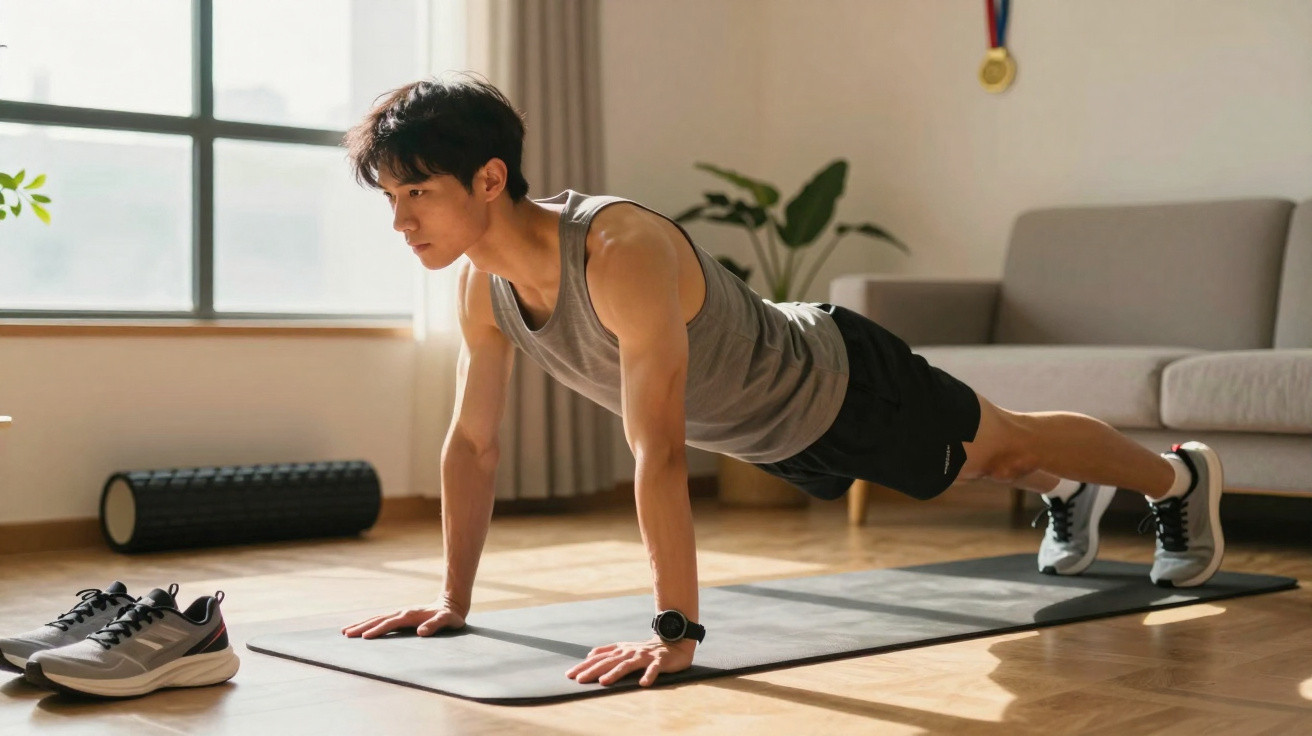
5. Standing position into high plank
From standing, walk your hands down your legs until you reach a high plank, then walk them all the way back up. Repeat 3-5 times. Also, keep drawing your navel in towards your spine. For a more advanced variation, add a press-up before walking back up. If you have low blood pressure, remember to pause between rounds.
6. Bridge with alternate knee to elbow
Come into your bridge position. While holding the bridge, draw your right knee towards your right elbow, then repeat with the left. Do 10 repetitions on one side before changing over.
7. Downward-facing dog transitions
Move back and forth between high plank and downward dog 3-5 times. Pedal through the legs and rise onto your tiptoes a few times. As you are still warming up, feel free to keep your knees bent.
8. Standing quadriceps stretch
Return to standing, bend one knee and draw the foot towards your glute. Stay in the stretch for 30 seconds, then switch to the other side.
There you have it: Part 1 of the five-part Yoga for runners series. This section is particularly useful as part of your warm-up.
You can begin by introducing 4/5 of the movements, then add another with each run or each week. Start with whatever you can manage, and always listen to your body. There is no benefit in forcing your body to do too much, too soon.
If you have any questions or queries, please email me: [email protected]
I look forward to hearing your feedback and seeing your running times improve. Better overall muscle balance and flexibility will reduce your running pace.
All photographs are credited to Melissa Koch Photography.


Comments
No comments yet. Be the first to comment!
Leave a Comment