
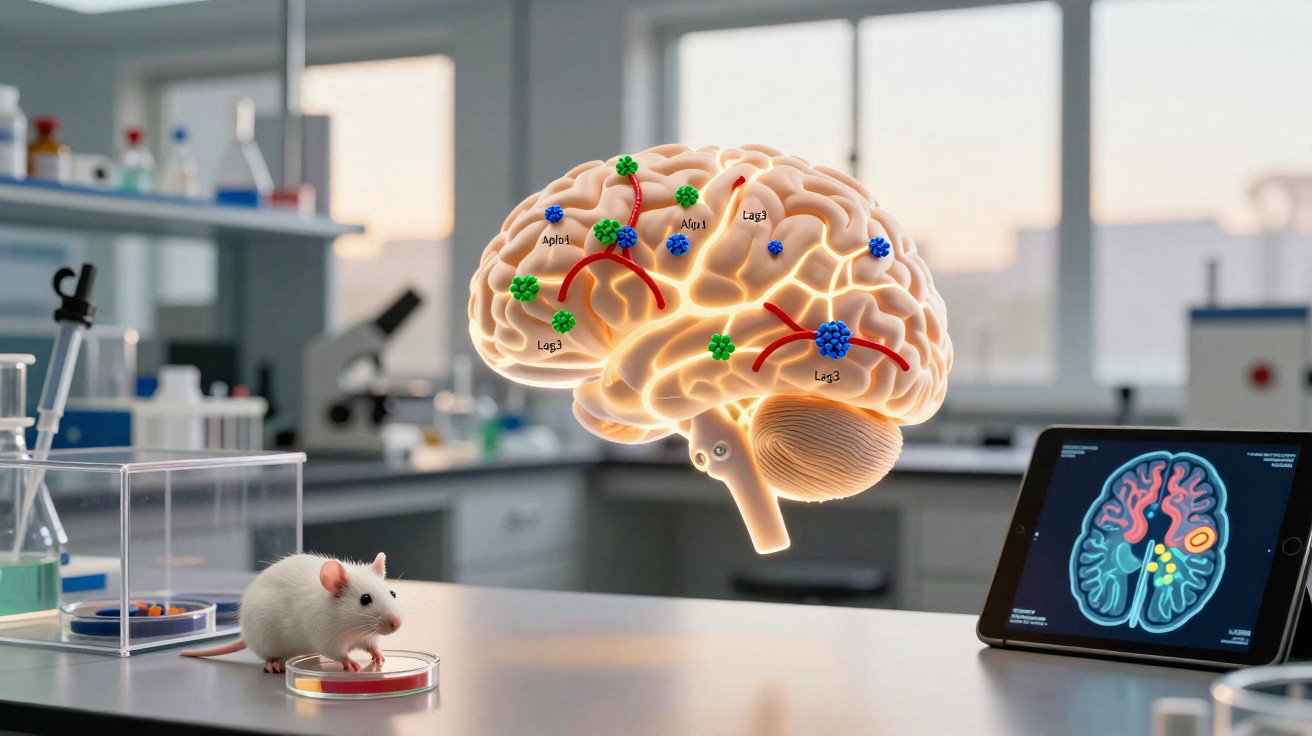
Researchers have identified a way in which Aplp1, a protein on the surface of brain cells, may help spread the material linked to Parkinson's disease between cells in the brain.
Encouragingly, an FDA-approved cancer medicine that targets Lag3 – another protein that interacts with Aplp1 – blocked this process in mice. The finding raises the possibility that a treatment for Parkinson's disease may already be available.
Aplp1 and Lag3 in Parkinson's disease
In a paper published last year, an international group of researchers described how these two proteins cooperate to enable toxic clusters of alpha-synuclein to enter brain cells.
"Now that we know how Aplp1 and Lag3 interact, we have a new way of understanding how alpha-synuclein contributes to the disease progression of Parkinson's disease," neuroscientist Xiaobo Mao from Johns Hopkins University said in June 2024.
"Our findings also suggest that targeting this interaction with drugs could significantly slow the progression of Parkinson's disease and other neurodegenerative diseases."
Parkinson's affects more than 8.5 million people worldwide and is the second most prevalent neurodegenerative disease, after Alzheimer's.
It is a progressive condition with no current cure, and diagnosis generally comes only once symptoms become apparent. These can include tremors, rigidity, problems with balance, speech difficulties, disrupted sleep, and mental health problems. At later stages, people with the disease can ultimately find walking or speaking difficult.
Most symptoms of Parkinson's arise when dopamine-producing neurons are lost or impaired in the substantia nigra, a brain area involved in precise movement control. Lewy bodies are believed to drive this damage: these abnormal protein clumps consist chiefly of misfolded alpha-synuclein and pass from one neuron to another.
Alpha-synuclein ordinarily supports communication between neurons, but it can inflict substantial damage when it misfolds and becomes insoluble. However, it remains difficult to determine whether this process causes Parkinson's disease or is instead a consequence of it.
How alpha-synuclein enters brain cells
Previous mouse research showed that Lag3 attaches to alpha-synuclein and helps Parkinson's disease pathology spread through neurons. Removing Lag3 greatly slows this process but does not stop it altogether, suggesting that another protein also helps neurons take up misfolded alpha-synuclein.
"Our work previously demonstrated that Lag3 wasn't the only cell surface protein that helped neurons absorb alpha-synuclein, so we turned to Aplp1 in our most recent experiments," said Johns Hopkins neuroscientist Valina Dawson.
The team studied genetically engineered mice lacking Aplp1, Lag3, or both proteins. Aplp1 and Lag3 were each able to independently assist brain cells in taking up harmful alpha-synuclein, but their combined effect markedly increased uptake.
In mice missing both Aplp1 and Lag3, 90 percent less harmful alpha-synuclein entered healthy brain cells. This meant that eliminating both proteins blocked more of the damaging protein clumps than deleting either one alone.
Cancer drug blocks the Aplp1-Lag3 interaction
The researchers treated normal mice with nivolumab/relatlimab, a melanoma drug containing a Lag3 antibody. They found it prevented Aplp1 and Lag3 from interacting and, once again, almost entirely stopped disease-causing alpha-synuclein clumps from forming in neurons.
"The anti-Lag3 antibody was successful in preventing further spread of alpha-synuclein seeds in the mouse models and exhibited better efficacy than Lag3-depletion because of Aplp1's close association with Lag3," said Ted Dawson, a neuroscientist at Johns Hopkins University.
The next stage is to assess the Lag3 antibody in mouse models of Parkinson's disease and Alzheimer's, for which research has also identified Lag3 as a possible target.
The study was published in Nature Communications.
An earlier version of this article was published in June 2024.






Comments
No comments yet. Be the first to comment!
Leave a Comment