
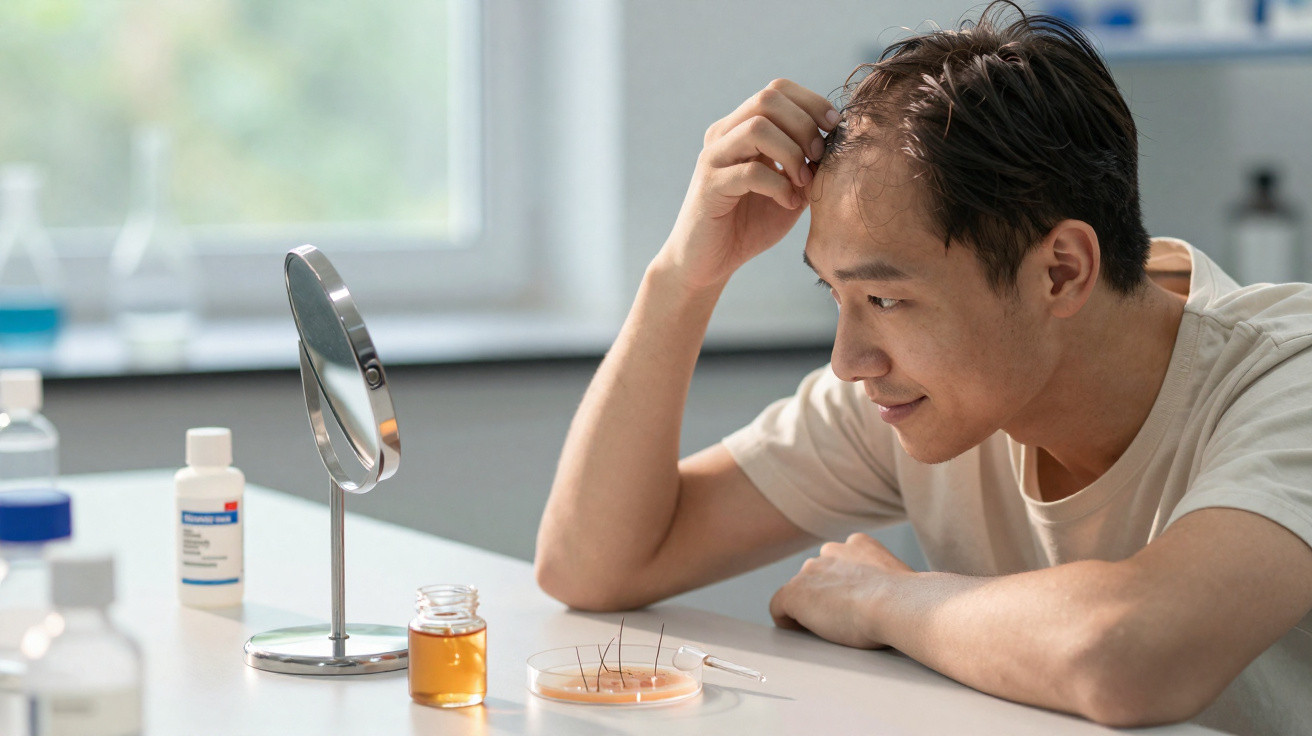
For many people, hair loss feels inevitable: they try expensive shampoos, supplements and tinctures, yet usually see only limited results. Scientists have now reported a surprising finding involving a simple sugar already present in our cells. In animal experiments, a gel containing this substance regrew hair as quickly as established medicines – and in some cases produced visibly denser growth.
An accidental finding in wound healing
The crucial clue did not come from a conventional hair-loss study, but from wound-healing research. A team from the University of Sheffield in the UK and COMSATS University Islamabad in Pakistan investigated the sugar deoxyribose. It is a component of DNA and is therefore found in every cell of the body.
The researchers had originally set out to test whether deoxyribose could speed up the healing of skin injuries. They treated skin wounds in mice with a gel containing the sugar. In the process, they noticed an unplanned side effect.
“Around the treated wounds, the animals’ hair regrew markedly faster and more densely than in untreated areas.”
That observation prompted the idea of testing the sugar specifically for hair loss. If tissue receives a better blood supply and cells are encouraged to multiply, weakened hair follicles might also be stimulated again.
Sugar gel for hormone-related hair loss
The researchers then used an established animal model for androgenetic alopecia, meaning hereditary, hormone-related hair loss. Male mice were given hormones intended to replicate the characteristic decline in hair growth. The team then shaved the animals’ back hair and divided them into several groups.
How the experiment was conducted
- Untreated group: The skin was left untreated after shaving.
- Placebo gel: The mice received a gel without an active ingredient.
- Sugar gel: A gel containing deoxyribose was applied daily.
- Minoxidil: Treatment with a commonly used, authorised medicine for hair loss.
- Combination: Deoxyribose gel plus minoxidil.
Over 20 days, the scientists recorded the speed and density of hair regrowth in each group. Images of the animals’ backs revealed clear differences: untreated mice retained large bald areas, whereas the treated groups had substantially more hair.
Results: sugar gel matches minoxidil
Most notably, the deoxyribose gel performed at least as well as minoxidil, which has long been one of the standard treatments for hereditary hair loss.
Key observations at a glance
- Faster hair growth: Within 20 days, the sugar groups developed dense, long fur across the treated areas.
- Comparable with minoxidil: In the measurements, the sugar gel matched the established medicine.
- No clear boost from combining treatments: Using deoxyribose and minoxidil together produced little more effect than either substance on its own.
The authors described the results as “promising”, but stressed that the data come exclusively from experiments in mice. The research remains a long way from a product for people.
What happens in the body
Why did hair follicles respond at all to a sugar primarily known for its role in genetics? Analysis of the tissue samples offers some clues. The researchers found more blood vessels in the treated area, along with a striking increase in skin cells.
“More blood vessels mean more oxygen and nutrients for the hair root – the follicle becomes stronger and the hairs become thicker.”
Minoxidil relies on precisely this mechanism as well: the active ingredient widens blood vessels and improves the supply to hair follicles. Deoxyribose may act in a similar way, although via a different biological pathway. The exact signalling processes are not yet understood.
For people with androgenetic alopecia – the most common form of hair loss in men and increasingly in women too – another treatment approach would be appealing. Existing options have limitations and can cause unpleasant side effects.
Comparison with existing treatments
Doctors currently rely mainly on two active ingredients for hereditary hair loss: minoxidil and finasteride. Both have been extensively studied, but neither is perfect.
| Treatment | Effect | Drawbacks and risks |
|---|---|---|
| Minoxidil | Stimulates hair growth and may slow progression | Does not work for everyone and often has only a limited effect; scalp irritation is possible, and results vary considerably. |
| Finasteride | Reduces hormone-related hair loss in many male users | May cause erectile problems, reduced libido and depressive symptoms; not authorised for women in many countries. |
This is where the hope surrounding deoxyribose lies: because the sugar occurs naturally in the body, researchers speculate that it may have a more favourable side-effect profile. That has not been proven. Only human studies can establish whether deoxyribose gel is sufficiently safe to use.
Who could benefit in future
The team is already looking beyond the traditional issue of receding hairlines. If the effect is confirmed, several groups could potentially benefit:
- People with hereditary hair loss, including men and women.
- Patients following chemotherapy, whose scalp hair often regrows only slowly.
- People with alopecia areata, an inflammatory form of patchy hair loss.
For now, all of these possibilities remain theoretical. The authors explicitly describe this as very early-stage research and caution against premature expectations. Even if initial small-scale human studies are positive, the route to an authorised treatment would usually take years.
How realistic is use in humans?
So far, the only results are from male mice with hormonally induced hair loss. This raises several questions:
- Does the effect also occur in female animals?
- Does human scalp skin respond in a similar way to mouse skin?
- What concentration is needed without overstimulating the skin and blood vessels?
Further animal experiments are therefore planned, followed by cautious studies involving volunteers. Initially, these would focus solely on skin tolerability and safety. Only afterwards would it be possible to reliably assess whether new hairs actually grow or whether existing hairs become thicker.
What people affected by hair loss should know now
Anyone currently experiencing hair loss should treat deoxyribose gels from dubious sources with caution. The research is at an early stage, and no standardised preparations with verified quality are available yet. Home-mixed products may cause skin damage or allergic reactions.
Instead, there are established measures that anyone can discuss with a dermatologist:
- Checking whether the hair loss is linked to an illness, nutrient deficiency or stress.
- Assessing whether minoxidil or finasteride may be suitable, alongside an honest evaluation of risks and benefits.
- Supporting treatment with gentle hair care, stress reduction and management of any scalp inflammation.
What terms such as androgenetic alopecia mean
The medical term androgenetic alopecia describes a combination of genetic predisposition, hormonal influence and age. Hair roots react excessively to certain male hormones. Over time, the hair follicle shrinks, the hair-growth phase becomes shorter, and new hairs grow progressively finer until they are barely visible.
Treatments usually target one of two areas: they either block hormonal influence, as finasteride does, or improve the supply and activity of the hair root, as minoxidil does – and possibly deoxyribose. An approach based on a sugar naturally produced by the body would fall into the second category.
Whether deoxyribose gel ultimately earns a place alongside, or even instead of, existing treatments will depend on many factors: its stability in cosmetic or pharmaceutical formulations, its safety during long-term use and, above all, whether the striking images seen in mice can genuinely be reproduced in humans.






Comments
No comments yet. Be the first to comment!
Leave a Comment