
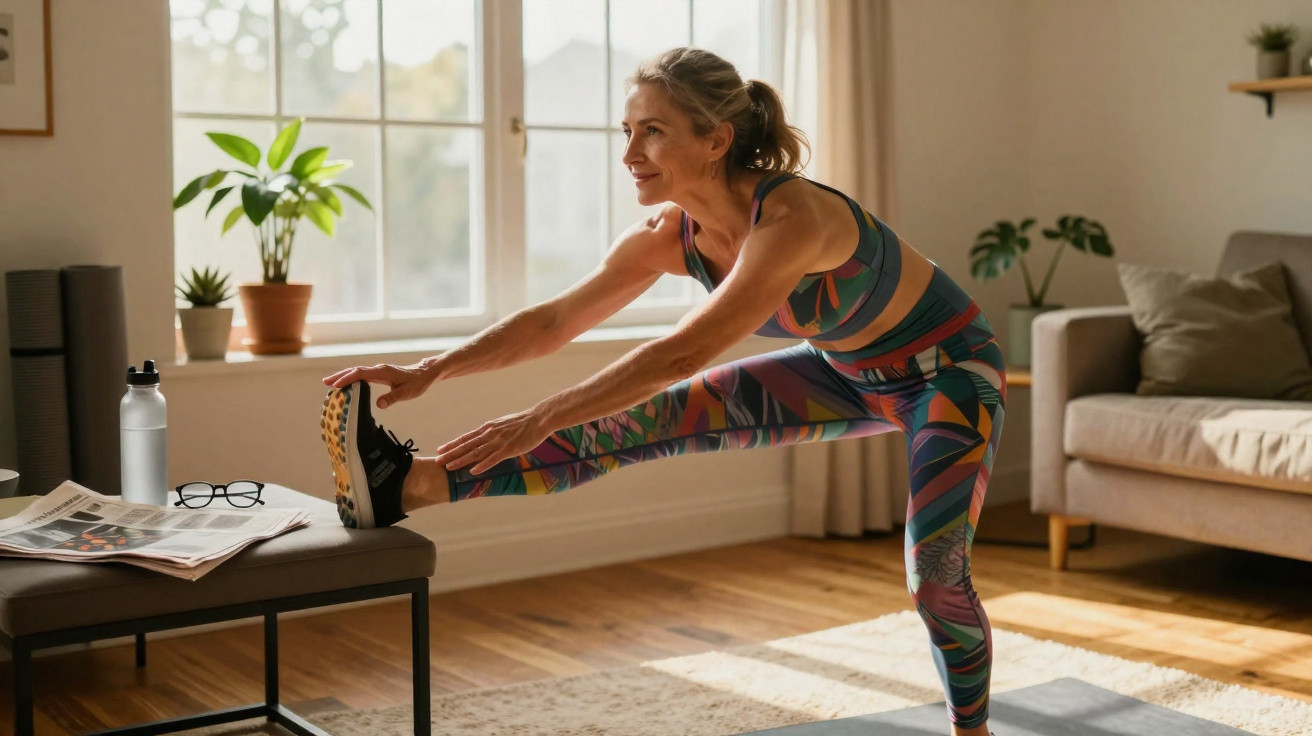
Fifteen people over 55 stand barefoot on their mats, with cautious scepticism visible on some faces. “Just stretching?” asks a grey-haired man behind me. “I need something for my back, not wellness.” Ten minutes later, that same man is folded into a gentle forward bend, breathing as though someone has loosened a knot in his lower back. Faces soften and shoulders drop. It is hardly surprising after years spent at screens, in cars and at the dining table. We carry tension around like invisible rucksacks. You only realise how heavy they were when they briefly disappear. And then one question arises.
Why stretching from 55 suddenly makes a difference
Anyone over 55 will recognise that moment in the morning when the body needs a few seconds to get going. Fingers feel a little stiffer, the neck seems rusty and the back has something to say about every turn. For a long time, this was simply regarded as an irritating side effect of getting older. Yet in the classes I support, I repeatedly see that people who begin stretching with purpose move through a room differently after just a few weeks. More lightly. More freely. Not younger, but less restricted.
I think of Monika, 62, a former bookkeeper. She had suffered neck pain for years, was often awake at night and experienced headaches during the day. MRI scans, an orthopaedic specialist and massages all helped briefly, but nothing lasted. Then, out of curiosity, she joined a stretching class, “just to see what it was like”. After four weeks of two 15-minute sessions at home and one class each week, she says: “The pain is still there, but it no longer controls me.” She can read for longer again without her head throbbing. Her husband laughs because she suddenly chooses to go for walks. Research supports her experience: studies show that targeted stretching can noticeably reduce tension in muscles and fascia.
So what is actually happening in the body? Tense muscles are like elastic bands held under strain for too long: eventually they become less yielding and signal their discomfort through pain. When we spend a great deal of time sitting, certain muscle groups shorten while others have to compensate. Stretching gently eases this constant pull. Muscles receive better blood flow, while fascia can slide over itself more easily again. Pain often comes not solely from a “damaged” back, but from the interaction of stress, posture and too little movement. Stretching acts like a quiet reset button for this system.
How to tackle tension with simple stretching
The biggest misconception is that stretching from 55 has to be complicated or acrobatic. In fact, just 10–15 minutes two to three times a week can be enough, provided you do it with intention. Try this, for example: stand with your feet hip-width apart, clasp your hands behind your back, gently draw your arms down and backwards, and allow your chest to open. Breathe calmly for 30 seconds. Then slowly tip your head to one side, as if bringing your ear towards your shoulder. Do not force the stretch; go only to the point at which your body says: “This feels intense, but still good.”
Let us be honest: nobody really does this every day. Nor do they need to. Many people overdo it at the start because they feel guilty: too much, too hard and for too long. The following day, the body responds with sore muscles or dizziness, and the stretching plan ends up abandoned in a corner. A better approach is to begin small, almost ridiculously small. Choose two exercises, do them for five minutes, and set aside three fixed days. No heroics, simply routine. The body responds well to repetition, not spectacle. And one point matters especially: breathe. Many people unconsciously hold their breath when a stretch starts to pull; that is precisely when a slow exhale helps.
Living with tension for a long time means dealing not only with muscles, but also with ingrained habits of thought. The internal commentary soon becomes: “That is just what being 60 is like.” One participant said recently:
“I always thought I was simply stiff. Now I realise: I had just been tense for years.”
- Start slowly: Stretch gently and consistently rather than rarely and with brutal intensity.
- Respect the pain threshold: A stretch may pull, but it should not burn, stab or radiate elsewhere.
- Keep your breathing calm: Hold every stretch for at least three slow breaths, without straining or holding your breath.
- Choose large muscle chains: Focus on the chest, hip flexors, hamstrings, neck and lower back.
- Keep expectations realistic: Initial relief often comes after only a few sessions, while deeper changes take weeks.
What remains when the body has room to move again
When you speak with people over 55, you often hear the same wish: “I just want to get up in the morning without suffering.” Stretching is not a magic wand, but it gives the body back something everyday life has almost taken away: room to move. Suddenly, a walk with the grandchildren no longer feels like a small expedition, but becomes enjoyable again. Lifting a bag of shopping still requires strength, yet no longer meets resistance from every fibre. And the mind begins to understand: I am not merely at the mercy of my body; I can play an active part.
It is striking how physical relaxation often changes the way people view their own ageing as well. Those who can move more easily make different plans: one person feels confident enough to return to the swimming pool, another signs up for gentle yoga, and a third gets back on a bicycle after years away. Tension is rarely only a local issue; it runs like invisible threads through everyday life, mood and sleep. When part of that tension is released, a small window quickly opens: what else might be possible if I keep going?
Perhaps that is the real message of stretching from 55: you do not have to prove anything. No marathon and no gym selfie. It is enough if your body offers you a little more ease when you get up. If your neck protests less, your back says “Stop” less often and your shoulders no longer feel like armour. And yes, there will be moments when you do not feel like unrolling the mat. But every gentle stretch is a small choice in favour of yourself. Not for an ideal, not for “anti-ageing”. Simply so that everyday life feels less constricted.
| Key point | Detail | Benefit for the reader |
|---|---|---|
| Targeted stretching loosens tense muscle chains | Regular, gentle stretching improves blood flow and the movement of fascia | Less neck stiffness, reduced back pain and greater freedom of movement in daily life |
| Small routines are more effective than occasional intensive efforts | 2–3 sessions of 10–15 minutes per week are often sufficient | A realistic programme that can be integrated into everyday life over the long term |
| Stretching also influences body awareness and attitudes to ageing | Less pain leads to greater activity and more confidence in one’s own body | Better quality of life, more motivation to move and greater social participation |
FAQ:
- Question 1: How often should I stretch from 55 to relieve tension?
- Question 2: Is stretching still advisable if I already have osteoarthritis or disc problems?
- Question 3: How strong can a stretch feel before it becomes harmful?
- Question 4: Is stretching alone enough, or do I also need strength training?
- Question 5: Can I simply start with online videos, or do I need a trainer?






Comments
No comments yet. Be the first to comment!
Leave a Comment