
Most current treatments aim to slow the advance of Alzheimer's disease, whereas reversing it is considerably more difficult. Once neurons have been lost, the adult brain is unable to replace them.
Research led by scientists at the University of South Carolina has now produced encouraging results: it regrew neurons in brain organoids and restored cognition in mouse models of Alzheimer's.
"After just two injections, these mice became smarter," says Peisheng Xu, professor of pharmaceutics at the University of South Carolina and corresponding author of the new research, published in Cell Biomaterials.
"Even after one injection, we already saw these mice's behavior differ from that of the nontreated ones."
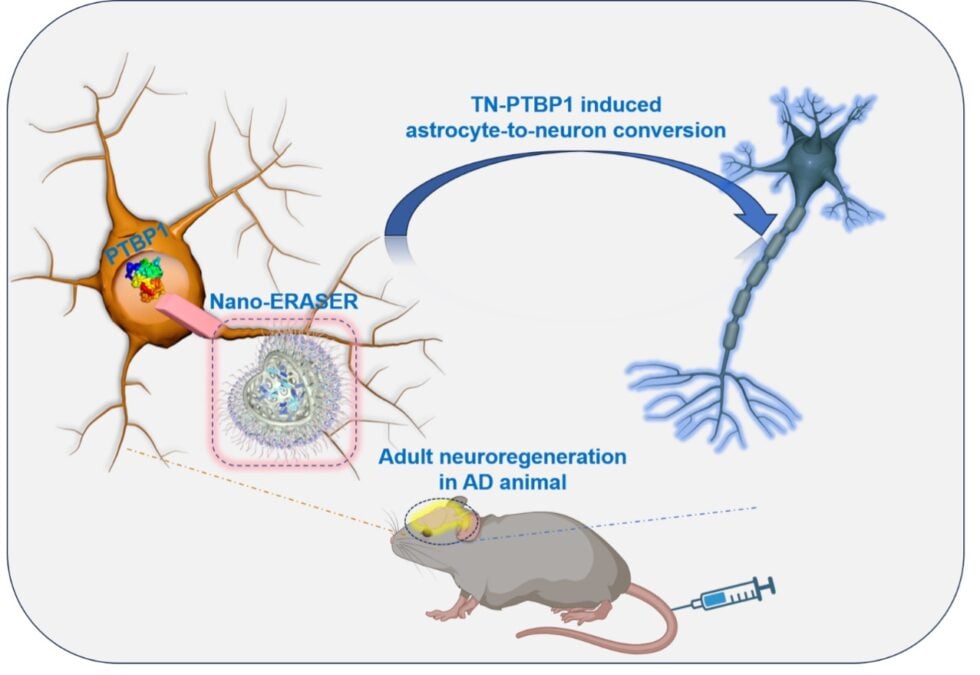
The graphical abstract of the study. (Wang et al., Cell Biomater. , 2026)
Nano-ERASER and neuron regeneration
Scientists at the University of Cambridge and the Max Planck Institute for Biophysical Chemistry developed a method in 2017 known as Trim-Away. It uses antibodies to break down selected proteins in mammalian cells for a range of applications.
In 2023, the team responsible for the latest study developed a version of Trim-Away that transports antibodies in an injectable polymer nanogel packed with nanoparticles. They called this system Nano-ERASER. In their initial experiment, the researchers targeted breast cancer cells.
The researchers have now demonstrated how Nano-ERASER might be used to treat Alzheimer's. This time, they focused on astrocytes, brain cells that support neurons and can turn into new neurons when required.
Current understanding suggests that this transformation takes place mainly during development, then slows sharply in the mature brain. It also appears to be controlled by a protein called PTBP1.
The team therefore used Nano-ERASER to target PTBP1 for degradation. When Nano-ERASER was applied to brain cells grown in laboratory dishes and to 3D organoids, PTBP1 levels appeared to fall, prompting astrocytes to transform into new neurons.
Using a microelectrode array, the researchers then verified that the converted neurons continued to operate like ordinary neurons, including by creating interconnected networks.
Testing Nano-ERASER in Alzheimer's mice
Would this translate into improvements in Alzheimer's symptoms?
For their subsequent experiments, the scientists studied mouse models of the disease, monitoring changes in both brain biology and behaviour.
Mice with Alzheimer's-like conditions commonly struggle to make nests, a troubling parallel with human patients who can likewise find everyday activities difficult.
The researchers also assessed cognition and memory through water-maze trials.
As expected, after several weeks, the treated mice regained their nest-building ability and completed the mazes more efficiently.
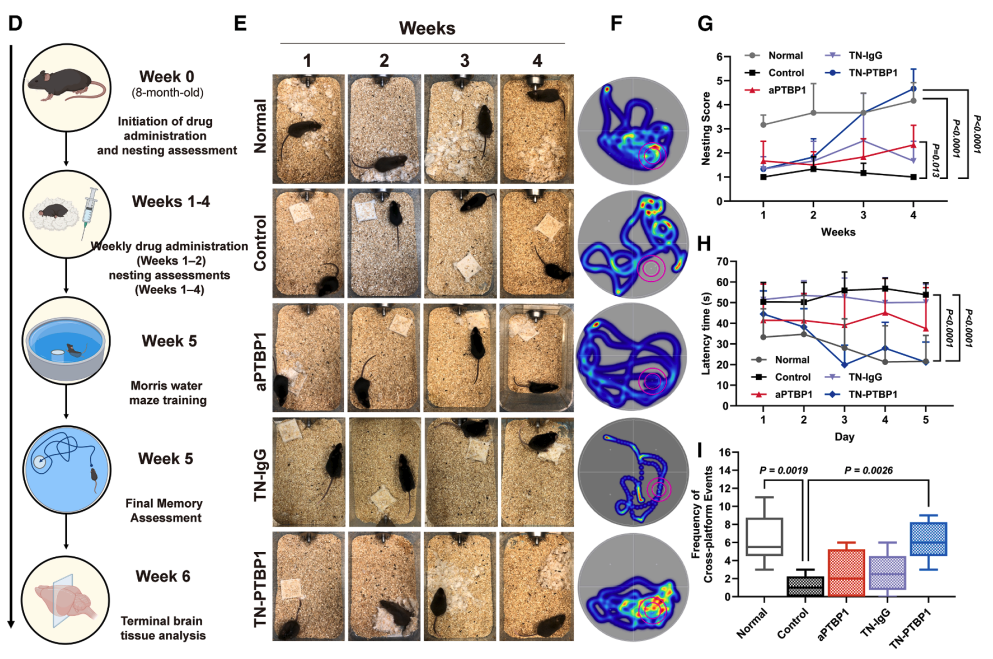
D) The experimental schedule. E) Mouse nesting assessments over time. F) The swimming paths in the water maze experiments. G-I) The animals' scores on the various tests. (Wang et al., Cell Biomater. , 2026)
The researchers further observed apparent improvements in biological signs of Alzheimer's disease within the animals' brains, including inflammation and the accumulation of harmful proteins.
"The new neurons can become mature and survive," says Xu.
"We also confirmed much higher neuron density in the brains of treated mice."
At such an early stage, there is naturally no assurance that these findings will translate to humans. Even so, the work may offer an intriguing new approach to tackling Alzheimer's.
Earlier research from other groups found that lowering PTBP1 regenerated neurons and eased symptoms of Parkinson's disease in mice. Frustratingly, subsequent studies were unable to reproduce those outcomes.
The latest findings appear to support the original results, potentially making the approach useful for reversing a variety of neurodegenerative diseases.
"By replenishing neurons in situ, restoring synaptic architecture, and potentially rebuilding damaged circuits, induced neurogenesis offers a path not only to slow neurodegeneration but to address one of its core structural consequences," the researchers write.
Related: Scientists Found 2 Existing Drugs Could Reverse Alzheimer's Brain Damage in Mice
Before this could happen, the team intends first to evaluate the technique over a longer timeframe and in primates.
"If we can advance it to the clinic, then we can have hope for patients with Alzheimer's disease," Xu says.
The study was published in Cell Biomaterials.
This article was fact-checked and edited by Fiona MacDonald. While we take pride in our process, we are only human. If you notice an error, please let us know.






Comments
No comments yet. Be the first to comment!
Leave a Comment