

Scientists have identified a little-known bacterial antibiotic that can disarm fungi behind life-threatening infections.
The finding is encouraging at a time when drug-resistant fungi are an increasingly serious global health concern.
"Fungal infections kill an estimated two million people worldwide each year, yet treatment options remain limited," explains molecular biologist Ana Traven of Monash University in Australia, who led the study published in Current Biology.
"Modern medicine, from surgery and cancer treatment to organ transplantation and intensive care, depends on our ability to prevent and treat these life-threatening infections."
Traven's team has now identified an established yet poorly known antibiotic that could offer some assistance.
"There are no vaccines for fungal infections, and some of the antifungal medicines we do have can be highly toxic, highlighting the urgent need for new ways to prevent and treat these diseases," Traven says.
How Candida albicans becomes dangerous
Candida albicans is a yeast that generally lives harmlessly on and within our bodies without notice - but, in very rare cases, it can turn pathogenic.
It usually causes infection only in people who are already seriously ill, immunocompromised, or have risk factors including major surgery or invasive medical devices.
C. albicans can alternate between a round yeast form, which may help it spread, and a filament-like hyphal form that can aid tissue invasion. In this form, it releases a toxin called candidalysin, which damages human cells.
When C. albicans enters the bloodstream - a condition known as candidemia - it can cause a life-threatening infection.
Meanwhile, the antifungal medicines previously used to treat it are increasingly failing to work as effectively as they once did.
Gladiolin shifts invasive fungi back to yeast cells
The recently identified antibiotic gladiolin drove fungi from invasive hyphae back into yeast cells - at least in laboratory petri-dish experiments.
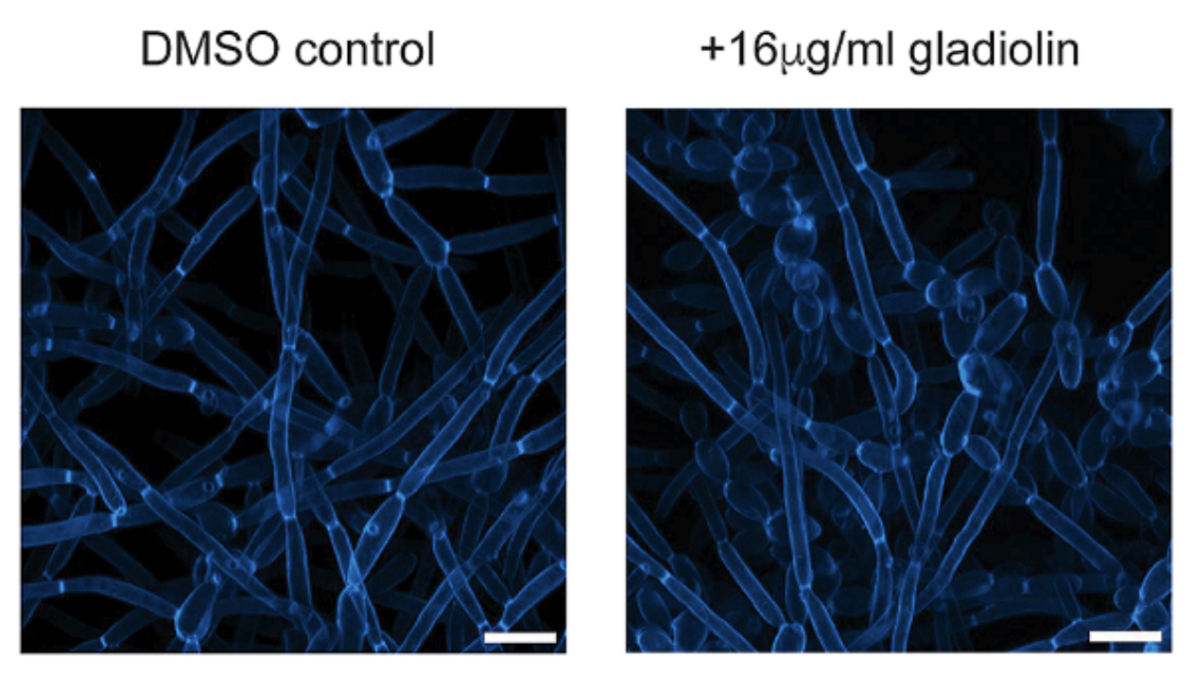
Gladiolin accelerates the transition from hyphae back to yeast cells. (Bharathwaj et al., Curr. Biol. , 2026)
Many of the most effective antibiotics available to us have been 'borrowed' from nature, and gladiolin follows that pattern.
Discovered in 2017, gladiolin is made by the bacterium Burkholderia gladioli. Like Candida, this bacterium can cause complications in hospital environments, although such cases are far rarer.
Bacteria and fungi are not invariably peaceful neighbours; they frequently compete for identical resources.
A microbe's rival may therefore hold, in its genes, some of the most potent chemical weapons against it.
Since B. gladioli can harm people - particularly in the settings where C. albicans is also problematic - clinicians could not simply introduce the bacterium and let the two compete.
Instead, researchers carefully extracted gladiolin from bacteria grown in the laboratory. The bacteria had originally been isolated from the lung of a patient with cystic fibrosis.
Gladiolin has already displayed promising activity against the bacteria responsible for tuberculosis. The latest results also build on research from 2024, which found that gladiolin can boost the activity of the powerful antifungal drug amphotericin B.
Gladiolin and amphotericin B work together
The new study explains how this bacterial product acts on C. albicans: it increases the activity of two crucial proteins, Tye7 and Gal4, sending the fungus's glucose metabolism into overdrive.
After C. albicans exhausts its glucose supply, gladiolin causes it to return to its less invasive yeast form.
Adding amphotericin B produced a synergistic effect, with the combination suppressing C. albicans biofilms more effectively than either treatment by itself.
"Our findings suggest that gladiolin could help existing drugs kill dangerous fungal pathogens, including drug-resistant biofilms that can form on medical devices, while potentially allowing lower, less toxic doses of antifungal drugs to be used," says molecular biologist Greg Challis, also of Monash.
Whether the treatment behaves similarly in the human body will remain unknown until it has first undergone a series of preclinical trials. Only then could the drug proceed to clinical trials in people to assess its safety and effectiveness.
Related: Deadly Fungal Infections Causing a 'Silent Pandemic', Scientists Warn
"Fungal infections are often overlooked because they are not as common as bacterial infections," says pathologist Nathan Wiederhold of UT Health San Antonio, who did not take part in the gladiolin research.
"But they can be much more difficult to diagnose and treat, and we're seeing increasing spread and resistance."
Every possible source of help will be needed, and gladiolin may be one part of it.
The research appeared in Current Biology.
This article was fact-checked and edited by Rebecca Dyer. While we pride ourselves on our process, we are only human. If you spot a mistake, please let us know.






Comments
No comments yet. Be the first to comment!
Leave a Comment