
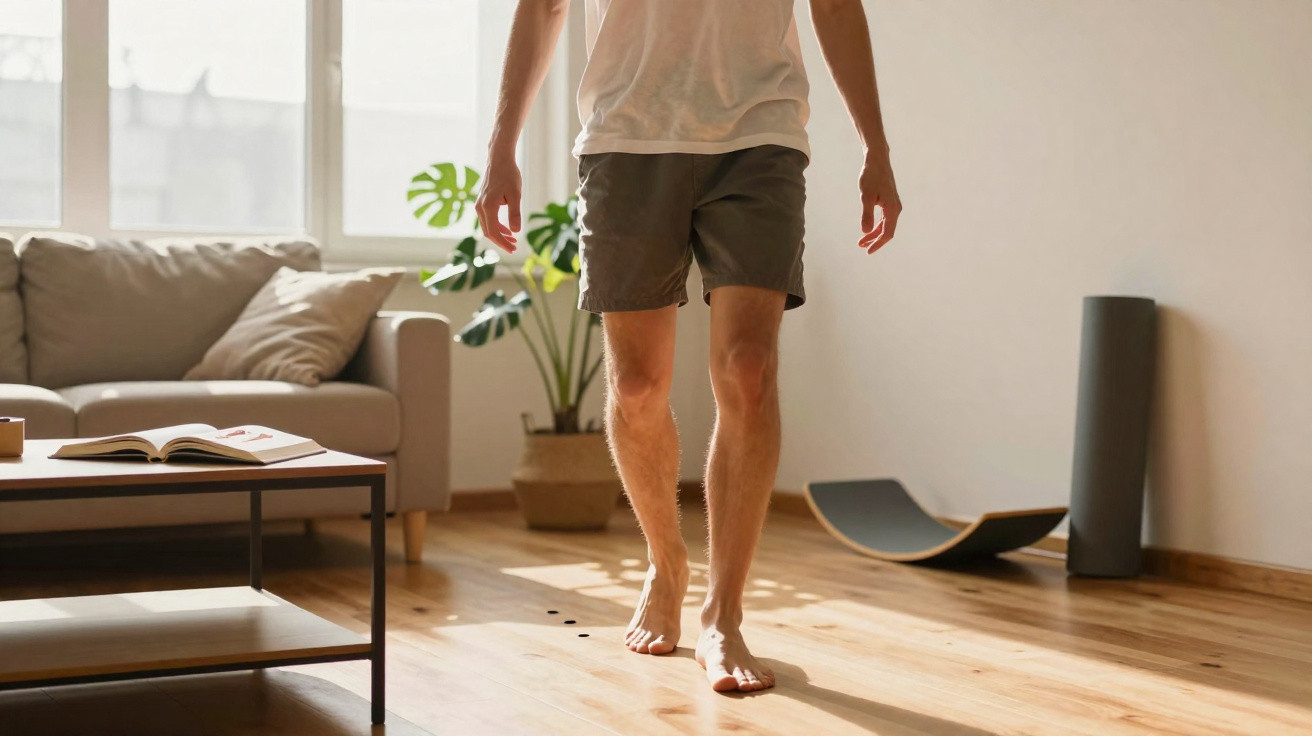
The first thing you might do after arriving home is slip off your shoes.
They end up in the hallway at a slight angle, a quiet sign that the day has come to an end. Beneath you, the floor may be cool, slightly dusty by the skirting board and smooth elsewhere. You barely register it. Phone in hand and only half focused, you head for the kitchen. But with each of those unnoticed steps, something subtle is taking place.
Your feet are continually adapting: adjusting their position, gripping the surface and making tiny movements you do not consciously detect. Your toes may open slightly, while your heel settles more naturally. With every step, your body makes minute corrections. While you text, flop onto the sofa or feed the cat, your internal balance system is quietly practising in the background.
That ordinary homecoming habit could do more for your steadiness than many balance exercises you never get round to doing. And it begins somewhere as unremarkable as the floor in your living room.
Why bare feet can “wake up” your balance
Look at a child moving barefoot around the house. Their toes catch the edge of a rug, they adapt as they go from tile to wood, and they may wobble one moment before racing off the next. Their feet are active, constantly sending messages to the brain. Compare that with many adults, whose feet are covered by thick socks and cushioned slippers, with little sense of the floor beneath them. It is the same body, but a very different exchange of information.
The soles of your feet contain sensory receptors that feed signals into your nervous system. They pick up texture, temperature, pressure and slight variations in level. After wearing shoes throughout the day, much of that information is dampened. Going barefoot turns the volume back up. Your brain becomes more aware of where your body sits in space. That information is the basic material of balance: no gym or app required, just skin meeting the ground.
In Japan, certain schools allow children to run and play barefoot on selected surfaces. Teachers say these children often develop improved posture and coordination over time. Physiotherapists see a comparable trend among older adults in clinical settings: a straightforward programme of safe barefoot walking at home may reduce unsteadiness and fear of falling. One study even showed that training the feet and ankles improved overall stability more than training the legs and core alone.
There is everyday proof you may already have experienced yourself. Walking on sand during a holiday can make your calves work harder sooner. On pebbles, you naturally slow down, change where you place your feet and use your toes more. A gentler version of this happens on kitchen tiles, a bathroom mat or wooden floorboards. Every unfamiliar surface gives your balance system a small session of practice.
The principle is quite straightforward. Staying upright relies on three major systems: vision, the inner ear and proprioception, the internal GPS that tells you where your limbs are. Bare feet against the floor boost that third system. When the skin on your soles directly senses the ground, your brain can create a clearer map of your position. The muscles and tendons in your feet and ankles then begin to activate with better timing. Across weeks and months, the small muscles that stabilise you become stronger and quicker to respond.
Thickly cushioned shoes are a little like wearing gloves all day before sitting down to play the piano. You can still hit the keys, but the touch is less precise. Barefoot walking removes that barrier. Your movements can become more accurate, less passive and more natural. Balance responds well to that honesty.
How to make barefoot time at home a gentle balance workout
Begin with something so easy that you cannot reasonably put it off. Choose a room with a safe, reasonably clean floor, such as the living room, bedroom or perhaps the hallway. In the evening, spend 10–15 minutes walking there with completely bare feet. No slippers and no socks: simply you and the floor.
Move slowly to begin with. Let the heel touch down, feel the weight travel to the ball of your foot, then through the toes. Pay attention to the way pressure shifts. Take several steps sideways, followed by a few backwards. This is not meant to be a formal workout; it is about rediscovering the ground in a way you may not have done for years. Your task is to feel more, not to do more.
People often rush into “barefoot living” and then develop aching arches or irritated Achilles tendons. Bodies do not respond well to abrupt change. Build up gradually. If you have spent all day in supportive footwear, your foot muscles are like someone who has been seated at a desk for hours: they are not ready to sprint. On the first day, even a few minutes barefoot is sufficient.
On a different day, introduce a brief balance challenge. Stand beside a table or kitchen worktop, raise one foot slightly from the floor and hold the position for a few breaths. Lower it, then repeat on the other side. Wobbling is precisely what makes the exercise useful. Those little tremors are your nervous system updating its software. Let’s be honest: hardly anyone really does this every day, but even doing it twice a week can bring a difference over time.
For some people, being without slippers feels almost like being undressed. Others feel concerned that their feet are “ugly” or that they walk strangely. Both reactions are normal. At a deeper level, walking barefoot can feel unexpectedly personal, even in your own home. Instead of concealing your stance and gait inside foam and fabric, you are faced with how you truly stand and walk. That is where improvement begins.
“The foot is often the missing link in balance training,” says one London-based physiotherapist. “People work their abs and legs, but forget the only part that actually touches the ground.”
To keep it playful rather than making it feel like another task, try adding small “anchors” around your home:
- Put a mat with a different texture, such as cork, bamboo or a mildly rough rug, in one area and cross it slowly each evening.
- While brushing your teeth, stand barefoot and gently transfer your weight from one foot to the other.
- Once a week, have a “barefoot hour” at home: no shoes, no thick socks, only natural walking on your usual floors.
What changes as your balance gradually improves
Better balance does not arrive with any fanfare. Instead, it appears in small moments that are easy to overlook. You get off a bus without stumbling when the driver brakes. You reach towards a high shelf without that brief panic in your ankles. You go down dimly lit stairs at night and feel unexpectedly composed. Your body begins to trust itself a little more.
There is also a quiet emotional element. On a difficult day, feeling unstable can make everything around you seem harsher and more threatening. When your foundation feels more secure, daily life may soften slightly. Perhaps you start taking the longer route around the block again. Or you spend more time playing on the floor with your children or grandchildren and can get back up more easily. We do not often connect this with bare feet on a living-room floor, but the relationship can be surprisingly close.
In practical terms, improved balance can also mean fewer near-falls at home, fewer sprained ankles on uneven pavements and a modestly reduced chance of serious injury as you get older. For athletes and weekend runners, time spent barefoot may improve foot control and ankle stability, often leading to cleaner strides and fewer overuse niggles. For everyone else, it is simply about moving around their own home with calmer confidence.
Some people observe changes in their posture: they stand a little taller, keep their knees less locked and align themselves more over the middle of the foot instead of heavily striking through the heels. Others find their toes begin to spread and their arches feel more responsive rather than “flat and dead”. This is not magic; it is the result of consistent, low-level stimulation. Just as your hands became more capable through daily typing or phone use, your feet react to regular use too.
We all know someone who swears by elaborate balance boards, wobble cushions and costly footwear. Those tools can certainly be useful. Yet the essential starting point is already quite literally beneath your feet. Barefoot walking at home costs nothing, needs little effort and fits naturally into existing routines. It occupies that unusual middle ground between “scientifically sound” and “realistically doable”. On an exhausted evening, the minimum you can do is remove your shoes and allow your nervous system to wake up a little.
There is something quietly grounding, too, about sensing your own floor: the dust you overlooked, a cool patch of tile or a warm band of sunlight on the carpet. On a day dominated by screens, that modest physical contact returns you to your body. One step follows another, with no noise and no performance. It is simply you, your balance and the familiar territory you usually cross on autopilot.
| Key point | Detail | Why it matters to the reader |
|---|---|---|
| Feet as balance sensors | Barefoot walking increases sensory feedback from the soles | Helps you see why such a simple habit can alter stability |
| Gradual, safe practice at home | Short daily sessions on clean, stable floors with gentle challenges | Offers a realistic way to begin without pain or feeling overwhelmed |
| Everyday benefit | Fewer wobbles, greater confidence, more ease in everyday movement | Makes the habit feel useful and easier to maintain over time |
FAQ:
- Is walking barefoot at home safe for everyone? Not necessarily. Anyone with diabetes, significant circulation problems or foot wounds should seek medical advice first. If your floors are cluttered, or there are plenty of sharp items or pet toys around, clear the area and begin somewhere controlled and well lit.
- How long does it take to see balance improvements? Many people spot subtle differences within a few weeks, such as feeling steadier on one leg or less unsteady on stairs. More substantial, lasting improvements develop over months as the feet and ankles strengthen and the nervous system adapts.
- Should I throw away my supportive shoes? No. Treat barefoot time as an addition rather than a substitute. You can continue wearing supportive shoes outdoors or on long walks, while using barefoot time at home to build balance and foot strength gradually.
- What if my feet hurt when I walk barefoot? Begin with very short periods on gentler surfaces, such as rugs or mats. If the pain is sharp, persistent or concentrated in one spot, speak to a podiatrist or physiotherapist. Pain is a signal, not something to push through blindly.
- Can barefoot walking really reduce my risk of falls as I age? It can form part of the wider picture. Strong, responsive feet and better balance reduce the likelihood of missteps at home. Alongside strength training, effective lighting and a safer environment, it can make everyday life feel a little less fragile.

Comments
No comments yet. Be the first to comment!
Leave a Comment