
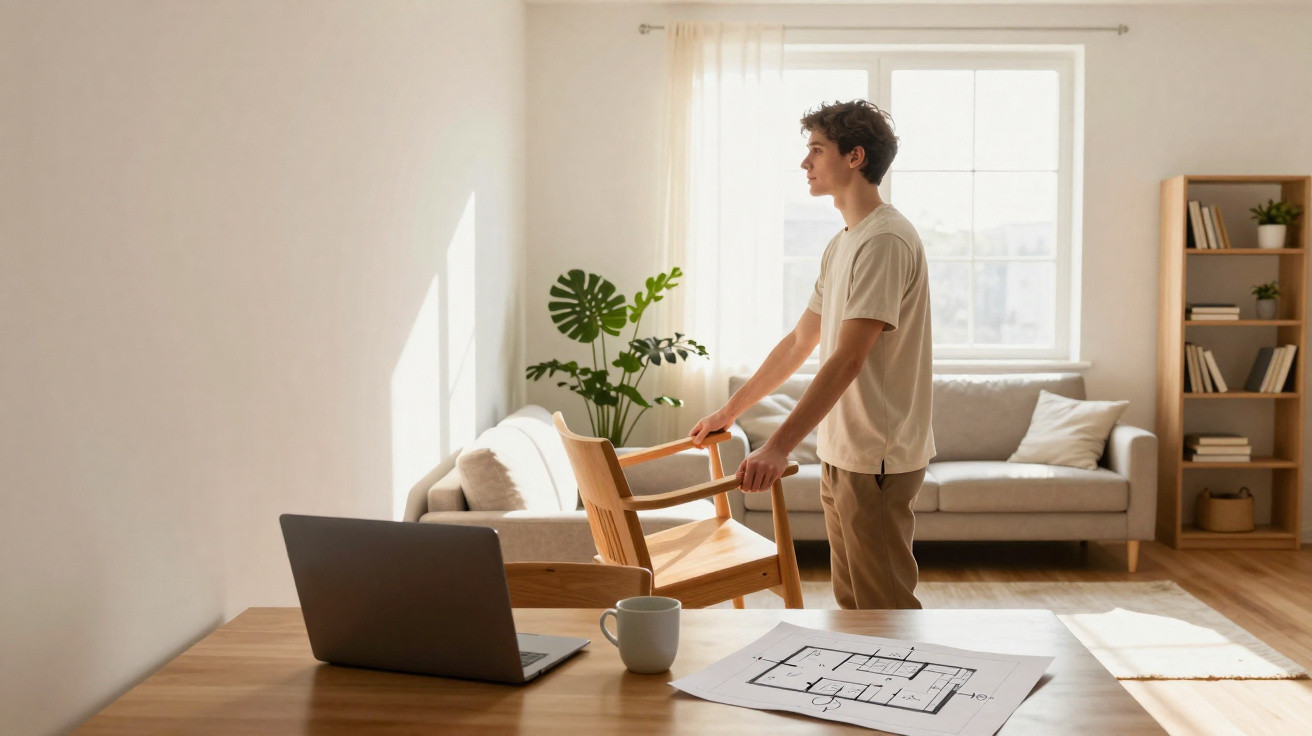
The first time you spot it, it can feel slightly ridiculous. You are at a dining table that has become your desk, with such heavy brain fog that you have forgotten why you opened the laptop. Your shoulders ache with tension, while your gaze keeps wandering to the washing-up, the laundry basket and the oddly tilted picture frame. You blame your workload, lack of sleep or phone. The chair beneath you and the wall in front of you never enter the equation.
Then, one weekend, you move the table towards the window on impulse. You position the chair at a slight angle to the daylight, remove clutter from the edge of your view and sit down. Within ten minutes, thinking feels more straightforward. You are no longer reaching for your phone every few moments. Somehow, your body feels calmer.
Nothing dramatic has happened.
Only the way your room connects with your brain has changed.
The invisible noise in our rooms
Spend a full day noticing where your eyes naturally settle at home. There is the corner filled with stray charging cables, the stack of half-finished books slipping from the coffee table and the television permanently in your eyeline, even when switched off. Every one of these visual fragments quietly competes for your attention.
Your brain continually scans, categorises and processes it all while you are merely attempting to send an email or help your child with homework. You may feel “tired from work”, yet part of that exhaustion comes from the unseen mental juggling your room demands. In a single room, your brain is answering fifty tiny questions without your awareness.
Think of the familiar lockdown arrangement: the kitchen table serving as an office, the sofa functioning as a break room and the bed becoming a meeting booth. A 2022 survey by the American Psychological Association found that 72% of remote workers felt “significantly mentally drained” by the end of the day. Screen time was blamed by many. But when researchers looked more closely, cluttered, multi-purpose rooms appeared repeatedly.
A remote worker I spoke with, Léa, once worked while facing her open-plan living room. She could see the television, the PlayStation and her partner passing through. Following months of burnout, she turned her desk by ninety degrees, leaving a blank wall, a plant and a window in view. Her role and hours stayed exactly the same. Two weeks later, she said her 4 p.m. dip had almost disappeared. “I’m not constantly negotiating with my own environment anymore,” she said.
It makes sense that this feels so noticeable. Brains favour patterns and dislike uncertainty. If your furniture is dispersed or your workspace merges with your place to unwind, your mind never entirely changes gear. Rather than having a distinct “work zone” and a distinct “rest zone”, you are stuck in an indistinct middle ground.
Psychologists describe this as cognitive load: the countless small pieces of information your mind is processing in the background. Untidy visual surroundings and uncomfortable layouts increase that load. A chair pointed at a busy corridor can make your ancient survival instincts burn energy tracking each movement. A desk beside a stack of unpaid bills lets anxiety interrupt your concentration whenever your eyes move to the right. Rearranging furniture may seem purely decorative, but it is really a subtle way to reduce the number of things your brain must resist.
Micro-renovations without buying a thing
Begin with one direct question: when you are normally working or thinking, what is the first thing your eyes meet? Answer honestly, rather than imagining the Instagram-ready version. Reposition your chair, table or sofa so that the main view is peaceful, uncluttered and mostly still. It could be a bare wall with a single picture, a window looking onto trees or sky, or an uncomplicated bookcase.
A turn of only thirty degrees can alter your cognitive load. Position your desk with the television behind rather than ahead of you. Shift the sofa a little so the kitchen mess is not directly in front of you. Move a small table beside a window and make it your dedicated “thinking spot”, used solely for tasks requiring deep focus. You have not redecorated; you have created unseen boundaries in your mind.
Many people begin by purchasing organisers or productivity tools, then feel disappointed when neither produces lasting change. The inexpensive solution is often found in the large items you already have. Reposition the sofa so the main route through the room does not cut across your view while you work on a laptop. Move a large bookcase to form a natural divide between the “work side” and “rest side” of the room.
One reader told me that she moved her bed fifteen centimetres further from her desk and rotated the headboard so the two no longer occupied the same visual plane. “I used to fall asleep staring straight at my inbox,” she said. Once it had been moved, her brain gradually stopped linking the bed with unfinished jobs. Sleep became easier. It was the same room and the same furniture, but with a different mental story.
This is often where we go wrong: we want a layout to resemble a Pinterest board instead of serving as a real, lived-in space. We tuck desks into gloomy corners “to save space”, then question why sitting there feels dreadful. Or we force every piece of furniture against the walls, creating an awkward vacant centre that resembles a waiting room rather than a home.
Honestly, nobody maintains this perfectly every day. Old routines return, post gathers again and chairs gradually shift. Perfection is not the aim; moving in the right direction is. If a particular position tightens your shoulders or scatters your thoughts, take that feeling as useful information. Make an adjustment. Nudge the table, rotate the chair and reclaim five per cent of your concentration at a time. That still counts as progress.
“When we change the arrangement of our rooms, we’re not just moving objects,” explains environmental psychologist Sally Augustin. “We’re changing where our attention goes, how safe we feel, and how much energy we spend just existing in that space.”
- Create one clear “work-facing” direction
Point the desk or table towards calm visuals with few distractions. - Use large pieces as soft dividers
Use a sofa, shelf or rug to distinguish the focus zone from the relaxation zone. - Respect natural light
Set your main thinking spot side-on to a window, rather than with your back to it or looking directly into glare. - Keep movement behind you rather than ahead
When concentrating, doors, corridors and active spaces should be outside your primary field of view. - Leave one surface almost empty
Keep a “clean slate” space that your brain connects with clarity and a fresh start.
Living in rooms that work with you, not against you
There is something quietly radical about looking at your home and asking, “Is this layout helping my mind, or draining it?” This does not mean becoming someone who smooths their sofa cushions or alphabetises their spices. It means recognising that our brains are persistently physical. Whether or not we register it, they react to chairs, angles and sightlines.
Once you have noticed it, it is difficult to ignore. You see how your desk draws you back to the screen even after you have finished work. You notice how a sofa facing the television turns it into the centre of the evening, whatever your intentions were for reading, stretching or talking. Then comes the small, almost defiant choice to move something a few inches and observe the result.
Your ideal focus spot may not be where you think it ought to be, but where your nervous system naturally settles. Perhaps it is a chair by a window in the corridor, where you unexpectedly write more quickly. Perhaps it is the far end of the dining table, turned away from the fridge. You begin to detect when one corner makes your thoughts feel weightier and another makes them feel lighter.
Most of us know the feeling of entering a hotel room or Airbnb and, without quite knowing why, relaxing within minutes. The bed is pointed towards the window, the desk sits away from the television and no surface is covered by twenty objects. You feel different because the room gives your brain fewer conflicts to manage. That same gentle sense of relief can be created at home without purchasing anything new.
Your experiments may not always work. You might drag a chair into place, sit down and discover that sunlight reaches your eyes every hour. You may move the desk and then find you miss the gentle background activity of the kitchen. Rooms evolve with the seasons, children growing older and changing jobs. Fortunately, furniture is not permanent.
Whenever you shift a table, turn a rug or change the orientation of a bed, you are posing a quiet question: what if my surroundings supported my concentration rather than taking it away? The answer will not be found in a catalogue. It will arrive in private, unremarkable moments when your tiredness feels lighter, your thoughts are less knotted and your home finally seems to be working with you.
| Key point | Detail | Value for the reader |
|---|---|---|
| Visual field shapes focus | Position primary seats and desks towards peaceful, low-clutter views | Limits distractions and mental tiredness when working or studying |
| Zones matter more than décor | Use furniture to divide work, rest and play spaces | Allows the brain to change modes and recover more completely |
| Small shifts beat big overhauls | Turn, slide or repurpose existing items instead of renovating | Delivers an immediate, low-cost improvement in everyday concentration |
FAQ:
- Question 1 Does rearranging furniture really affect focus, or is it just a placebo effect?
- Question 2 How can I improve focus if I live in a very small studio flat?
- Question 3 What’s the best direction for my desk to face when working from home?
- Question 4 How often should I rethink or change my room layout?
- Question 5 Can rearranging furniture help children concentrate better on homework?






Comments
No comments yet. Be the first to comment!
Leave a Comment