
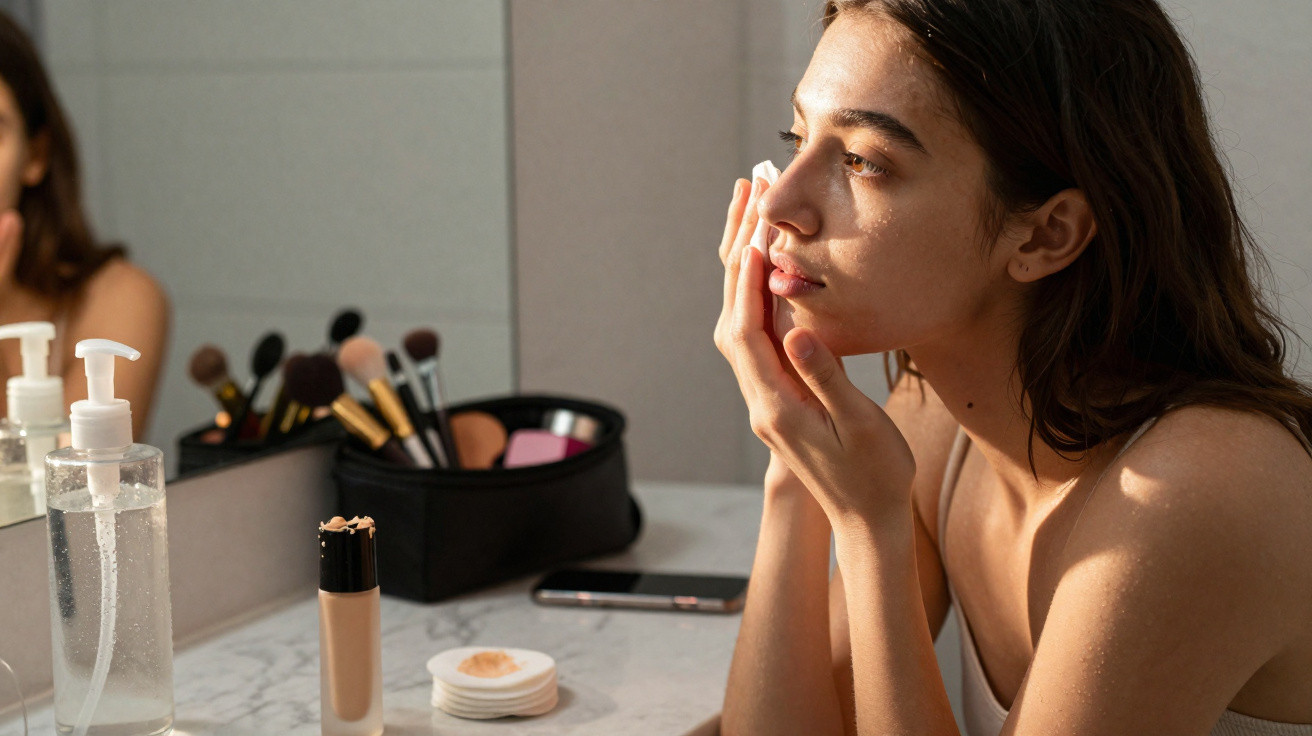
Foundation, concealer and powder are as much a part of a perfect start to the day for many people as coffee and checking their phone. Yet dermatologists increasingly caution that wearing make-up every day can upset the skin’s balance, with effects that may not become apparent for months.
Make-up as armour – what is really happening underneath
Make-up can work wonders, making us look fresher, more alert and well groomed. Some people feel almost “undressed” without a made-up face. But behind this familiar routine sits a highly sensitive organ: the skin.
Skin is constantly renewing itself. It produces sebum, sheds dead cells and works to keep its protective barrier intact. Daily make-up can interfere with precisely these processes, particularly when several layers are applied.
Skin is not a blank sheet of paper on which colour can be applied at will. It is working in the background around the clock.
Occlusive effect: when skin is trapped beneath a film
Many foundations, especially high-coverage versions or “long-lasting” formulas, sit on the skin like a film. Professionals refer to this as an occlusive effect. Although it sounds harmless, it is not necessarily so.
- Sebum cannot drain away as easily.
- Pores clog more quickly.
- A warm, damp environment develops – ideal for bacteria.
This can result in blemishes, blackheads and inflamed spots, even in people who previously had very few skin concerns. Skin may suddenly look uneven and blotchy, or become irritated. The usual response is often to apply even more make-up to conceal it. That is how the cycle begins.
Gradual irritation caused by ingredients
Certain ingredients can also slowly unsettle the skin. Not everyone immediately develops redness or a burning sensation; very often, the process is far subtler.
Potentially problematic ingredients include:
- Fragrances and perfume in foundation, powder and setting spray
- Certain preservatives
- Some colour pigments, particularly in very long-wearing formulations
The skin tends to give quieter signals: it may appear more delicate, become red, feel tight, turn dry more quickly or shine in the T-zone at the same time. This is known as gradual irritation. Many people mistakenly interpret it as “sensitive skin” and put even more product on top rather than looking for the cause.
The underestimated damage of lazy make-up removal
The day’s most critical moment often comes in the evening. Tired from work, childcare or the sofa, it is precisely then that the urge to take the easy option wins. Removing make-up is postponed or done only half-heartedly.
Anyone who goes to bed wearing make-up takes dirt, sebum and product residue under the duvet with them – the skin cannot work properly overnight.
When make-up, sweat, fine particulate pollution and oxidised sebum remain on the skin, several things can happen:
- Pores become blocked and inflamed more easily.
- The skin’s natural overnight regeneration is slowed down.
- Over time, the complexion looks dull and tired.
- Fine lines may appear earlier because the skin barrier seems weakened.
Many dermatologists view the combination of high-coverage make-up and poor cleansing habits as a genuine driver of premature signs of skin ageing – even without sun exposure or smoking.
How often should you wear make-up – and how much is still okay?
Nobody needs to throw away their entire make-up collection. What matters is how consciously products are used. From a dermatological perspective, daily full make-up with multiple layers is considered problematic when skin is already struggling with blemishes, redness or dryness.
Make-up-free breaks can be helpful: set days on which the skin is left bare. On those days, gentle cleansing, moisturiser and sunscreen are enough. After a few weeks, many people find that their skin appears calmer and that they need less coverage.
How to recognise skin-friendly make-up
Anyone who does not want to give up make-up should choose products specifically designed to place less strain on the skin. A quick look at the packaging is worthwhile.
| Product type | What to look for |
|---|---|
| Foundation | Lightweight texture, “non-comedogenic”, preferably fluid rather than extremely thick |
| Powder | Finely milled, free from strong fragrances, applied sparingly |
| Concealer | Apply only to individual areas rather than over large sections of skin |
| Primer | Avoid daily use of versions with a very high silicone content |
Many people benefit from swapping “full coverage” products for lighter textures, such as tinted moisturisers or BB creams. The skin remains more breathable while the complexion still looks more even.
Hygiene: brushes, sponges and phone screens as bacterial hotspots
Another frequently overlooked factor is the tools used for applying make-up. Beauty sponges, brushes and fingers are pressed against the skin every day, often without being cleaned regularly.
Damp sponges in particular provide an ideal breeding ground for germs. Using one to apply liquid foundation repeatedly spreads bacteria across the entire face. The same applies to brushes left unwashed for weeks.
A practical rule of thumb:
- Clean beauty sponges thoroughly at least once a week, and more often for blemish-prone skin.
- Wash brushes used for foundation, concealer and powder every one to two weeks.
- Wipe your phone screen briefly every day – it rests directly against the cheek and chin.
The psychological side: when going without make-up causes insecurity
Many people say they feel “naked” without make-up. This is understandable when you have spent years seeing yourself only with make-up in the mirror. Bare skin can then seem unfamiliar, with every small area of redness appearing like a flaw.
The more often a face is shown only with make-up, the greater the barrier can become to appearing without a filter from time to time.
Dermatologists observe that people who care for their skin gently and give it deliberate breaks often develop a different relationship with their body after a while. Small irregularities become less dramatic when the overall appearance looks healthier, clearer and more balanced.
Practical steps to reduce the pressure
- Introduce one fixed “no-make-up day” a week – Sunday, for example.
- When working from home or on a day off, use only mascara or brow gel instead of a full foundation routine.
- Look at yourself in the mirror without make-up deliberately, rather than only glancing past quickly.
Many people then realise that their own skin does not need to be perfect to look well cared for and attractive. This shift in perspective often reduces the urge to follow a full make-up routine every day.
How skin recovers when it gets a break
Giving skin regular time without make-up allows its natural processes to function more effectively. Sebum can drain freely, the protective barrier becomes more stable and redness often subsides with the right skincare.
People prone to clogged pores beneath the surface and inflamed spots often notice a change only after several weeks. Skin works in cycles, so quick miracles are rare. However, persistence pays off: after making the switch, many people need considerably fewer products because their skin looks calmer on its own.
Simple routines are useful during this phase: gentle cleansing, a well-tolerated serum, a suitable moisturiser and consistent sunscreen. Aggressive exfoliants or constantly changing trend products can otherwise aggravate the situation again.
Those who understand that make-up does not heal the skin but merely smooths its appearance usually make different choices: fewer layers, more considered product selection and a clearer focus on skin health. In the end, the best “foundation” remains skin stable enough not to need any on many days.






Comments
No comments yet. Be the first to comment!
Leave a Comment