
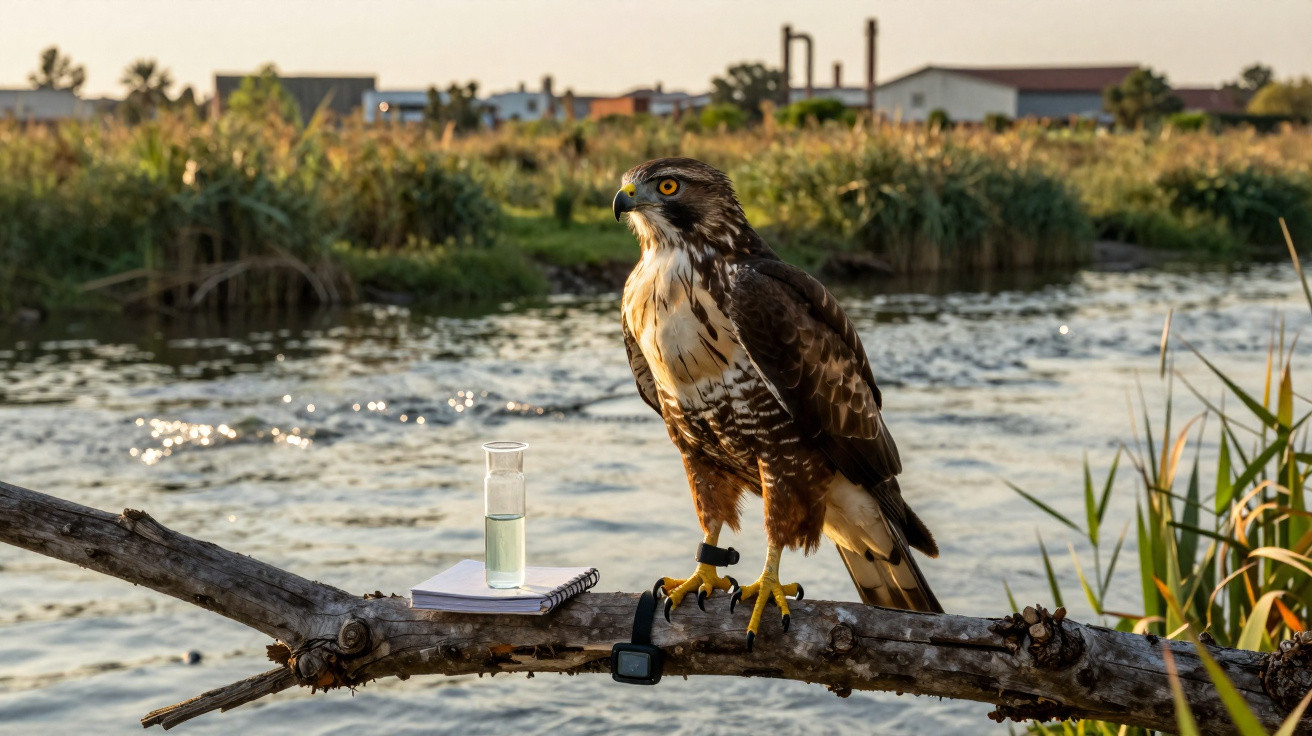
Majestic birds of prey usually bring dramatic aerial manoeuvres to mind, rather than invisible chemistry. Yet new research from Italy indicates that raptors reveal the extent to which the environment is contaminated by so-called “forever chemicals”. These substances occur in tap water, frying pans, jackets and cosmetics – and build up in bodies without ever properly disappearing.
What lies behind “forever chemicals”
The substances examined are PFAS, or per- and polyfluoroalkyl substances. For decades, these chemicals have been used in countless everyday goods: they make fabrics water-repellent, pans non-stick, packaging grease-resistant and firefighting foams highly effective. Their drawback is that they barely break down.
PFAS are found not only in drinking water, but also in rivers, lakes and soils, eventually reaching our bodies. The kidneys and liver can eliminate them only to a very limited extent. As a result, the substances gradually accumulate in blood and tissue, a process experts call bioaccumulation.
“PFAS do not disappear; they travel: from products into the environment, from the environment into animals, and from animals into people.”
Studies associate high PFAS exposure in people with:
- disruption to hormone balance
- weakened immune systems and poorer vaccine responses
- altered liver function and raised blood lipid levels
- an increase in certain types of cancer
- possible effects on fertility and children’s development
The new Italian research now places the impact on wildlife – especially birds of prey – at the centre of attention, showing just how clearly they reflect the problem back to us.
Birds of prey as nature’s early-warning system
The researchers assessed data from several regions around the world and examined numerous species, including falcons, eagles, buzzards and other predators. The outcome was clear: PFAS could be detected in virtually every bird body part analysed – in blood, livers, eggs and even feathers.
This points to a key finding: birds of prey are highly suitable “sentinel species”, acting as biological early-warning systems. Because they sit at the top of the food chain, they accumulate everything that has already built up in fish, small mammals and other prey.
“Where birds of prey show high PFAS levels, the entire food chain below them is already heavily contaminated.”
The study also identifies a clear difference among raptors. Species that feed mainly on fish carry considerably higher concentrations than those hunting solely on land. This directly highlights a long-recognised weakness in our ecosystems.
Why water bodies become PFAS hotspots
PFAS enter rivers and lakes through industrial wastewater, sewage-treatment plants, landfill sites and run-off from contaminated soils. Fish then absorb these compounds through their gills and food. Since PFAS hardly degrade, concentrations in their bodies rise with every further meal.
Fish-eating raptors, such as ospreys and certain harriers, feed at the top of this aquatic food chain. The Italian data show that their PFAS levels are regularly higher than those of related species that prey on mice or other land animals.
Birds of prey therefore identify aquatic landscapes as especially sensitive areas. Where PFOS and related long-chain compounds accumulate, persistent contamination hotspots emerge that are difficult to control. These long-chain PFAS are regarded as particularly long-lasting and prone to bioaccumulation.
How effects intensify along the food chain
One important process is known as biomagnification. A small fish takes up a low level of PFAS from the water. A predatory fish eats many small fish, while a white-tailed eagle in turn consumes many predatory fish. At every stage, the substances become more concentrated in the body:
- low concentration in water
- higher concentration in small aquatic organisms
- still higher concentration in fish
- peak levels in birds of prey, otters or seals
Raptors are therefore more than a symbol of a healthy natural environment: they are also a measuring tool for the unseen chemical burden in rivers, lakes and wetlands.
New PFAS variants – the same problem, with less data
In some areas, international regulations have already reduced concentrations of certain PFAS types. However, replacement chemicals are filling the gap, and far less is known about them. Manufacturers are shifting from long-chain compounds to shorter-chain substances or new molecules with similar properties.
These substances likewise reach the air, water and soil while toxicologists are still gathering evidence. The Italian study therefore warns against being misled by falling levels of individual “older” chemicals. The overall chemical burden remains substantial – and may be underestimated.
“While known PFAS are regulated, industry is introducing new variants for which robust risk data are lacking.”
This is precisely where birds of prey play a role: in effect, they incorporate every new generation of PFAS that reaches their prey. They do not respond to individual chemical names, but to what is actually circulating in the environment.
Why long-term monitoring is so urgent
The researchers call for standardised, long-term monitoring programmes. Only these can track how contamination develops over years and decades. It is important not to rely exclusively on birds of prey, but to combine them with other animal groups, for example:
- fish and mussels for aquatic systems
- amphibians as indicators of wetland habitats
- small mammals in agricultural landscapes
- marine mammals in coastal and open-ocean regions
Raptors provide a kind of umbrella indicator: when they show high levels, widespread and long-term contamination is likely. Policymakers and public authorities can use such data to identify hotspots, prioritise clean-up work or tighten limit values.
Practical implications for everyday life
Although the study focuses on birds of prey, it also raises practical questions for consumers. Many people want to know how they can at least limit their personal exposure. Experts often suggest similar approaches:
- check tap water for regional contamination and, if needed, use suitable filters
- replace old, heavily damaged non-stick pans and look for PFAS-free coatings when buying new ones
- choose outdoor clothing and waterproofing products carefully, paying attention to references to fluorinated protection
- cut down on packaging waste, particularly greaseproof fast-food packaging
These measures will not solve the global problem, but they show that the issue is not confined to remote conservation areas: it is directly linked to our consumer choices.
How severely PFAS affect birds of prey
For the animals themselves, this is not simply a matter of laboratory readings. High PFAS exposure in birds can contribute to poorer reproduction, weakened immunity and developmental problems in chicks. If eggs have thinner shells or chicks are less likely to survive, entire populations can become destabilised over time.
Birds of prey are often sensitive to environmental toxins because they mature sexually late, rear only a small number of young each year and invest substantial energy in every clutch. Even minor disruption to breeding success or health can affect populations in the longer term.
| Aspect | Possible consequence of high PFAS levels in birds of prey |
|---|---|
| Breeding success | fewer chicks hatching or surviving |
| Immune system | greater susceptibility to infections and parasites |
| Hormone balance | disrupted breeding cycles, altered behaviour |
| Long-term exposure | gradual decline in populations in contaminated areas |
Such effects do not affect rare species alone. Even birds of prey considered widespread can come under gradual pressure while still appearing stable on the surface.
Why PFAS will remain an issue for a long time
A central feature of PFAS is their extreme persistence. Even if all emissions stopped immediately today, a vast legacy burden would remain in soils, sediments and organisms. This reservoir continues to release substances little by little, much like a store from which small quantities keep seeping out.
Birds of prey therefore act not only as indicators of present-day pollution, but also of this “chemical past” stored in the environment. Changes in their blood levels or eggs can reveal whether clean-up measures are genuinely having an effect over the years.
For specialists, the Italian study demonstrates two things: first, how extensively PFAS have entered ecosystems; and second, how useful biomonitors such as eagles and falcons are for tracking a trend whose causes often date back decades. Anyone looking to the sky therefore sees more than spectacular hunters – they also see valuable witnesses to an ongoing burden that has long since reached everyday life.






Comments
No comments yet. Be the first to comment!
Leave a Comment