
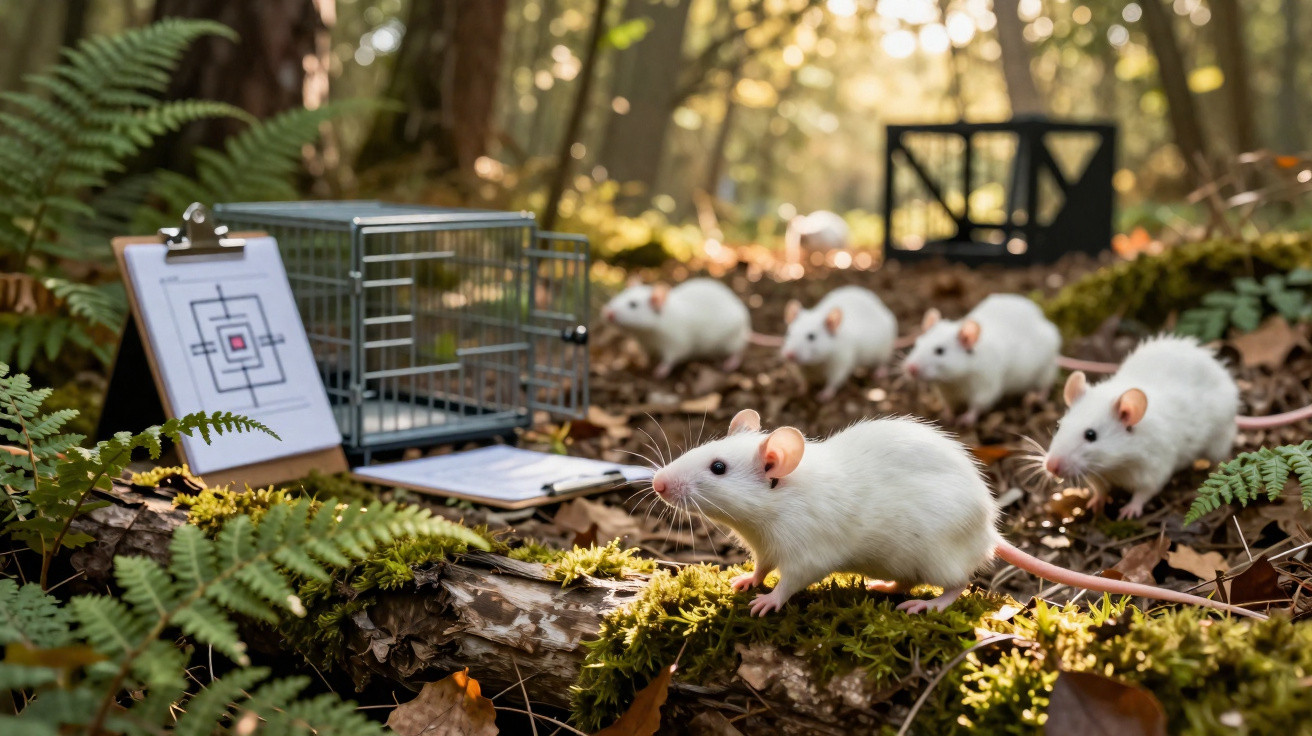
Dozens of laboratory mice that were given freedom to explore a sizeable outdoor enclosure returned to normal mouse anxiety levels within only a week, researchers have found. The observation suggests that ‘rewilding’ could stop laboratory-induced fear responses from arising in the first place.
Scientists at Cornell University in the US say the results prompt questions about the most appropriate ways to conduct animal anxiety tests in laboratories. They may also offer insight into how anxiety first develops in animals, humans included.
“We put them in the field for a week, and they returned to their original levels of anxiety behavior,” says biologist Matthew Zipple.
“Living in this naturalistic environment both blocks the formation of the initial fear response, and it can reset a fear response that's already been developed in these animals in the lab.”
How laboratory mice anxiety is measured
Researchers commonly create and assess anxiety in mice with an elevated plus maze, or EPM. The apparatus has two arms: one enclosed arm, where the animals feel more secure, and another exposed arm that places the mice in a more open setting.
When faced with an EPM, mice usually investigate the maze and then retreat to the enclosed sections. Researchers interpret this as evidence of fear brought on by a single encounter with the open spaces. The behaviour is so enduring that SSRI anti-anxiety medicines do not overcome it.
Rewilding reset the mice’s fear response
The team released 44 mice from their laboratory cages into a comparatively expansive outdoor area, allowing them to burrow, climb and encounter a range of sensations and environmental conditions. This appeared to function as a reset button.
After being placed back in the EPM, the mice explored open and enclosed areas to the same extent, as though they were seeing the maze for the first time. This outcome was seen whether the mice had been rewilded from birth or not.
What varied environments could reveal about anxiety
The results could affect our understanding of anxiety and its connection with the environment, a relationship that might apply to people as well as mice. A limited range of experiences may potentially encourage anxiety.
“If you experience lots of different things that happen to you every day, you have a better way to calibrate whether or not something is scary or threatening,” says neurobiologist Michael Sheehan.
“But if you've only had five experiences, you come across your sixth experience, and it's quite different from everything you've done before, that's going to invoke anxiety.”
According to the researchers, the way anxiety is investigated in laboratories, and the extent to which mouse experiments can be applied to humans, may need reconsidering. What is regarded as anxiety in laboratory mice may be readily eased by their surroundings rather than being embedded in their biology.
The possibility that a more protected life contributes to anxiety has also been examined in studies involving people. A wider range of experiences, including riskier ones, might help to lessen anxiety, although multiple factors are known to be involved.
“This opens a lot of possibilities for asking interesting questions about how our library of experiences shapes our response to novel experiences, because I think that's essentially what anxiety is – when you have an inappropriate response to something that isn't actually scary,” says Sheehan.
The research has been published in Current Biology.





Comments
No comments yet. Be the first to comment!
Leave a Comment