
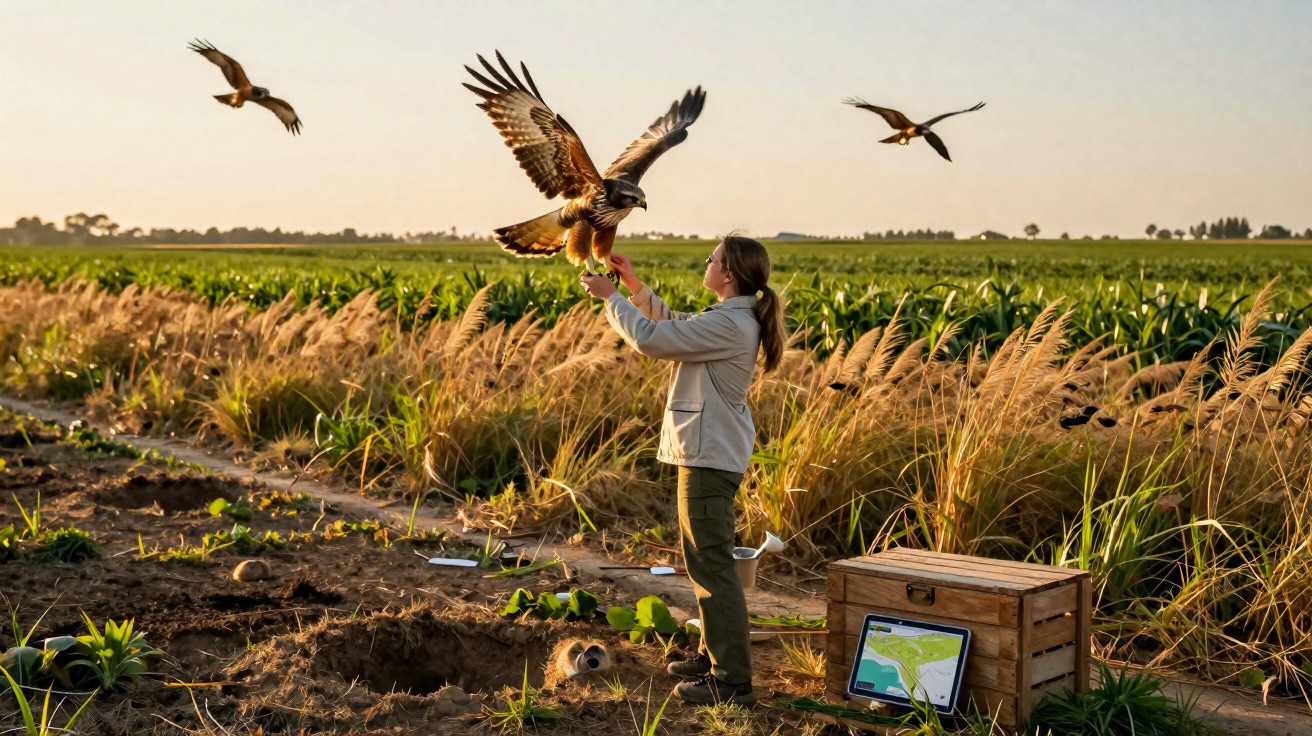
A red kite hangs over a field, its wings flickering and its head cocked, seemingly tuned to movement beneath the waves of wheat. Somewhere below it, a vole makes a fatal error.
A few minutes later, the bird drifts away with a small, motionless body gripped in its talons. The farmer breathes out. There is less need for poison, fewer traps to set, and one more fragment of balance has returned. Across Europe and North America, this is no longer an unusual sight: it plays out thousands of times daily, quietly woven into familiar landscapes.
More than 50,000 reintroduced birds of prey now sweep through skies that were once empty. Rodents are altering their behaviour, crops are responding, and entire food webs are changing in ways that might have seemed like hopeful fantasy twenty years ago.
The most striking part is the speed at which this knock-on effect travels.
Raptors have returned – and the land is responding
Wait beside a hedgerow at sunset in central England or northern Spain and the difference is tangible. Farmland no longer has an empty sky. Buzzards circle on thermals, barn owls fly low across grassy margins, and kestrels hover in the breeze like kites brought to life.
These are more than attractive observations for birdwatchers. They form part of a low-key ecological experiment unfolding across whole landscapes. In recent decades, Europe and North America have reintroduced or actively supported more than 50,000 birds of prey, ranging from red kites in the UK to Harris's hawks in American cities.
With their return, rodents are no longer merely charming, unseen neighbours. In healthy ecosystems, they are once again what they have always been: monitored.
Across a mosaic of farms in the UK's Chiltern Hills, red kites had once dwindled to only a few pairs. Since reintroduction work began in the late 1980s, their numbers have risen into the thousands. Local people say the sky has “come alive again”. Farmers describe a different change: one grower reports a 30–40% reduction in visible vole damage in certain fields since the birds started nesting in nearby woodland.
In Catalonia, Spain, agri-environment schemes placed perches and barn owl nest boxes around vineyards and cereal fields. After only a few breeding seasons, owl territories spread across places that had previously been serious hotspots for rodent outbreaks. Damage to grapes from gnawing, once accepted as an unavoidable expense, eased noticeably.
Urban areas are part of the story as well. In some US cities, red-tailed hawks and peregrine falcons treat skyscrapers as cliff faces, discreetly hunting rats near rivers and parks while office workers beneath them look at their phones, largely unaware of the aerial activity overhead.
There is no mystery behind this: it is basic ecology finally being allowed to operate. When nothing hunts them, rodents reproduce rapidly and feed continuously. Add predators and the pattern changes completely. Field research indicates that the effect is not simply determined by the number of rodents killed; it also lies in rodents beginning to live under constant threat.
Voles remain exposed for less time. Mice make briefer foraging trips. They eat fewer seedlings and fresh shoots because every moment spent in open ground may be their last. Ecologists refer to this as the “landscape of fear”, and its effects extend far beyond rodents. Vegetation recovers, ground cover becomes denser, and soil retains more moisture. A small shape in the sky can ultimately affect land, water and even carbon cycles.
These reintroduced birds are returning to trophic cascades that decades of persecution, pesticide use and habitat loss had partly disrupted. It is almost possible to see the food web being stitched back together, thread by thread and wingbeat by wingbeat.
How people are working with raptors rather than fighting rodents
At the edge of a wheat field on a farm in Italy's Po Valley, a plain wooden pole stands by itself. Initially, it appears to serve no purpose. There are no cables or notices, only a pole. Then a common buzzard lands on it, turns its head and surveys the ground like a security camera.
The pole is a hunting perch, one element of an expanding set of measures designed to let birds of prey carry out work once handled by poison and traps. The approach is remarkably straightforward: offer raptors secure lookout points, nesting locations and nearby wild strips where rodents are confident enough to emerge. Farmers in areas of Spain, Portugal, Israel and California are putting perches along field boundaries every 100–200 metres.
When properly balanced, every pole can act as the hub of a natural rodent-control area, driven by little more than gravity and hunger.
Many land managers already understand that poisoning rodents can have unintended consequences. Secondary poisoning moves through the food chain to foxes, owls and even pets. Yet the first appearance of chewed stems can create genuine alarm. Everyone recognises the instinct to reach for the quickest, most powerful solution available and deal with it.
Moving towards raptor-friendly measures requires patience and a measure of trust. Beginning on a modest scale can help, too: one barn owl box above a troublesome field, a strip of rough grass beside a fence, or several wooden perches in place of a row of bait boxes. Let's be honest: nobody really does this every day, perfectly, across their entire property.
The important change is to see raptors as partners rather than incidental wildlife in the background. When farmers share practical successes with one another, the approach spreads much more quickly than it ever could through a government leaflet.
Ecologist Ana Martínez, who works with wine growers in La Rioja, puts it like this:
“You’re not ‘introducing predators’ to your land, you’re reopening a job position that’s been vacant for fifty years.”
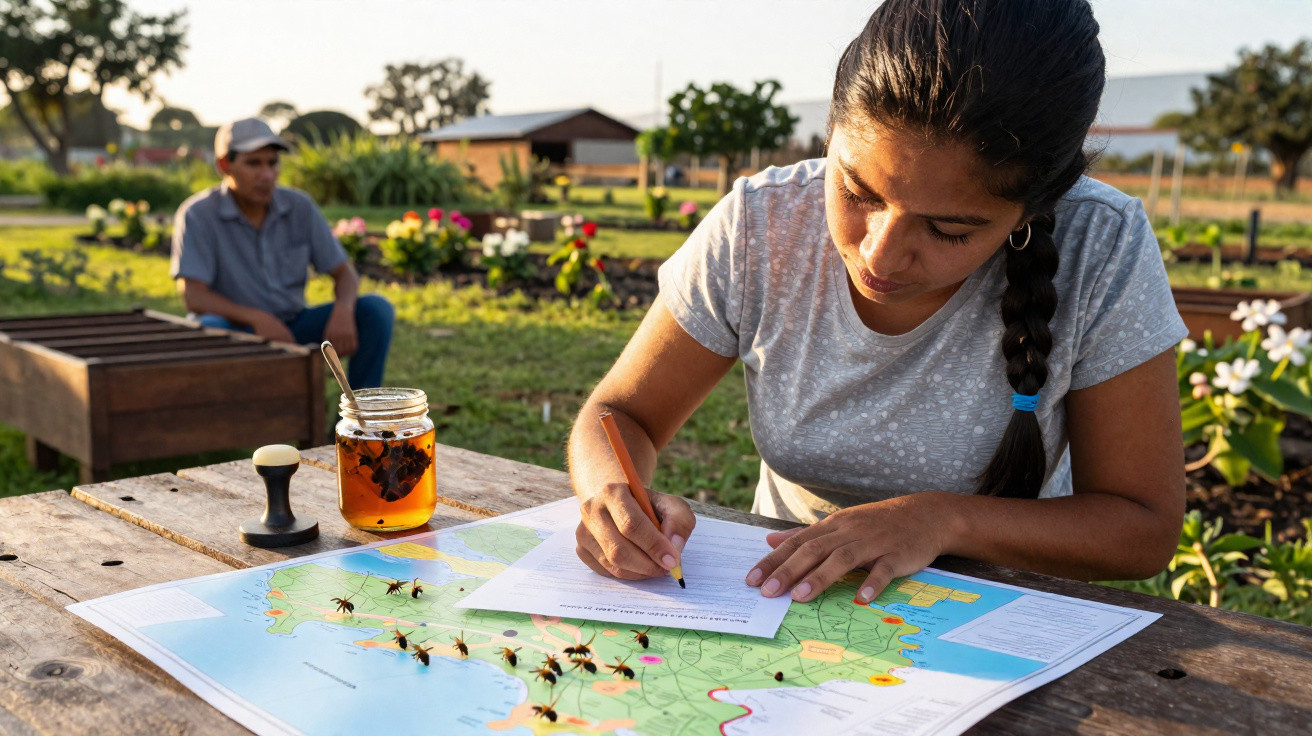
Her team supplies maps, straightforward data sheets and a commitment: if growers create sky-high “infrastructure” for owls and kites, the team will help them track rodents, crop damage and nesting success.
- Put up 3–5 perches for every 10 hectares of open field, positioned away from busy roads.
- Fit at least one barn owl box near rodent hotspots, with its opening directed away from prevailing rain.
- Keep some margins untidy, with long grass, hedgerows and rough vegetation that provide prey and cover.
- Gradually stop using the most potent rodenticides, particularly close to established raptor perches.
- Make simple records throughout the year of raptor sightings, rodent evidence and damage.
In theory, this may sound like another task added to an already crowded list. In practice, many farmers say it feels as though they finally have support.
When the skies fill, food webs remember
People often notice birds of prey when they disappear, and then again when they come back. The intervening years of silence can seem ordinary while they are happening. Personally, that is the most difficult thing to acknowledge; at landscape level, it is precisely what is now beginning to change.
As red kites spiral above motorways, kestrels perch on fence posts from Poland to Portugal, and hawks circle suburban parks, something more profound than simply having “more birds around” is occurring. Trophic cascades - the top-down effects through which predators influence prey and prey influence plants - are quietly returning to life.
On a Welsh slope planted with young trees, foresters saw saplings survive beyond their most vulnerable stage, with fewer being ring-barked by voles. In a Californian orchard, growers say owl nest boxes are now as commonplace as irrigation valves. In small European valleys where rodent eruptions once resembled natural disasters, a new saying is circulating: “Let the raptors work.”
For a long time, the prevailing story has been that people manage nature from above, clipboard in hand. This movement involving more than 50,000 reintroduced and supported raptors suggests another model: make a few adjustments, then stand back, observe and adapt while hawks, owls and kites do the hard work.
Conflict has not vanished. Chickens are sometimes taken, pigeon racers raise objections, and some people simply dislike the thought of hooked claws and sharp beaks overhead. Even so, more areas quietly adopt the approach every year. It is not driven by romance, but by the fact that poisoned bait is costly, hazardous and ultimately unreliable. Once a kestrel has settled in, it hunts without charge.
On a chilly evening, a barn owl may slip silently from a nest box you helped install, carrying a struggling mouse to its chicks. At that point, the entire connection is clear: you, the timber, the bird, the rodent, the soil and the next harvest. It is untidy and cannot be completely controlled - and that is exactly what makes it effective.
This is not solely about removing raptors from extinction lists. It is also about rediscovering what occurs when the sky and the ground reach an uneasy but workable truce. On a planet where climate and biodiversity headlines can feel overwhelming, the quiet form circling above a field is more than an enjoyable sight.
It shows that, once ecosystems are given even a little space, they remember how to carry on from there.
| Key point | Detail | Why it matters to the reader |
|---|---|---|
| Raptors regulate rodents | More than 50,000 reintroduced birds of prey are reducing rodent numbers and altering rodent behaviour on farms and in towns. | It demonstrates how natural predators can limit crop damage and reduce dependence on poisons. |
| Simple tools work | Perches, nest boxes and rough field margins encourage owls, kites and hawks to hunt efficiently. | It offers practical ideas that any landowner or community can adapt, including on a small scale. |
| Trophic cascades are returning | Predators affect prey, prey affect plants, and plants influence soil and water, helping to restore food-web balance. | It helps explain the larger significance of a single bird in the sky - and its relevance to everyday life. |
FAQ:
- Do reintroduced birds of prey really make a substantial dent in rodent numbers? No two studies agree on an exact percentage, but many identify clear reductions in visible rodent activity and damage around fields where raptors hunt regularly.
- Do increased raptor numbers mean farms use fewer pesticides? In several regions, they do. Farmers who rely on barn owls, kites or buzzards often cut back on rodenticides, particularly the strongest products.
- Can this approach work in cities and suburbs as well? To an extent. Urban hawks and owls hunt rats and mice, especially near parks, rivers and large gardens, although waste management remains very important.
- Does it pose a risk to pets or small livestock? In certain circumstances, small pets outdoors and unprotected poultry may be at risk, so basic safeguards such as covered runs and housing birds at night remain essential.
- What can an ordinary person do to help raptors return? You can support nest-box schemes, protect old trees, avoid second-generation rodenticides and support local conservation groups working with farms and towns.





Comments
No comments yet. Be the first to comment!
Leave a Comment