
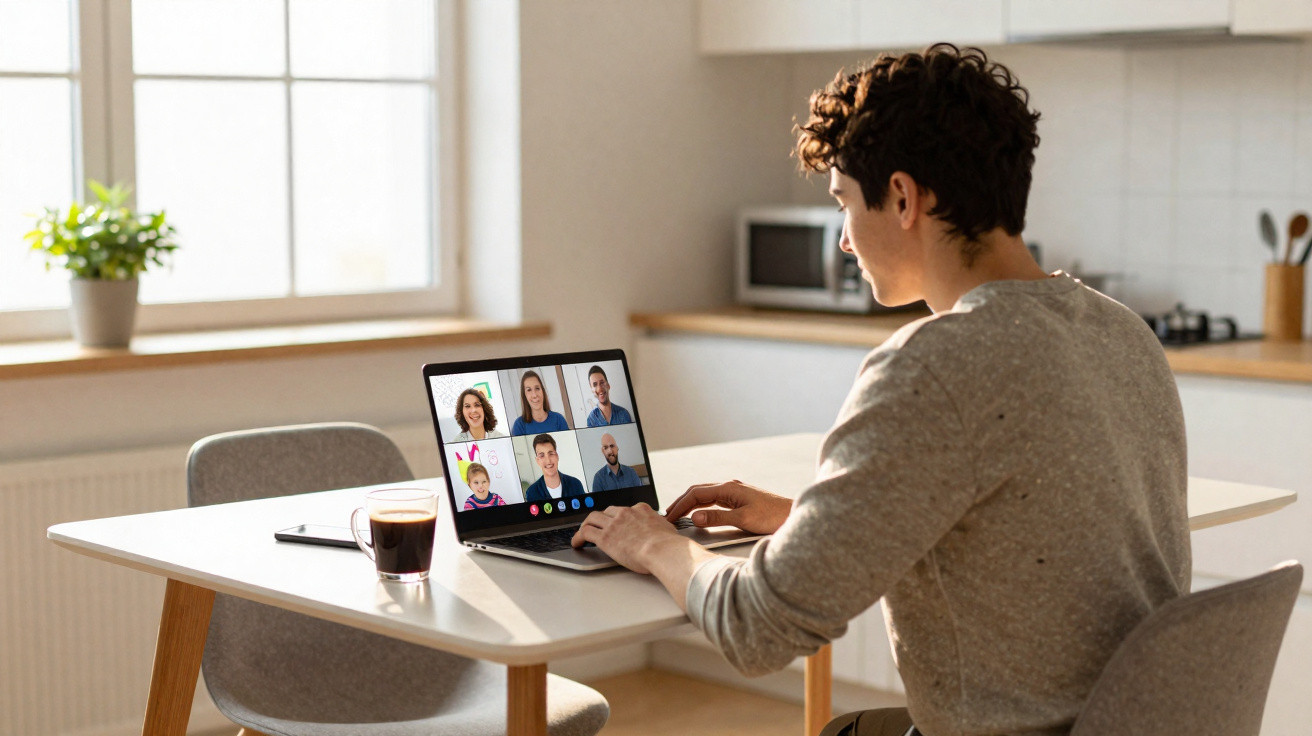
The laptop teeters on the edge of the kitchen table, beside a mug leaving an ever-widening ring of cold coffee. A toddler is stacking plastic bricks on one side. On the other, a mother is working her way through a Zoom meeting: camera on, microphone muted, with email alerts sounding every ten seconds. She replies to a client while cutting up an apple, monitoring the washing machine and checking a notification from the school app. A colleague on the call says sorry for “the noise” in his shared flat. Her manager, comfortably settled in a silent home office, smiles and says, “That’s the beauty of remote work, right? Flexibility for everyone.”
The mother returns the smile, aware of something he is not.
Flexibility is not distributed equally.
The quiet winners of the remote work revolution
A quick look through LinkedIn reveals the same story again and again: upbeat posts about “finally making the school run” or “taking a midday break to cuddle the baby”. Remote work has offered parents something they lacked for decades - time that more closely fits around their children’s lives. There is no commute, fewer frantic mornings and less guilt after school.
For plenty of parents, working from home has been more than a workplace benefit. It has been a means of coping.
Consider Lara, a project manager with two children under seven. Before 2020, she began at 6 a.m., making sandwiches, sorting school bags and rushing for the train. She got home at 7 p.m., exhausted and just in time for homework tantrums and warmed-up pasta.
These days, she signs on at 8:45, after school bags have been dropped in the hallway. Between calls, she puts on a load of washing, has lunch with her youngest twice each week and even gets to see daylight during winter. Her performance has not declined; if anything, she has earned two promotions. The reason is not discipline alone. Remote work now finally flexes around the pace of family life.
That freedom has produced a new group of “golden remote workers”: parents with established routines, early starts and a compelling reason to shut the laptop at 5 p.m. School runs, evening meals and bath times give their days fixed points. This structure subtly improves concentration and makes boundaries necessary.
People without children, meanwhile, can slip into a less defined routine. Starts become later, evenings run together and Slack messages arrive at 10 p.m. The office once created limits; now, personal obligations are often the only thing that does. Remote work has not levelled the field. It has benefited those whose lives already contain firm, unavoidable boundaries.
Why remote work feels brutal without children
Remote work was marketed as freedom: work anywhere, live your best life and at last balance your interests with your job. Yet for many single people and people without children, that promise has proved unexpectedly empty. Without the built-in social rhythm of children’s timetables, the day can dissolve into one long, illuminated stretch of screen time.
You wake up, turn over, and your office is already there: your bed, kitchen worktop or sofa. There is no real beginning and no real end.
The effect is clear in shared flats. One person claims the kitchen table, another works from the sofa, while someone else balances at the end of their bed with a ring light attached to a bookshelf. Lunch is instant noodles, eaten while one hand remains on the mouse. After eight hours of calls, nobody particularly wants to speak. Friday drinks move from “let’s hop on a quick Zoom” to “I’m exhausted, maybe next week.”
A 2023 Owl Labs survey found that fully remote workers are 67% more likely to feel isolated than hybrid workers. For people living alone, the laptop can become their manager, colleague and only meaningful interaction of the day. The outcome is an odd combination of freedom and quiet suffocation. You may be able to run at 2 p.m., but who is there to tell?
The irony is that parents working from home are repeatedly pulled back into ordinary life. There are school pick-ups, upset children, forgotten PE kits and deliveries from neighbours. Although frustrating, these disruptions also bring them out of the digital tunnel. Those without children often experience the reverse: unbroken immersion in digital work. It may appear productive on a timesheet, but by Friday it can feel completely exhausting.
Offices once provided small rituals - commuting, coffee-machine gossip and a casual “how was your weekend?” Remote work removed them. Parents reconstructed many of them around their children. Many other workers did not replace them at all, and that absence can quietly damage their mental health.
How to take back your day when remote work does not suit you
When your life lacks ready-made landmarks such as school bells and bath time, borrow the tool parents use without necessarily realising it: a routine with teeth. This is not about creating a flawless self-help timetable. It means establishing several non-negotiable moments that divide the day into manageable, human-sized sections.
Choose three “hard edges” for each day: a set start time, a genuine break and an unmistakable finish. Treat them as somebody else’s requirements, rather than optional extras.
Begin simply. Start work at the same time every morning, even when no one is checking. Have lunch away from the screen at least three times a week. Get up, step outdoors, touch a tree or look at a brick wall - anything that reminds your body it exists below the neck.
A frequent mistake is attempting to reproduce a complete office day at home. You do not require eight consecutive hours of concentration. You need a small number of cues that tell your brain: “Now we begin. Now we pause. Now we stop.” Honestly, nobody manages this every day. However, doing it regularly enough creates a slim but genuine layer of sanity.
“Remote work didn’t break our social lives,” a psychologist told me. “It just showed who already had invisible support systems - and who was improvising alone.”
- Create fake commutes: Take a walk around the block before starting work and once you have logged off. It may sound ridiculous, which is precisely the point: your brain needs a ritual marking the shift in the day.
- Use people as anchors, not apps: Arrange a weekly coffee, co-working session or gym class with actual people. One recurring plan beats five vague ‘we should hang out’ messages.
- Protect one offline hour: Pick one inviolable hour with no Slack, email or doomscrolling. Parents may have that hour taken by their children. You can select yours - and that is your advantage.
What remote work is really doing to our social map
Remote work was meant to level the playing field: identical screens, tools and opportunities. Instead, it is subtly remapping who prospers and who disappears into the margins. Parents, particularly mothers, have at last gained working days that can adapt to school hours and bedtime, even though the arrangement remains tiring. People looking after elderly parents receive comparable relief.
Workers without these responsibilities often provide the greatest amount of unseen overtime, specifically because others do not expect them to sign off.
In meetings, the unstated prejudice is reversed: “She has kids, let’s not schedule late,” compared with “He’s single, he can take the evening shift.” Promotions and desirable assignments flow towards employees who are “always available” - a description easily attached to workers without children. Yet these same people report greater loneliness and weaker connections to their teams. On paper, they are remote work’s flexible power users. Privately, many are barely holding on.
The reality behind the remote work revolution is complicated. It is valuable for parents who now spend more time near their families, even when they are more exhausted than ever. It can also free disabled workers and carers who were shut out of conventional office life. But it can be quietly devastating for everyone else whose social world once relied on the office, and whose self-worth depended on being visible in an actual room.
One difficult question remains: if remote work endures, who will be responsible for restoring the lost elements of community, structure and shared time? If companies will not do it, are we prepared to acknowledge that “work from anywhere” brought a cost we never truly agreed to pay?
| Key point | Detail | Value for the reader |
|---|---|---|
| Remote work favours routines | Parents and carers receive built-in structure through family schedules | Helps explain why some people appear to “win” at remote work more easily |
| Isolation affects people unevenly | Single people and flat-sharers report more loneliness and blurred boundaries | Validates your experience and reduces unspoken guilt or self-blame |
| Rituals act as armour | Firm daily edges (start, break, stop) safeguard mental health and focus | Provides practical actions to regain control over your day |
FAQ:
- Is remote work really “better” for parents than the office? For many parents, yes. Removing the commute and staying closer to their children can compensate for some of the chaos, despite constant interruptions. It is not easier, but it often feels better suited to family life.
- Why does remote work feel so draining when I live alone? Your working day can extend without boundaries. Without built-in social contact or a fixed schedule, your brain never fully switches off, gradually leading to burnout.
- Should I go back to the office if I’m struggling with remote work? Hybrid working is often the strongest option. Even two days each week in a shared workplace can restore routine, informal contact and a feeling of belonging without sacrificing flexibility.
- How can teams support colleagues without kids more fairly? Do not assume they are “always available”. Share late meetings, respect boundaries and discuss workloads openly instead of rewarding unnoticed overwork.
- Can remote work be fixed, or is it just broken for some people? It can be made better. Clear expectations, optional in-person hubs and honest discussion about who bears the social cost can make remote work less unequal and much less lonely.






Comments
No comments yet. Be the first to comment!
Leave a Comment