
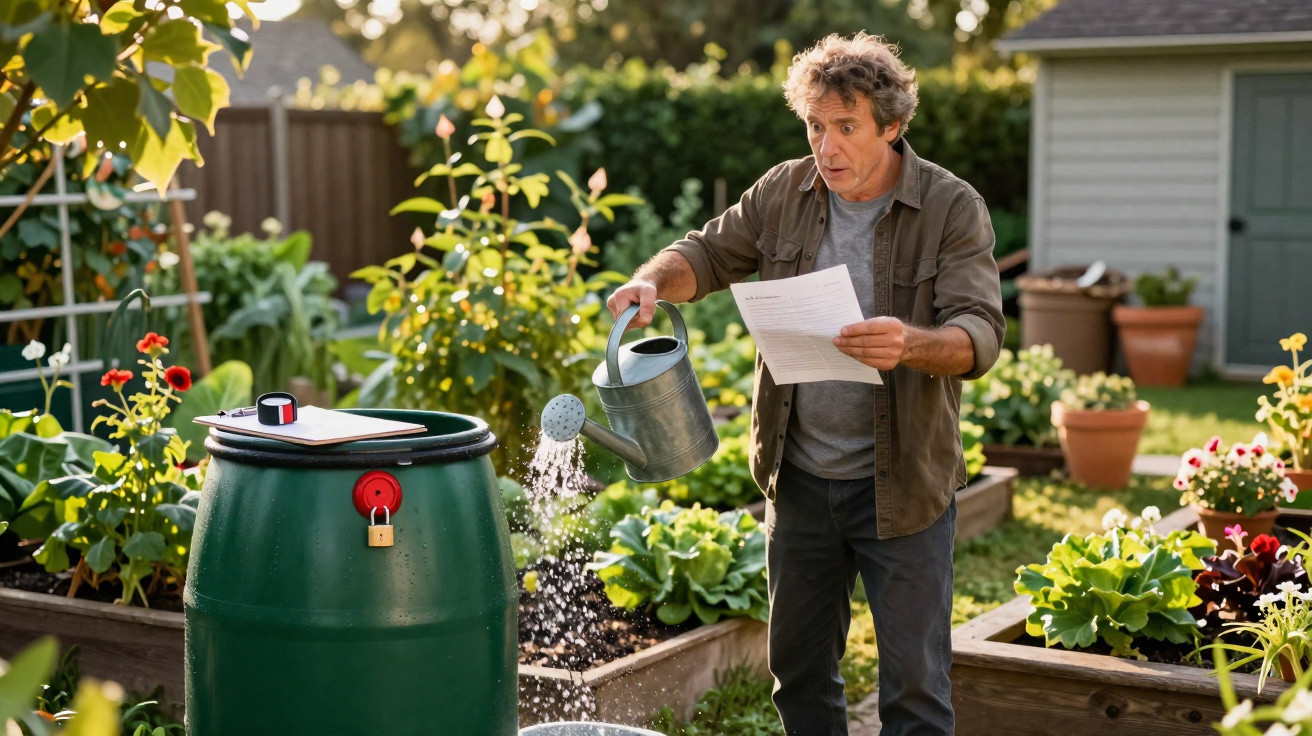
The watering can halts in mid-air. A neighbour stands motionless, glancing from the sky to the new black plastic barrel that has been steadily collecting water throughout autumn. Somewhere, a crow calls, as though it has heard something confidential. On the kitchen table, a phone displays a headline that seems impossible: “€135 fine for gardeners using rainwater without authorization from December 18, 2025.”
Nothing about the garden has changed. The roses are unaware of the regulations. The tomatoes have no interest in legal wording. But collecting the water that runs off the roof now suddenly seems a little like crossing a boundary.
The law has come through the garden gate.
Rainwater, fines and an unsettling new reality for gardeners
Imagine a late-spring Sunday morning. You are wearing old trainers, with a coffee mug balanced on the wall, a hose in one hand and the rain barrel lid already lifted. The scent of damp earth and freshly cut grass hangs in the air. It is one of those calm, restorative moments when the noise of everything else finally fades away.
Now picture precisely the same moment with a tight feeling in your stomach, because every drop you use could result in a €135 charge. Not in some symbolic sense: it could appear on the next water bill or follow a polite, but not entirely welcome, visit from an inspector.
That change-from a free offering from the sky to a controlled resource-is what is truly unsettling people.
Accounts are already appearing on gardening forums and local Facebook groups. A retired teacher in a small town says she was given a leaflet warning of “unauthorized private rainwater collection”. A young couple restoring an old property have uploaded pictures of their three blue barrels, asking whether they must take them away before December 18, 2025.
No one appears fully certain about how the rule would be enforced. Some people cite water agencies, while others refer to municipal orders. One widely shared post features a printed notice fixed up in a DIY shop: “From 18/12/2025, use of rainwater systems may require registration.”
Where clear guidance ought to be, anxiety takes its place.
The proposed €135 fine is part of a wider story. Cities are dealing with drought and flash flooding within the same year. Ageing pipes lose thousands of litres beneath the ground. Drinking water is extracted, processed, chlorinated and transported, only to be sprayed over lawns that could manage perfectly well with rainwater.
Legislators say they must monitor every form of water use-even the rain landing on a shed roof-in order to balance local water supplies and sewerage networks. They argue that registered installations can prevent backflow contamination and undeclared wells.
For gardeners, however, it can seem as though they are being penalised for quietly caring for a small part of the planet at no cost.
How to use rainwater legally and without worry
The essential question is no longer “Will I get caught?” but “How can I do this properly?” If this new €135 rule affects your area, the most sensible first step is starkly straightforward: locate the exact legal text that applies to your postcode. Do not rely on a screenshot or hearsay. Find the regulation itself on the official website of your council, county or water authority.
Then search for three terms: “authorization”, “declaration” and “exemption”. Many rules do not prohibit rainwater use at all. Instead, they require the system to be declared, filtered or kept separate from the drinking-water network.
A brief phone call or email could change a possible “risk of fine” into a stamped authorisation safely stored in a drawer.
After that, treat the garden as a small infrastructure scheme. Where does rain land? Which route does it take? How can it be stored without causing concern? Straightforward, clearly visible arrangements are often easiest to explain and regularise: a single barrel beneath a gutter, a sealed lid and a basic leaf filter.
Some councils now provide grants for compliant tanks while also promising stricter checks on unauthorised systems. It sounds contradictory, but that is the present situation. One reader from a suburban area said she spent €300 on a new certified tank and received €150 from the local authority.
In headlines, the law may look like an opponent; in practice, it can sometimes be a disorganised ally.
Let us be honest: nobody reads every technical appendix on pipes and valves unless it is their job. This is where a few practical habits make a difference. Retain receipts for any system that is installed. Photograph the barrel and its connections. Record the date on which you declared it.
With everything documented, speaking to an inspector feels less like an interrogation and more like checking the same information. There will, of course, be excessive enforcement in certain places and almost none in others. That inconsistency is genuine.
“Water is going to be the new petrol,” a municipal engineer told me, half joking, half deadly serious. “The more it becomes scarce, the more every litre will be watched.”
- Find out whether your rainwater system requires a simple declaration or full authorization.
- Keep a small paper or digital folder containing every document linked to the installation.
- Speak with neighbours and local gardening groups to exchange reliable information rather than simply spreading fear.
What the €135 rainwater fine reveals about our water future
The €135 fine is more than a figure on a document. It is a warning sign. It shows that private gardens are no longer beyond the attention of water managers. Institutions that once concentrated on factories and large farms are now examining balconies, courtyards and suburban lawns.
That may feel intrusive, but it also exposes just how vulnerable water systems have become. If domestic barrels matter enough to be covered by legislation, each litre is beginning to count in ways earlier generations could scarcely have imagined.
We are entering a period in which an ordinary rain shower is no longer merely “bad weather”, but something to be measured, controlled and, at times, negotiated.
There is a quiet sense of loss on a human level too. On a warming planet, the garden has become one of the few remaining spaces where people can breathe and work with something alive. Being told that this area now exists beneath the threat of a fine can feel like another private pleasure being regulated out of reach.
In practical terms, gardeners are notably resourceful. They are already exchanging alternatives: water-saving mulches, drought-tolerant plants and shared cisterns declared as a group. Some are redesigning entire beds so they need less watering, not because of the fine but because the climate gives them little alternative.
People have to adjust, even when it hurts a little.
There is an understated irony in all this. For years, environmental campaigns urged households to collect rainwater, cut their tap-water use and “think about the planet”. Now, some of that same behaviour is presented as something requiring monitoring, with a fine as the consequence.
This conflict between environmental reasoning and administrative reasoning is exactly where frustration boils over. People do not object to rules that work in everyday life. They push back when the rulebook seems detached from what happens in actual soil, beneath actual rain.
Perhaps the next step is for authorities to sit down with gardeners, rather than speaking only with engineers and lawyers.
The picture is therefore clear: a changing climate, anxious institutions, frustrated residents and a simple plastic barrel at the centre of it all. On December 18, 2025, that barrel does not suddenly become illegal everywhere, but it does become more visible to the law.
Some people will quietly pay for a compliant system. Others will reluctantly abandon rainwater altogether and go back to tap water. Many will remain somewhere between the two, partly informed and partly concerned, hoping that common sense wins out during inspections.
The important question is no longer only “Will I be fined?” but “What sort of shared water culture do we want when even the sky requires paperwork?”
| Key point | Detail | Why it matters to the reader |
|---|---|---|
| New rules from 18 December 2025 | A €135 fine may apply where rainwater is used without authorisation, depending on local legislation. | Know when an installation could begin to create a problem. |
| Authorization or declaration required | Certain areas require rainwater-harvesting systems to be registered, particularly where they are connected to the domestic network. | Understand the steps that can prevent penalties. |
| Ways to remain compliant | Documentation, photographs, invoices, equipment choices and sharing information with neighbours. | Continue watering the garden without unnecessary stress. |
FAQ:
- Will every gardener really be fined €135 from 18 December 2025? No. The fine applies only where local or national regulations explicitly refer to unauthorised rainwater use, and normally following an inspection or complaint.
- Can I still collect rainwater for my garden? In many areas, yes, provided the system is declared or installed in line with particular safety and plumbing requirements.
- How do I know whether I need authorization? Check your council or regional authority website, or contact the water agency; search for information on “rainwater harvesting” or “domestic installations”.
- Which rainwater arrangements face the greatest risk? Systems linked to indoor plumbing, toilets or washing machines generally face tighter rules than a basic standalone garden barrel.
- Is it worth investing in a compliant rainwater system now? If droughts and water restrictions are common where you live, a legal and efficient arrangement may save money and stress over the longer term.






Comments
No comments yet. Be the first to comment!
Leave a Comment